
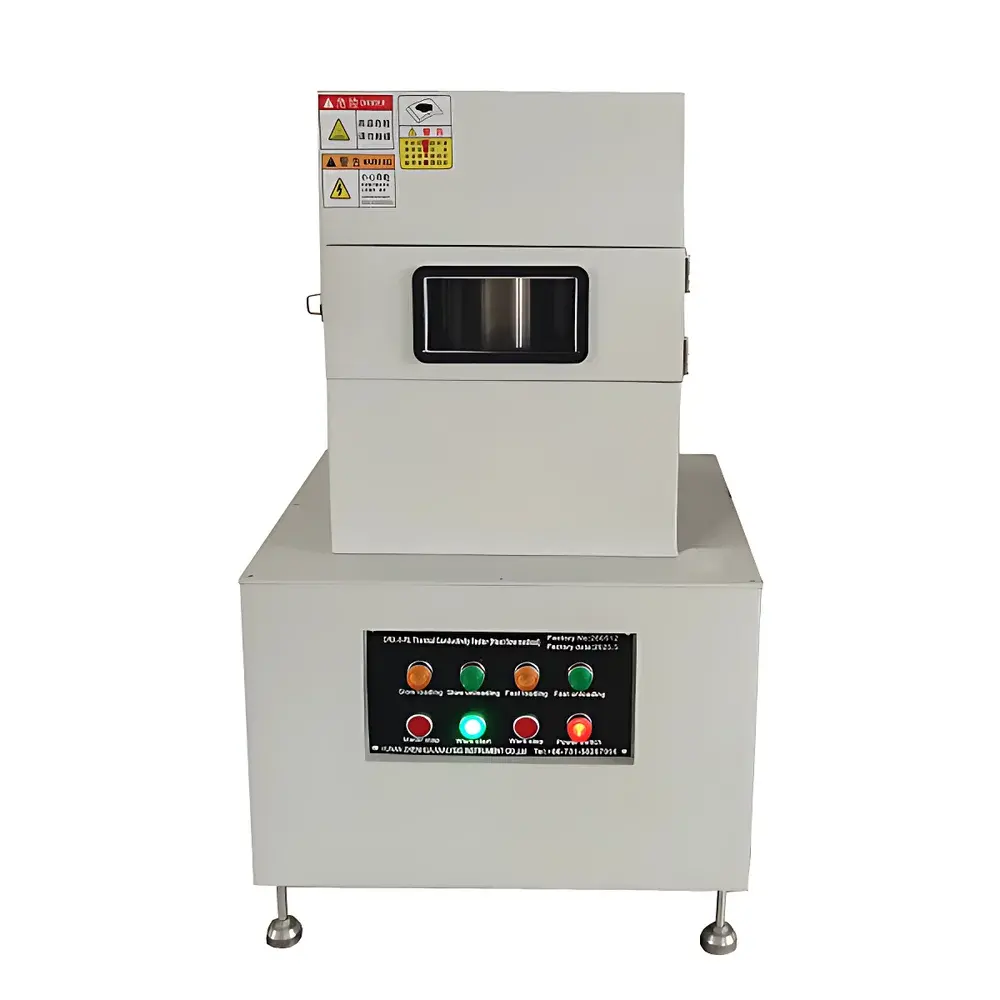
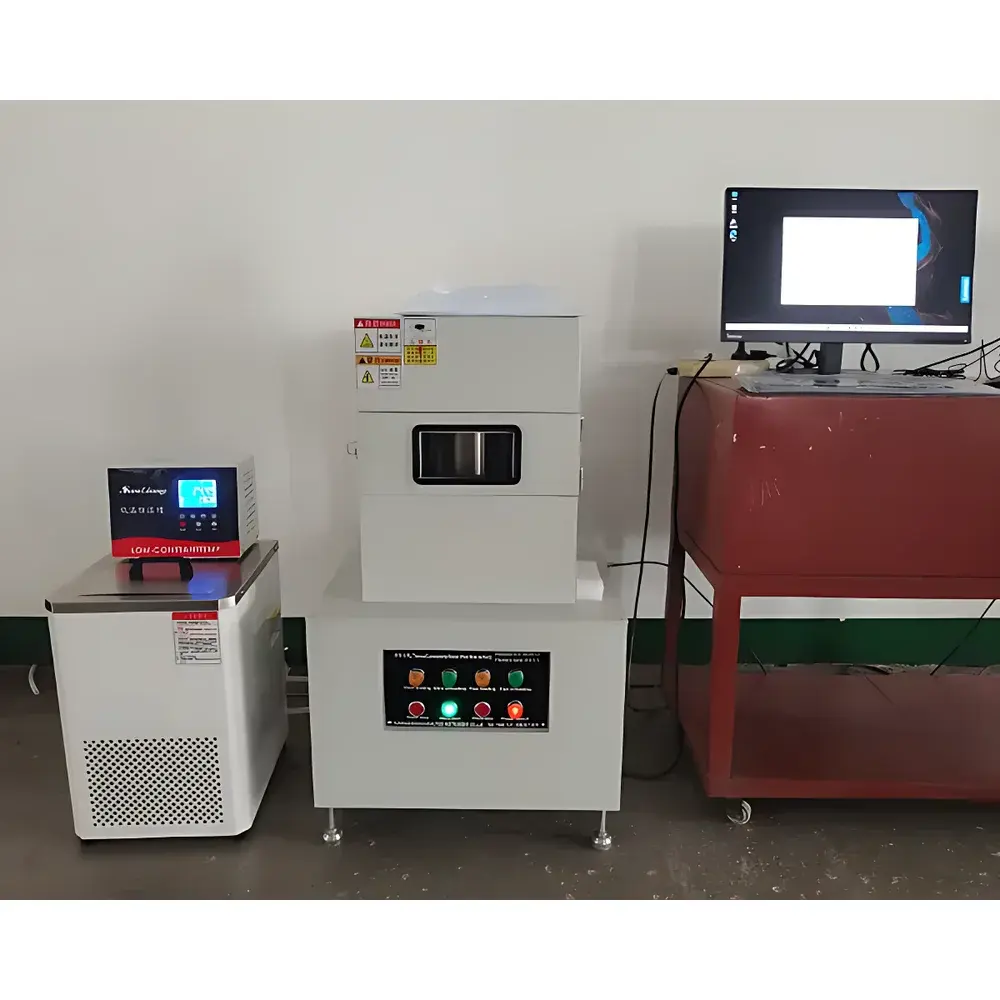
ZHENHUAFENXI DRL-III Thermal Conductivity Analyzer (Heat Flow Method)
| Brand | ZHENHUAFENXI |
|---|---|
| Origin | Hunan, China |
| Model | DRL-III |
| Measurement Principle | Heat Flow Method |
| Thermal Conductivity Range | 0.010–50 W/m·K |
| Accuracy | ±3% |
| Repeatability | ±1% |
| Temperature Range | Ambient to 200 °C (Hot Plate), 0–99.99 °C (Cold Plate) |
| Sample Diameter | Ø10–30 mm |
| Sample Thickness | 0.02–20 mm |
| Thermal Resistance Range | 5×10⁻⁶ – 0.05 m²·K/W |
| Pressure Range | 0–1000 N |
| Displacement Resolution | 0.01 mm |
| Dimensions (L×W×H) | 60 cm × 58 cm × 90 cm |
| Compliance Standards | ASTM E1530, ASTM C518, ISO 8301, DIN EN 12939, DIN EN 13163, DIN EN 12667, JIS A 1412 |
Overview
The ZHENHUAFENXI DRL-III Thermal Conductivity Analyzer is a precision benchtop instrument engineered for the quantitative determination of thermal conductivity (λ), thermal resistance (R), and interfacial contact resistance using the steady-state heat flow method. Based on Fourier’s law of conduction, the system establishes a unidirectional, one-dimensional temperature gradient across a planar sample sandwiched between two parallel, independently controlled temperature plates. A calibrated heat flux sensor—mounted in direct thermal series with the sample—measures the axial heat flow rate under controlled boundary conditions. The instrument operates under ambient pressure and supports both fixed and programmable temperature gradients, enabling rigorous characterization of solid, semi-rigid, and compliant materials in compliance with internationally recognized thermal transport standards.
Key Features
- Steady-state heat flow measurement architecture with dual-zone plate temperature control: hot plate (ambient to 200 °C, 0.01 °C resolution) and cold plate (0–99.99 °C, 0.01 °C resolution)
- Motor-driven vertical actuation for automated sample loading, compression force application (0–1000 N), and real-time displacement monitoring (0–30.00 mm, 0.01 mm resolution)
- Integrated thickness measurement capability prior to thermal testing, eliminating manual caliper dependency and reducing operator-induced variability
- Standardized sample geometry support: circular specimens Ø10–30 mm, thickness 0.02–20 mm; compatible with thin films via multi-layer stacking protocols
- Full test automation including thermal equilibration, data acquisition, parameter logging, and report generation
- Rugged mechanical design with thermally isolated enclosure and low-drift sensor electronics to ensure long-term measurement stability
Sample Compatibility & Compliance
The DRL-III is validated for use with low-to-moderate conductivity materials (0.010–50 W/m·K), including polymeric composites, elastomers, ceramics, glass, graphite-based thermal interface materials (TIMs), metal matrix laminates, insulating foams, and printed circuit board substrates (e.g., aluminum-clad and copper-clad boards). It accommodates challenging geometries such as ultra-thin adhesive tapes, viscous thermal greases (using auxiliary containment frames), and heterogeneous layered assemblies. All measurement protocols align with ASTM E1530 (for contact resistance), ASTM C518 (for insulation materials), ISO 8301 (thermal insulation—determination of steady-state thermal resistance), and European harmonized standards DIN EN 12939, DIN EN 13163, and DIN EN 12667. The system supports GLP-compliant documentation workflows, including user-accessible audit trails for calibration history, test parameters, and raw thermal flux/time-series data.
Software & Data Management
The instrument is operated via a dedicated Windows-based thermal analysis platform that provides full control over temperature ramping, dwell times, compression profiles, and data sampling intervals. Software modules include: (i) calibration management with traceable reference material libraries (e.g., certified PMMA, sapphire, and stainless steel standards); (ii) multi-step test sequencing for aging studies, pressure-dependent R-value mapping, and thermal interface optimization; (iii) real-time visualization of heat flux, temperature differentials, and calculated λ/R values; and (iv) export-ready reporting in PDF, CSV, and XML formats compliant with internal QA/QC requirements. Data files retain metadata such as operator ID, timestamp, environmental conditions, and instrument firmware version—enabling full traceability per FDA 21 CFR Part 11 and ISO/IEC 17025 guidelines when deployed in regulated environments.
Applications
- Quality assurance of thermal interface materials (TIMs) including silicone greases, phase-change pads, and graphite films used in power electronics cooling
- Thermal performance validation of PCB substrates, heat spreaders, and embedded cooling layers in automotive and aerospace electronics
- Material development for battery thermal management systems—characterizing separator films, encapsulants, and module gap-fillers
- Research into anisotropic conduction behavior in layered composites and nanostructured ceramics
- Reliability assessment of contact resistance evolution under thermal cycling or mechanical load (e.g., solder joint interfaces, bolted flanges)
- Regulatory submission support for UL, CE, and IEC certification of insulating components in electrical enclosures and energy-efficient building materials
FAQ
What international standards does the DRL-III comply with?
ASTM E1530, ASTM C518, ISO 8301, DIN EN 12939, DIN EN 13163, DIN EN 12667, and JIS A 1412.
Can the system measure thermal contact resistance between two dissimilar surfaces?
Yes—the instrument supports dedicated contact resistance protocols with adjustable clamping force and real-time interfacial temperature monitoring.
Is multi-layer sample testing supported for ultra-thin films?
Yes—stacked configurations enable effective thermal property extraction for samples below 0.05 mm thickness using normalized flux summation algorithms.
Does the software support 21 CFR Part 11 compliance for pharmaceutical or medical device applications?
The platform provides electronic signatures, audit trails, and role-based access control; full Part 11 implementation requires site-specific validation per organizational SOPs.
What is the minimum required sample diameter and thickness?
Ø10 mm minimum diameter; 0.02 mm minimum thickness—achievable using precision spacers and multi-layer compensation methods.



