
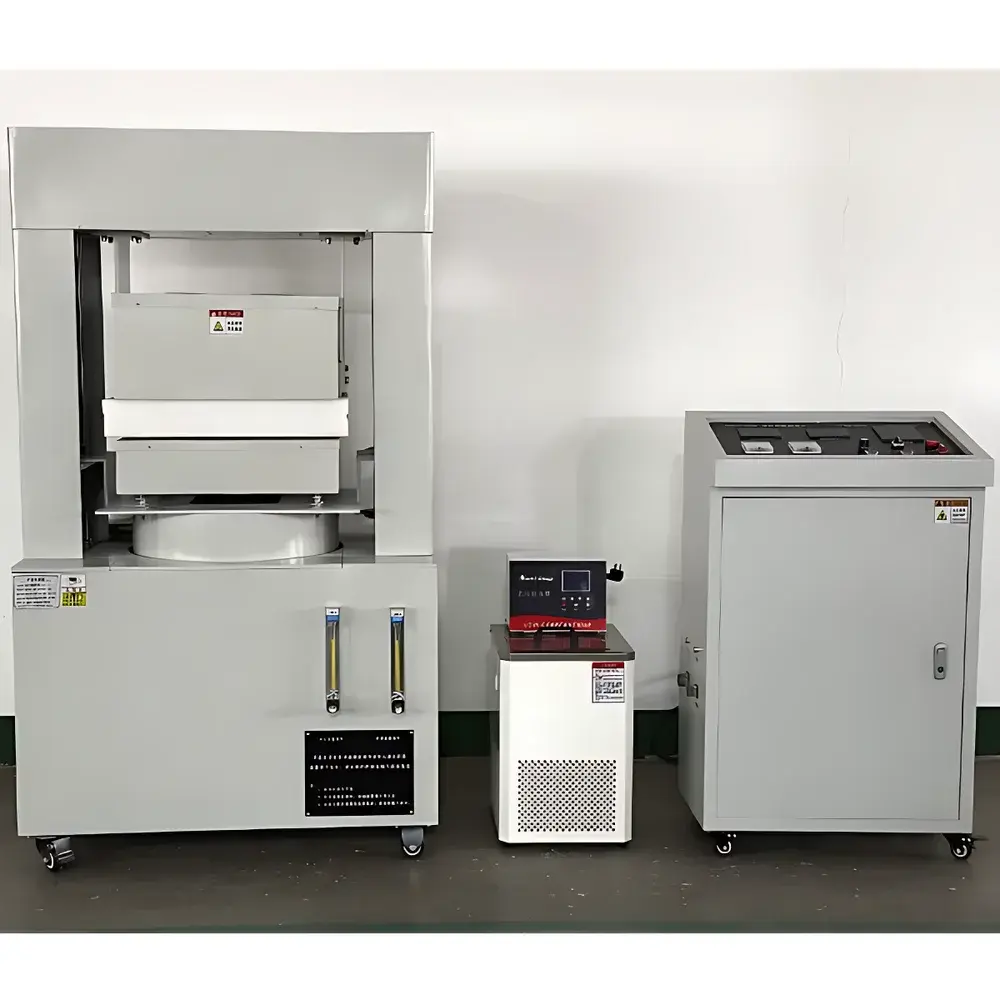
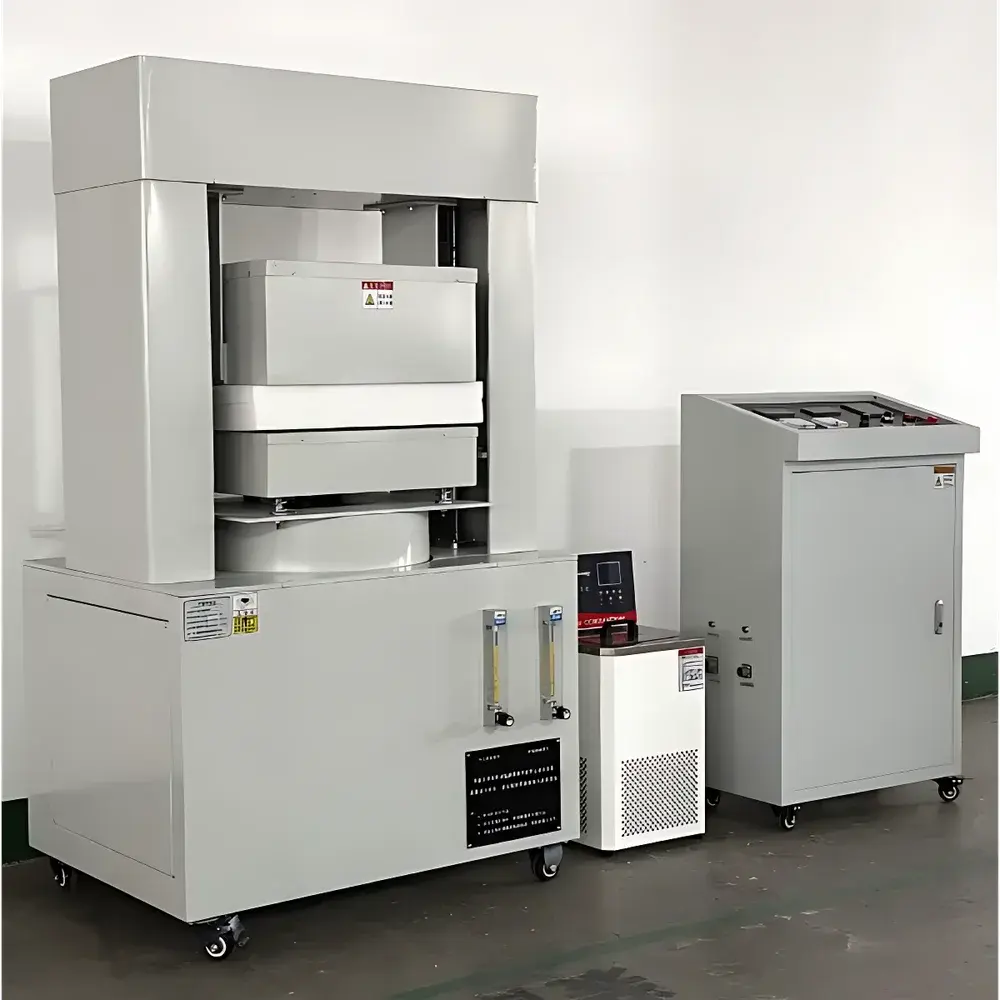
ZHENHUAFENXI DRX-I-SPB High-Temperature Thermal Conductivity Analyzer (Water-Flow Guarded Hot Plate Method)
| Brand | ZHENHUAFENXI |
|---|---|
| Origin | Hunan, China |
| Manufacturer Type | Authorized Distributor |
| Country of Origin | China |
| Model | DRX-I-SPB |
| Instrument Type | Guarded Hot Plate Method (Water-Cooled) |
| Continuous Sample Capacity | 1–3 stacked layers |
| Test Environment | High-Temperature Atmosphere (up to 1400 °C) |
| Dimensions (L×W×H) | 1500 mm × 650 mm × 1120 mm |
| Thermal Conductivity Range | 0.015–2.7 W/(m·K) |
| Accuracy | ±3% |
| Repeatability | ±1% |
| Temperature Range | Ambient to 1400 °C |
| Sample Form | Solid slabs or bricks (standard: Ø180 mm × 50 mm or ≤230 mm × 230 mm × 65 mm) |
| Heating Power Control | Adjustable, computer-regulated |
| Water Flow Rate | 10 g/s (temperature-stabilized coolant loop) |
| Total Power Consumption | ≤4.5 kW |
| Operating System | Windows 10 / 7 / XP |
| Electrical Supply | 220 V, 50 Hz |
Overview
The ZHENHUAFENXI DRX-I-SPB High-Temperature Thermal Conductivity Analyzer is a precision-engineered guarded hot plate system designed specifically for the reliable measurement of thermal conductivity in refractory materials under elevated temperature conditions. It implements the water-flow guarded hot plate method—defined in YB/T 4130–2005 and aligned with GB/T 17911.8–2002—to quantify steady-state heat transfer through solid, low-conductivity specimens including ceramic fiber modules, insulating firebricks, refractory castables, and high-purity oxide-based insulation boards. Unlike transient methods (e.g., laser flash), this instrument operates on the principle of one-dimensional, steady-state conduction across a thermally guarded specimen sandwiched between a heated upper plate and a water-cooled lower plate. Heat flux is precisely measured via calibrated power input to the hot plate and verified by mass flow and ΔT monitoring of the coolant circuit. The system achieves thermal equilibrium at temperatures up to 1400 °C, enabling characterization under service-relevant conditions encountered in kiln linings, metallurgical furnaces, and aerospace thermal protection systems.
Key Features
- Guarded hot plate architecture with active water-cooled guard ring and base plate to minimize lateral heat loss and ensure unidirectional conduction
- High-temperature furnace capable of stable operation from ambient to 1400 °C, equipped with dual-zone PID control and Class I thermocouple (Type S) calibration traceability
- Computer-controlled heating power regulation with real-time feedback loop to maintain ±0.5 °C thermal stability during measurement
- Integrated mass-flow-controlled cooling system delivering precisely regulated water at 10 g/s, with inlet/outlet temperature monitoring for accurate heat removal quantification
- Modular sample holder accommodating single or stacked configurations (1–3 layers) to support comparative testing of composite refractory systems
- Industrial PC-based control interface with intuitive GUI, automated test sequencing, and built-in validation routines per ISO 8302 and ASTM C177 guidelines
- Compliance-ready data logging: timestamped raw values (power, T_hot, T_cold, ΔT_specimen, flow rate), intermediate calculations, and final k-values stored with audit trail
Sample Compatibility & Compliance
The DRX-I-SPB accepts rigid, flat-surfaced solid specimens conforming to standard geometries: circular discs (Ø180 mm × 50 mm) or rectangular slabs (≤230 mm × 230 mm × 65 mm). Custom fixtures are available for non-standard dimensions upon request. It is validated for use with low-to-moderate conductivity materials (0.015–2.7 W/(m·K)), particularly those exhibiting minimal thermal expansion hysteresis below 1400 °C. The instrument satisfies metrological requirements outlined in YB/T 4130–2005 and GB/T 17911.8–2002. While not pre-certified to ISO/IEC 17025, its architecture supports laboratory accreditation workflows—including uncertainty budgeting per GUM (JCGM 100:2008) and GLP-compliant reporting when paired with validated calibration procedures and documented environmental monitoring.
Software & Data Management
The embedded Windows-based software provides full automation of test initiation, equilibrium detection, data acquisition, calculation, and report generation. All measurements adhere to the guarded hot plate equation: k = Q·d / (A·ΔT), where Q is net heating power (corrected for guard losses), d is specimen thickness, A is cross-sectional area, and ΔT is the measured temperature gradient. Raw sensor inputs—including heater voltage/current, six-point thermocouple array readings, and digital flow meter output—are logged at 1 Hz. Export options include CSV, PDF, and XML formats compliant with LIMS integration. Audit trails record user logins, parameter changes, calibration events, and report revisions—supporting 21 CFR Part 11 readiness when deployed with electronic signature modules and network-access controls.
Applications
- Quality assurance of monolithic refractories and ceramic fiber insulation used in cement rotary kilns and steel ladle linings
- R&D evaluation of novel nanostructured insulators and aerogel-reinforced composites under simulated service temperatures
- Comparative thermal performance assessment of multi-layer refractory systems (e.g., hot-face brick + backup insulation + casing)
- Validation of computational thermal models (e.g., ANSYS Fluent, COMSOL) requiring experimentally derived k(T) curves
- Third-party certification testing for ISO 22455 (refractory product thermal properties) and national building material standards
FAQ
What standards does the DRX-I-SPB comply with?
It is engineered to meet YB/T 4130–2005 and GB/T 17911.8–2002, with operational alignment to ISO 8302 and ASTM C177 principles.
Can the system measure thermal conductivity as a function of temperature?
Yes—stepwise isothermal testing across the full 50–1400 °C range enables construction of k(T) curves with user-defined temperature intervals.
Is calibration traceable to national standards?
Reference calibration using NIST-traceable SRMs (e.g., NIST SRM 1470a) is supported; users must perform periodic verification per internal SOPs.
Does the instrument support GMP/GLP documentation requirements?
With optional electronic signature configuration and controlled access protocols, it meets foundational data integrity criteria for regulated environments.
What maintenance is required for long-term accuracy?
Annual thermocouple recalibration, quarterly inspection of water-cooling seals and flow sensors, and biannual verification of guard zone thermal uniformity are recommended.



