
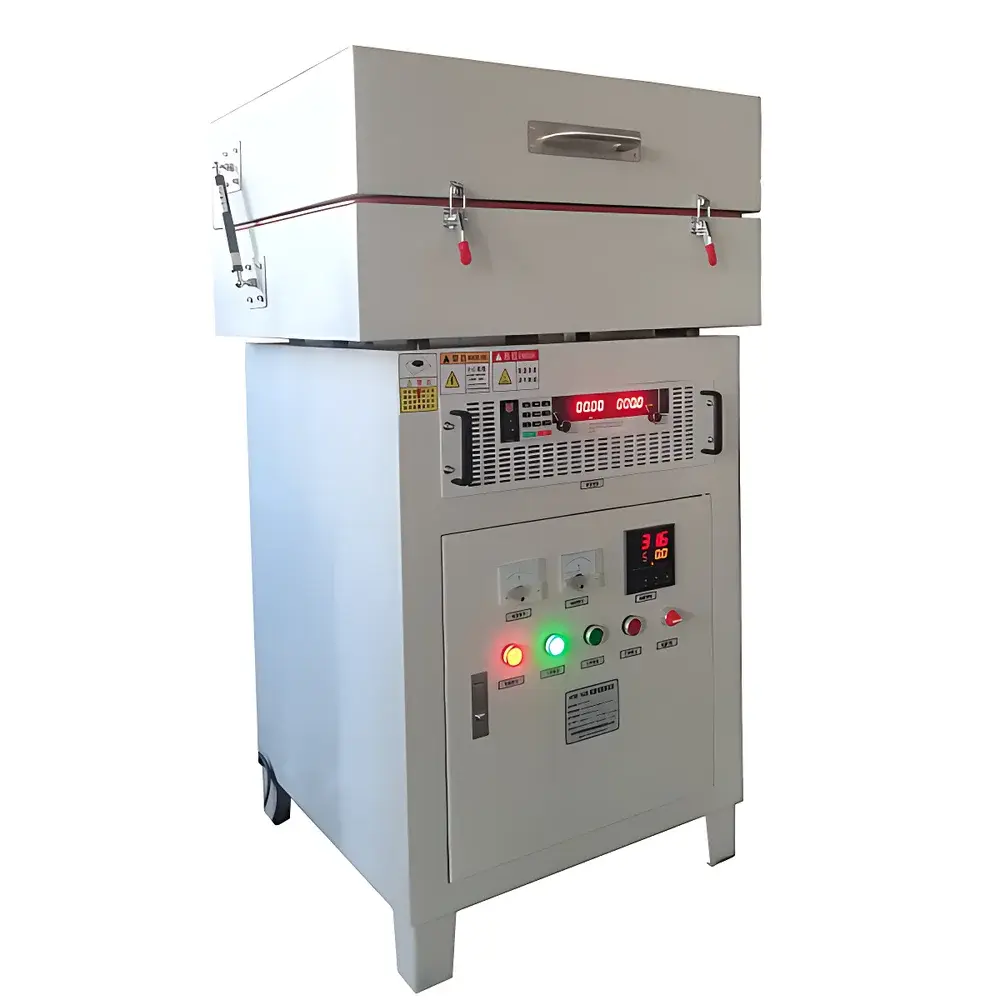
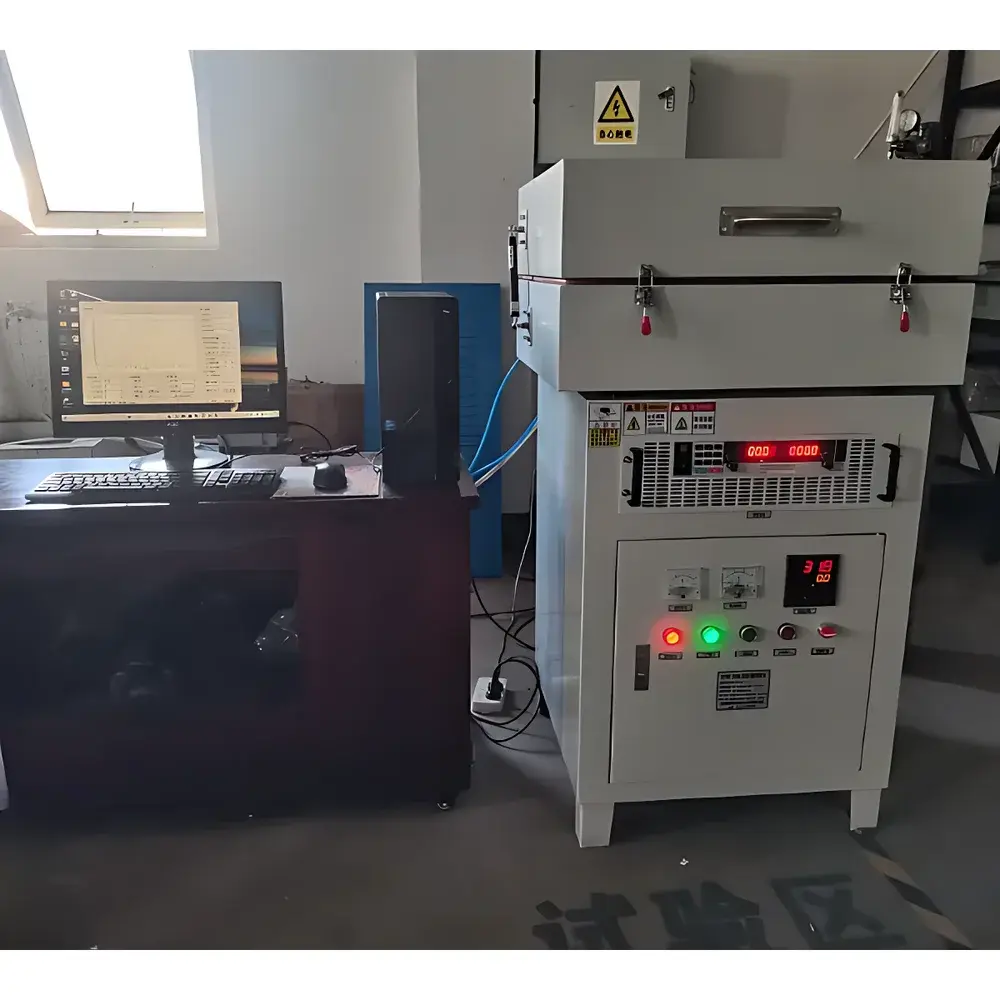
ZHENHUAFENXI GDT High-Temperature Resistivity Tester
| Brand | ZHENHUAFENXI |
|---|---|
| Origin | Hunan, China |
| Model | GDT |
| Temperature Range | Ambient to 900 °C / 1400 °C / 1600 °C (selectable furnace configuration) |
| Constant Current Source | 0–40 A, 0–24 V, stability ±0.01 A |
| Sample Diameter | 20–50 mm |
| Sample Length | 100 mm (customizable) |
| Voltage Tap Spacing | Adjustable |
| Dimensional Measurement | Digital Caliper, 0–150 mm, resolution 0.01 mm |
| Voltage Measurement | Digital Voltmeter, 0–199.99 mV, resolution 0.01 mV |
| Temperature Controller | Japanese imported microcomputer-based programmable controller with SSR solid-state relay drive and universal thermocouple input (K, S, R types supported) |
Overview
The ZHENHUAFENXI GDT High-Temperature Resistivity Tester is an engineered system designed for precise electrical resistivity characterization of conductive and semi-conductive solid materials—particularly carbon-based refractories, graphite electrodes, sintered ceramics, and high-temperature alloys—under controlled thermal conditions. It operates on the four-terminal (Kelvin) measurement principle to eliminate lead resistance and contact potential errors, ensuring traceable and reproducible bulk resistivity data across elevated temperature regimes. The instrument integrates a programmable high-stability current source, precision low-voltage digitization, and a thermally isolated furnace assembly with multi-zone thermal profiling capability. Its architecture conforms to fundamental metrological requirements for materials science laboratories engaged in ASTM D4496, ISO 8503-2, and IEC 60404-5 compliant testing protocols.
Key Features
- Triple-range high-temperature furnace options: configurable for maximum operating temperatures of 900 °C, 1400 °C, or 1600 °C, each equipped with dual-layer insulation, inert atmosphere compatibility (N2, Ar), and optional vacuum sealing (≤10−2 mbar).
- High-precision constant-current excitation source: 0–40 A output with <±0.01 A long-term stability over 2-hour dwell periods; programmable ramping and step-hold current profiles synchronized with temperature programs.
- Four-wire voltage sensing architecture with guarded input circuitry, minimizing thermal EMF contributions and enabling accurate measurement of microvolt-level potential drops across variable inter-electrode spacing.
- Modular sample holder design accommodating cylindrical specimens from Ø20 mm to Ø50 mm and fixed 100 mm length; electrode contact pressure and alignment are mechanically adjustable to ensure uniform current density distribution.
- Integrated digital caliper interface for real-time geometric input: direct acquisition of specimen diameter and length into the data acquisition engine, automatically computing cross-sectional area and aspect ratio for resistivity derivation (ρ = R × A / L).
- Programmable temperature control system featuring a Japanese-made microprocessor-based PID controller with auto-tuning, ramp/soak programming, and thermocouple type auto-detection (K, S, R, B, N, E, J, T).
Sample Compatibility & Compliance
The GDT system supports standardized test specimens conforming to ASTM C611 (carbon and graphite materials), ISO 18517 (electrical resistivity of refractory ceramics), and GB/T 24523 (Chinese national standard for carbon electrode resistivity). It is suitable for dense, non-porous solids with surface resistivity below 106 Ω·cm at room temperature. Specimen preparation must ensure parallel, flat, and clean end faces to minimize contact resistance variability. The instrument’s thermal and electrical subsystems meet CE electromagnetic compatibility (EMC) directives and comply with IEC 61000-4 series immunity standards. All calibration procedures align with ISO/IEC 17025 requirements for testing laboratories, and raw data files include embedded metadata for GLP audit trails (timestamp, operator ID, furnace setpoint, current/voltage readings, geometry inputs).
Software & Data Management
Acquisition and analysis are managed via the proprietary ZHF-GDT Control Suite v3.2—a Windows-based application supporting real-time dual-channel plotting (temperature vs. time; resistivity vs. temperature), automated calculation of temperature coefficients of resistivity (TCR), and export to CSV, Excel, or PDF formats. The software enforces 21 CFR Part 11-compliant user authentication (role-based access control), electronic signatures, and immutable audit logs recording all parameter modifications, measurement triggers, and calibration events. Raw voltage and current waveforms are captured at ≥10 Hz sampling rate, with optional oversampling for noise reduction in low-signal regimes. Data integrity is preserved through SHA-256 hash generation per test session, enabling forensic verification during regulatory inspections.
Applications
- Quality assurance of graphite anodes and cathodes in battery material production lines.
- Thermal degradation studies of carbon composites used in aerospace brake systems.
- Resistivity mapping of sintered silicon carbide (SiC) substrates across 25–1500 °C for power electronics packaging validation.
- R&D of metal-ceramic cermets where phase transitions induce abrupt resistivity changes detectable at sub-1 °C resolution.
- Calibration reference material characterization for national metrology institutes requiring traceable high-temperature conductivity standards.
FAQ
What furnace temperature range should I select for graphite electrode testing?
Graphite electrodes typically require evaluation up to 1400 °C to capture oxidation onset and structural transition effects; the 1400 °C furnace option includes MoSi2 heating elements and Al2O3-fiber insulation optimized for inert-atmosphere operation.
Is four-wire measurement mandatory for valid resistivity reporting?
Yes—ASTM D4496 explicitly requires four-terminal sensing for materials with bulk resistivity below 102 Ω·cm to exclude contact and lead resistance artifacts; the GDT system implements true Kelvin forcing with independent current sourcing and voltage sensing paths.
Can the system operate under reducing atmospheres such as H2/N2?
The 1400 °C and 1600 °C furnace configurations support H2-compatible gas manifolds and quartz or molybdenum sample fixtures; consult the safety manual for maximum permissible H2 concentration limits based on furnace seal class.
How is thermal EMF compensated during low-voltage measurements?
Voltage measurement circuits incorporate copper-constantan thermocouple compensation, zero-reference auto-nulling prior to each reading cycle, and synchronous AC current excitation (1 Hz square wave) with lock-in detection to reject DC drift and thermal offset.
Does the software support automated compliance reporting for ISO 17025 accreditation?
Yes—the Control Suite generates per-test compliance reports including uncertainty budgets (Type A and Type B components), calibration certificate references, environmental condition logging (ambient temperature/humidity), and full traceability to NIST-traceable standards used during system verification.



