
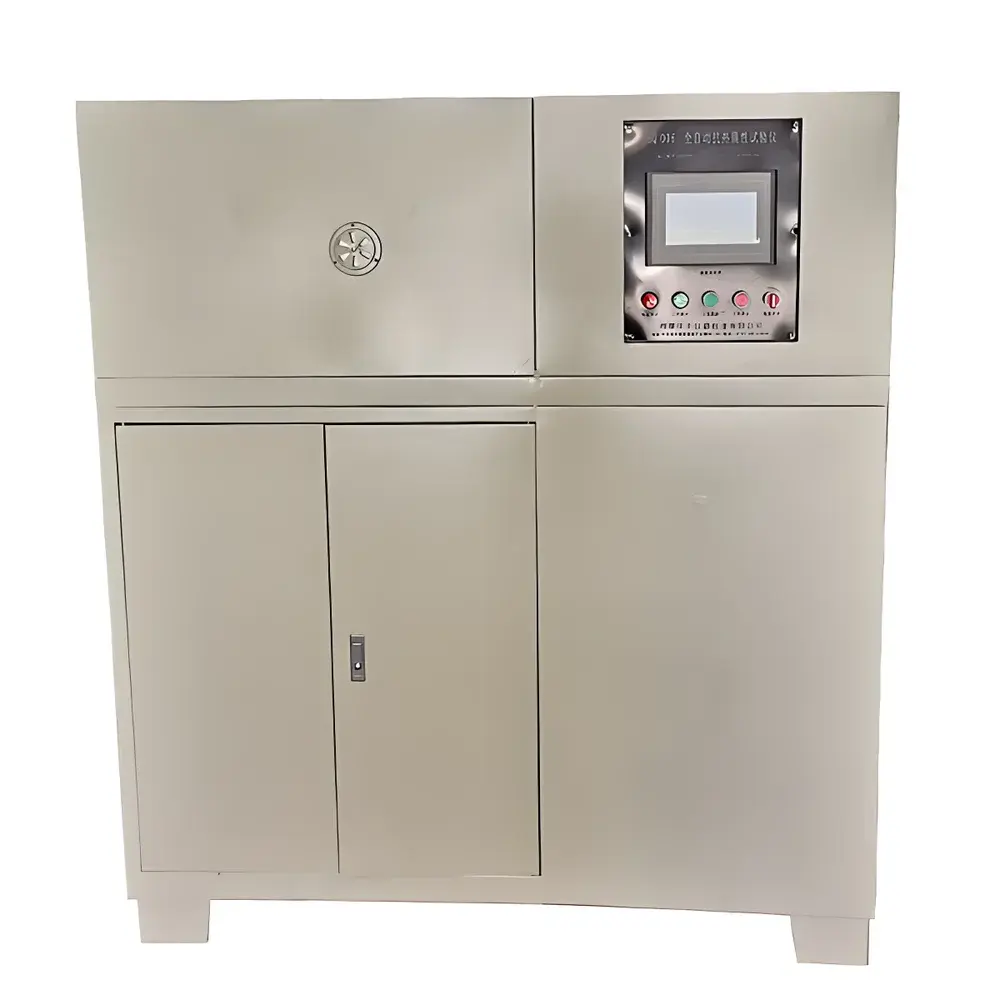
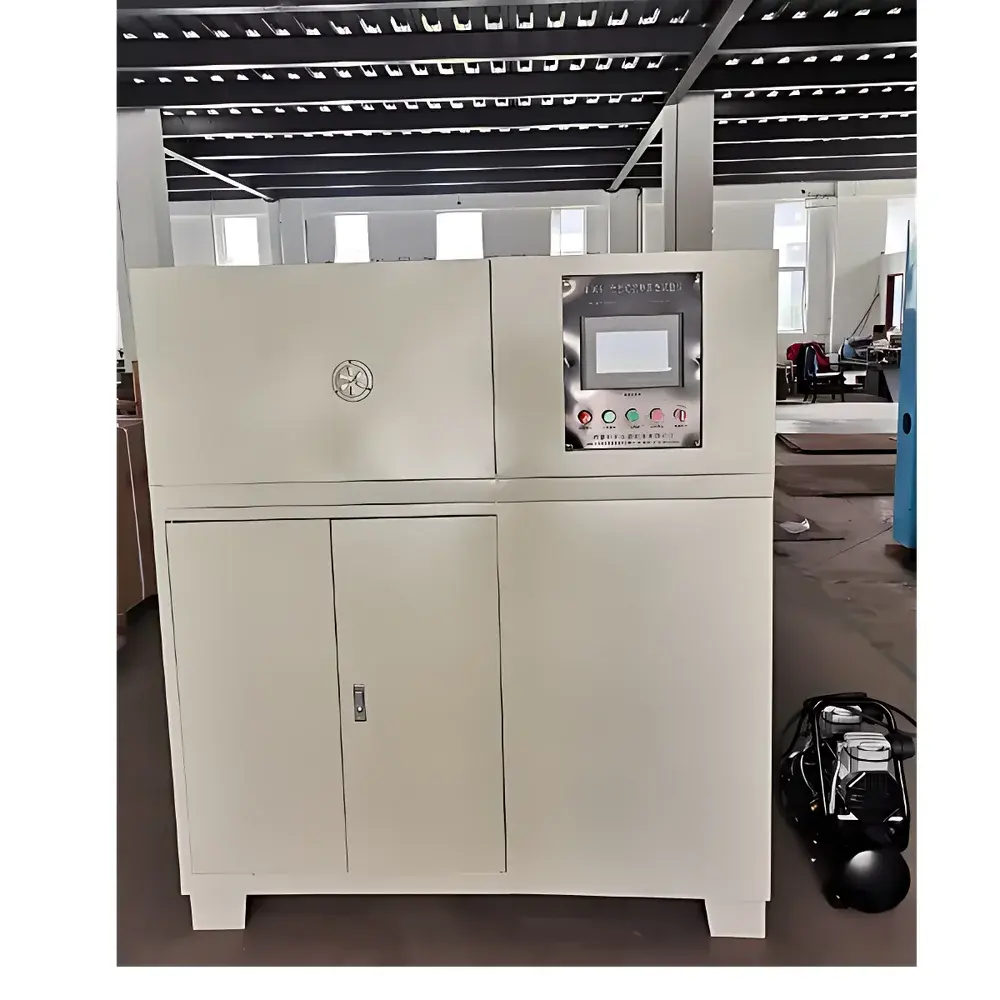
ZHENHUAFENXI SQ006F Fully Automated Thermal Shock Resistance Tester with Forced-Air Cooling
| Brand | ZHENHUAFENXI |
|---|---|
| Origin | Hunan, China |
| Model | SQ006F |
| Maximum Furnace Temperature | 500 °C |
| Temperature Control Accuracy | ±2 °C at 500 °C |
| Effective Chamber Dimensions | 350 × 350 × 350 mm |
| Cold-to-500 °C Ramp Time | 120 min |
| Heating Power | 5 kW |
| Timer Range | 0–180 min |
| Air Compressor Capacity | 30 L |
| Air Compressor Power | 1 kW |
| Human-Machine Interface | 7-inch Touchscreen Industrial PC with SCADA-based Configuration Software |
| Compliance | GB/T 25994–2010, GB/T 3810.9–2016 |
Overview
The ZHENHUAFENXI SQ006F Fully Automated Thermal Shock Resistance Tester with Forced-Air Cooling is a purpose-built thermal cycling instrument engineered for quantitative evaluation of thermal shock resistance in advanced ceramic materials—particularly honeycomb ceramics, refractory products, porcelain tiles, graphite components, and silicate-based structural materials. It operates on the principle of controlled rapid thermal cycling between elevated furnace temperatures and ambient or forced-air-cooled environments, simulating real-world thermal stress conditions that induce microcracking, spalling, or mechanical degradation. Unlike conventional manual or semi-automated systems, the SQ006F implements programmable dual-phase exposure: high-temperature soaking (up to 500 °C) followed by precisely timed convective cooling via integrated forced-air quenching. This methodology aligns directly with the standardized thermal shock protocols defined in GB/T 25994–2010 (Honeycomb Ceramics) and GB/T 3810.9–2016 (Ceramic Tiles), supporting both immersion-based and non-immersion test modes depending on specimen water absorption characteristics.
Key Features
- Automated thermal shock cycle execution: fully hands-off operation from sample loading to final cooling phase
- Forced-air cooling system integrated within the main enclosure, eliminating dependency on external water chillers or cryogenic media
- Precision temperature control architecture maintaining ±2 °C stability at 500 °C, validated per IEC 60584 thermocouple calibration standards
- 7-inch industrial touchscreen HMI running embedded SCADA configuration software with real-time graphical display of temperature profiles, cycle timing, and status flags
- Modular furnace chamber (350 × 350 × 350 mm effective volume) constructed with low-thermal-mass insulation and optimized airflow distribution for uniform thermal gradients
- Programmable soak-and-quench sequencing: soak duration adjustable from 1 to 180 minutes; cooling phase triggered automatically upon timer expiry
- All-in-one mechanical integration minimizing footprint (< 1.2 m² floor space) while preserving service accessibility and thermal safety compliance
Sample Compatibility & Compliance
The SQ006F accommodates standard-format specimens conforming to national and international dimensional requirements—including 50 × 50 × 50 mm refractory cubes, 100 × 100 × 10 mm ceramic tile coupons, and cylindrical honeycomb monoliths up to Ø80 mm × 100 mm length. Its dual-mode protocol supports both immersion-based thermal shock (for low-density, high-porosity materials with water absorption > 3%) and dry-cycle air-quenching (for dense ceramics, graphite, or low-absorption silicates). The instrument meets essential metrological and procedural criteria outlined in GB/T 25994–2010 and GB/T 3810.9–2016, including mandatory temperature ramp rate verification, soak uniformity mapping, and post-cycle visual/quantitative damage assessment guidance. While not certified to ISO/IEC 17025 as a standalone testing laboratory, its design enables traceable operation within GLP-compliant quality systems when paired with documented calibration records and operator training logs.
Software & Data Management
Control and monitoring are managed through an embedded Windows-based industrial PC running proprietary SCADA-style configuration software. The interface provides real-time plotting of furnace temperature versus time, configurable alarm thresholds (e.g., overtemperature, cooling failure), and event-triggered data logging at user-defined intervals (1–30 second resolution). All experimental parameters—including setpoint temperature, soak duration, cooling initiation timestamp, and final equilibrium temperature—are stored locally in CSV format with ISO 8601 timestamps. Audit trail functionality includes operator ID entry (via soft keyboard), session start/stop logging, and automatic firmware version tagging. Data export supports USB transfer and network-enabled file sharing for integration into LIMS or QA documentation workflows. The system does not implement FDA 21 CFR Part 11 electronic signature controls but maintains sufficient metadata integrity for internal QC reporting and R&D traceability.
Applications
This tester serves critical roles across R&D laboratories, production QA departments, and third-party certification bodies engaged in ceramic material development and qualification. Primary use cases include: evaluating thermal shock resilience of automotive catalytic converter substrates during exhaust thermal cycling simulations; validating heat exchanger ceramic matrix composites under repeated startup/shutdown transients; assessing glaze adhesion stability in architectural tile manufacturing; screening silicon carbide and alumina-based refractories for metallurgical furnace linings; and supporting DOE-funded research on next-generation nuclear-grade ceramic insulators. Its reproducible, operator-independent cycling reduces inter-test variability—enabling statistically robust Weibull analysis of failure probability versus thermal delta-T.
FAQ
What standards does the SQ006F comply with?
It is designed and validated for conformance with GB/T 25994–2010 and GB/T 3810.9–2016, covering honeycomb ceramics and ceramic tiles respectively.
Can the instrument perform water-quench testing?
No—it is configured exclusively for forced-air convective cooling; immersion-based quenching requires separate apparatus per GB/T 25994 Annex A.
Is external compressed air required?
No—the unit includes an integrated 30 L/1 kW oil-free air compressor dedicated to the cooling circuit.
How is temperature uniformity verified inside the chamber?
Uniformity mapping is performed during factory acceptance testing using three calibrated Type K thermocouples positioned at center, top corner, and bottom corner per GB/T 25994 Section 6.2.
Does the system support remote monitoring or Ethernet connectivity?
Yes—standard Ethernet port enables TCP/IP communication for external SCADA integration or periodic log retrieval via FTP.






