
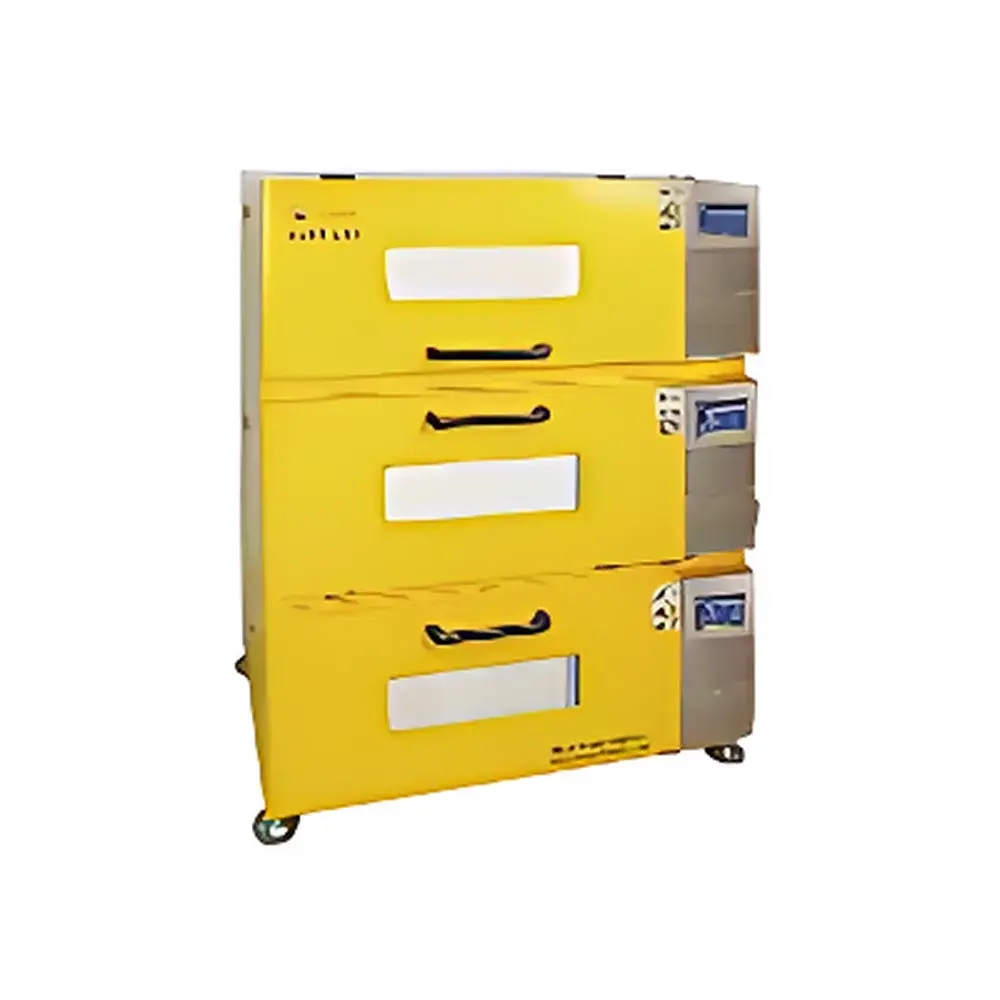
ZhiChu ZCZY-CS9 Triple-Stack CO₂ Incubator Shaker
| Brand | ZhiChu |
|---|---|
| Origin | Guangdong, China |
| Model | ZCZY-CS9 |
| Instrument Type | CO₂-Controlled Temperature-Shaking Incubator |
| Stacking Configuration | 3-Layer Modular Stack |
| Timer Range | 0–999.9 h |
| Oscillation Frequency | 10–250 rpm (Φ50 mm platform) |
| Oscillation Amplitude | Φ50 mm (standard), Φ26 mm (optional) |
| Temperature Range | 4–60 °C (ambient: 23–25 °C) |
| Temperature Uniformity | ±0.5 °C at 37 °C |
| Temperature Accuracy | ±0.1 °C |
| Humidity Range | Ambient to 90 % RH |
| Humidity Accuracy | ±5 % RH |
| Humidity Resolution | 1 % RH |
| CO₂ Range | 0–20 % |
| CO₂ Accuracy | ±0.1 % (IR sensor) |
| CO₂ Decay Time | 30 min (5.0 % → 4.5 %) |
| Platform Dimensions (L×W) | 1000 × 530 mm per layer |
| Max Capacity (per layer, stainless steel clamps) | 250 mL × 66 or 500 mL × 45 or 1000 mL × 28 or 2000 mL × 18 |
| Max Capacity (per layer, polymer clamps) | 250 mL × 66 or 500 mL × 45 or 1000 mL × 28 or 2000 mL × 15 |
| Noise Level | <55 dB(A) |
| Power Supply | AC 220 V ±10 %, 50–60 Hz |
| External Dimensions (W×D×H) | 1430 × 845 × 1740 mm (3-layer) |
| Net Weight | ~728 kg |
Overview
The ZhiChu ZCZY-CS9 Triple-Stack CO₂ Incubator Shaker is an integrated bioprocessing platform engineered for high-throughput cell culture, microbial fermentation, and suspension-based bioreactor development under tightly controlled environmental conditions. It combines precision temperature regulation, dynamic CO₂ concentration control, programmable orbital shaking, and active humidity management within a modular three-tier architecture. The system operates on the principle of forced-air convection with PID-driven thermal feedback, infrared (IR) CO₂ sensing with real-time closed-loop adjustment, and digitally regulated servo-motor-driven eccentric triple-cam oscillation—ensuring mechanical stability and minimal vibration transmission across stacked layers. Designed for continuous operation in GLP-compliant laboratories and upstream biomanufacturing environments, it supports long-duration experiments requiring reproducible gas exchange, consistent shear profiles, and sterility maintenance over multi-day or multi-week timelines.
Key Features
- Modular triple-stack configuration (ZCZY-CS9) maximizes volumetric capacity while minimizing floor footprint—each layer operates independently with dedicated temperature, CO₂, humidity, and agitation control.
- Eccentric triple-cam drive mechanism delivers smooth, low-noise orbital motion (<55 dB[A]) with ±1 rpm frequency accuracy and selectable amplitudes (Φ50 mm standard; Φ26 mm optional).
- High-fidelity IR-based CO₂ sensing (0–20 % range, ±0.1 % accuracy) enables rapid response to setpoint changes and maintains stable gas composition; CO₂ decay half-life exceeds 30 minutes from 5.0 % to 4.5 %, confirming robust chamber sealing.
- Active humidity control (ambient to 90 % RH, ±5 % accuracy) integrates bottom-mounted evaporation reservoirs, adjustable heating elements, and condensate management—enabling precise water activity modulation without condensation buildup.
- Triple-glazed, double-heated tempered glass doors with independent door-edge heating prevent fogging during low-temperature/high-humidity operation and allow unobstructed visual monitoring at all angles.
- LCD touchscreen interface displays real-time and setpoint values for temperature, CO₂, humidity, speed, time remaining, and elapsed duration on a single screen; supports user-defined password protection and parameter locking to prevent accidental modification.
- Comprehensive data logging capability stores up to five years of timestamped records—including temperature, CO₂, humidity, and speed curves—with USB export functionality compliant with internal audit requirements.
- UV-C germicidal irradiation cycle (programmable duration) and R-corner 304 stainless steel interior minimize microbial carryover between runs; electrostatically coated exterior ensures chemical resistance and cleanroom-compatible surface integrity.
Sample Compatibility & Compliance
The ZCZY-CS9 accommodates standard Erlenmeyer flasks (250–2000 mL), baffled bottles, and custom bioreactor vessels via interchangeable clamp plates—stainless steel (corrosion-resistant) or medical-grade polymer (single-hand release). Each 1000 × 530 mm platform supports up to 66 × 250 mL flasks or 18 × 2000 mL vessels per layer. The system meets ISO 13485 design principles for laboratory equipment and incorporates fail-safes aligned with IEC 61010-1:2012 safety standards. While not FDA 21 CFR Part 11–certified out-of-the-box, its encrypted parameter locking, audit-trail-capable data logging, and configurable user access levels support validation pathways for GMP-aligned workflows. All materials contacting the chamber interior are non-leaching and autoclavable where applicable.
Software & Data Management
Onboard firmware supports local configuration, real-time graphing, and event-triggered alarms (e.g., overtemperature, CO₂ deviation >0.3 %, motor stall). Data files (CSV format) are exportable via USB-A port and retain full metadata—including operator ID, session start/stop timestamps, and calibration history tags. Optional Wi-Fi-enabled remote monitoring (via secure TLS-encrypted mobile app) allows status checks, alarm notifications, and limited parameter adjustments from off-site locations—subject to institutional IT security policies. No cloud storage is performed by default; all data remains resident on device or user-controlled media.
Applications
- Mammalian cell line expansion under physiological CO₂ (5 %) and humidified 37 °C conditions with controlled shear stress.
- High-density bacterial or yeast cultivation requiring synchronized aeration, mixing, and pH buffering via CO₂ saturation.
- Stem cell differentiation assays where temporal modulation of O₂/CO₂ ratios and mechanical stimulation influence lineage commitment.
- Biopharmaceutical process development—comparing growth kinetics across flask formats, evaluating clone stability under variable agitation profiles, and scaling shake-flask data to benchtop bioreactors.
- Environmental microbiology studies involving psychrophilic or thermophilic strains across extended temperature gradients (4–60 °C) with concurrent gas control.
FAQ
Can individual layers operate at different temperatures and CO₂ concentrations simultaneously?
Yes. Each of the three stacked layers features independent PID controllers, dedicated IR CO₂ sensors, and isolated air circulation paths—enabling concurrent multi-condition experiments.
Is the humidity system capable of maintaining >85 % RH at 4 °C?
Yes. The combination of bottom-reservoir evaporation, chamber-wall heating, and adaptive dew-point compensation ensures stable high-humidity delivery across the full temperature range.
What is the maximum allowable flask fill volume for 1000 mL vessels at 250 rpm?
For optimal oxygen transfer and minimal splashing, fill volume should not exceed 30 % of nominal capacity (i.e., ≤300 mL) when operating above 200 rpm on the Φ50 mm platform.
Does the system support validation documentation packages (IQ/OQ/PQ)?
ZhiChu provides factory calibration certificates and mechanical performance reports; site-specific IQ/OQ protocols must be developed by end users or qualified third-party service providers in accordance with local regulatory expectations.
How is condensate managed during prolonged high-humidity operation?
A sloped stainless steel base directs condensed moisture toward a central drain channel; no manual siphoning or disassembly is required—routine wipe-down suffices.





