
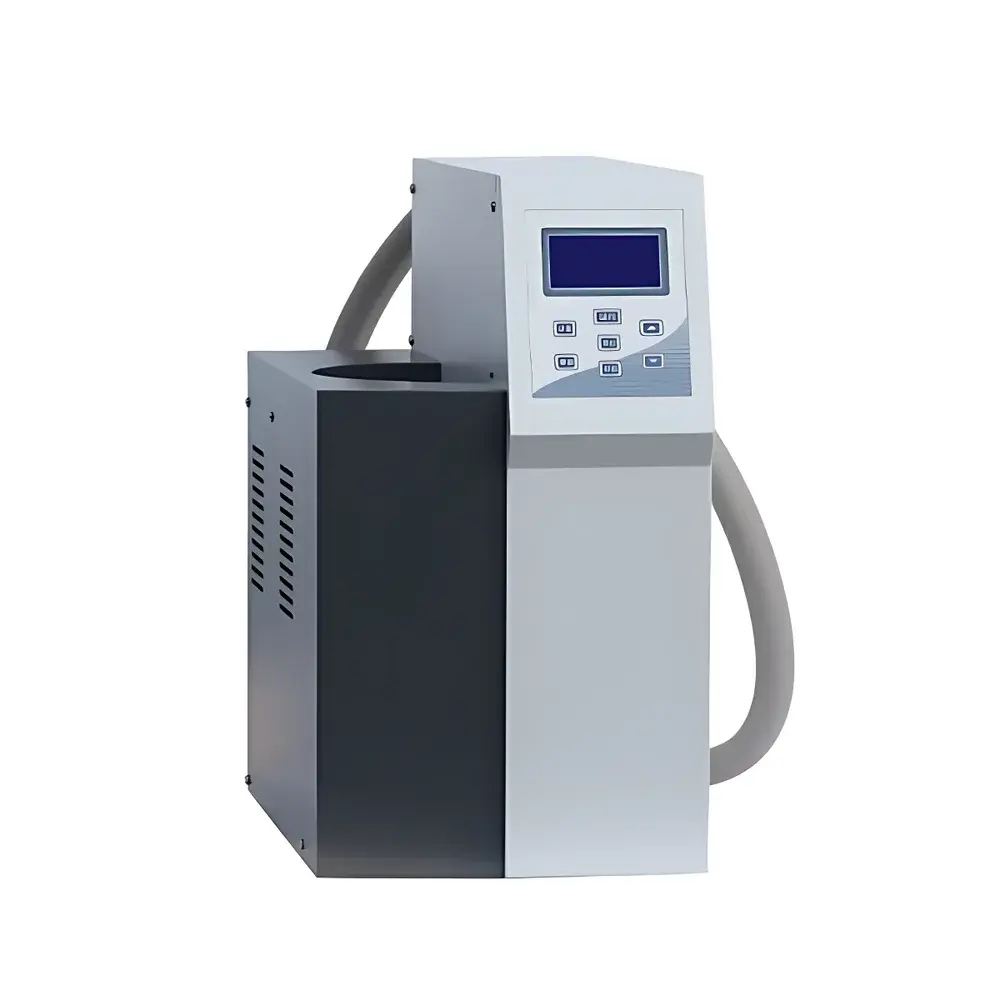
Zhonghuipu HS-3 Fully Automated Static Headspace Sampler
| Brand | Zhonghuipu |
|---|---|
| Origin | Beijing, China |
| Manufacturer Type | Manufacturer |
| Product Category | Domestic |
| Model | HS-3 |
| Instrument Type | Static Headspace Sampler |
| Automation Level | Fully Automated |
| Sample Vial Heating Range | 40–200 °C (customizable up to 250 °C) |
| Valve Temperature Control Range | 40–200 °C (customizable up to 330 °C) |
| Sample Transfer Line Temperature Control Range | 40–200 °C (customizable up to 330 °C) |
| Quantitative Loop Volume | 1 mL (customizable up to 3 mL) |
| Temperature Control Accuracy | ±1 °C |
| Vial Capacity | 15 positions |
| Heated Vial Positions | 1 |
| Compatible Vial Sizes | 10 mL and 20 mL |
| Equilibration Time | 0–100 min |
| Pressurization Time | 0–10 min |
| Sampling Time | 0–10 min |
| Loop Equilibration Time | 0–10 min |
| Injection Time | 0–10 min |
| Analysis Time | 0–100 min |
| Purge Time | 0–100 min |
| RSD | ≤1.5% (for 100 ppm ethanol in water) |
| Power Consumption | Peak 350 W |
| Dimensions (L×W×H) | 430 × 270 × 500 mm |
| Net Weight | ~20 kg |
| Sample Path Materials | RESTEK-passivated, Siltek®/Sulfinert®-treated 316L stainless steel tubing |
| Sampling Method | Positive-pressure headspace sampling |
| GC Interface | TTL/RS-232/USB |
Overview
The Zhonghuipu HS-3 Fully Automated Static Headspace Sampler is an engineered solution for precise, reproducible volatile compound analysis in gas chromatography (GC) workflows. It operates on the principle of static headspace analysis—where a sealed sample vial is heated to equilibrium, allowing volatile analytes to partition into the vapor phase above the sample matrix. A precisely metered volume of this equilibrated headspace gas is then transferred via positive-pressure injection into the GC inlet. Designed for laboratories requiring high throughput without compromise in analytical integrity, the HS-3 delivers robust automation, thermal stability, and inert sample path integrity—critical for trace-level quantitation of polar, acidic, or sulfur-containing compounds in complex matrices such as environmental water, pharmaceutical formulations, food extracts, and forensic evidence.
Key Features
- Fully automated sequence execution: pre-programmed method parameters control vial positioning, heating, pressurization, loop filling, transfer, and GC synchronization—requiring zero manual intervention across up to 15 samples.
- Single-position heated vial chamber with programmable temperature control from 40 °C to 200 °C (optional 250 °C), ensuring accurate thermal equilibration per ASTM D6866 and ISO 11843 protocols.
- Heated six-port valve and quantitative loop assembly (standard 1 mL, optional up to 3 mL), both maintained within a thermally insulated enclosure (40–200 °C; optional 330 °C) to eliminate cold spots and prevent condensation or adsorption losses.
- Inert sample pathway constructed entirely from RESTEK-passivated 316L stainless steel tubing treated with Siltek®/Sulfinert® surface chemistry—validated for low carryover (95%) of reactive species including H2S, methanethiol, organic acids, and aldehydes.
- Motor-driven mechanical actuation system eliminates dependency on external carrier gases or compressed air, reducing infrastructure requirements and operational variability.
- Integrated self-diagnostics: automatic vial presence detection, collision avoidance logic, real-time motion monitoring, and fault-triggered emergency stop—ensuring long-term mechanical reliability and operator safety.
- Front-panel LCD interface with Chinese-language menu navigation and embedded microcontroller; also supports remote operation via RS-232, USB, or TTL-level GC-ready signal handshake for synchronized instrument control.
Sample Compatibility & Compliance
The HS-3 accommodates standard 10 mL and 20 mL crimp-top or screw-cap headspace vials, compatible with widely adopted septa materials (e.g., PTFE/silicone, butyl rubber). Its positive-pressure sampling architecture enables direct analysis of liquid, semi-solid, and solid-phase samples—including aqueous solutions, soil slurries, polymer pellets, and tablet formulations—without derivatization or solvent extraction. The system meets foundational requirements for GLP-compliant environments through audit-trail-capable method storage, parameter locking, and hardware-based thermal validation. While not pre-certified to FDA 21 CFR Part 11, its architecture supports integration with validated LIMS and electronic lab notebook (ELN) platforms when deployed with appropriate procedural controls. Performance validation data—including RSD ≤1.5% for 100 ppm ethanol in water and sub-ppb detection of benzene in drinking water—aligns with USP , EPA Method 502.2, and ISO 15681-2 benchmarks.
Software & Data Management
The HS-3 operates autonomously using onboard firmware that stores up to 15 user-defined methods, each containing independent settings for equilibration, pressurization, loop fill, purge, and injection timing. All parameters are editable via the front-panel interface or remotely via ASCII command protocol over RS-232/USB. No proprietary software installation is required; however, third-party chromatography data systems (CDS) such as Agilent OpenLab, Thermo Chromeleon, or Shimadzu GCsolution can trigger HS-3 sequences via TTL-level “ready” signal input and receive status feedback (e.g., “vial loaded”, “injection complete”). For labs implementing 21 CFR Part 11 compliance, external CDS platforms may enforce electronic signatures, audit trails, and user access controls—leveraging the HS-3’s deterministic hardware behavior and repeatable timing resolution (±0.1 s).
Applications
- Environmental testing: VOCs (benzene, toluene, ethylbenzene, xylenes) in groundwater per EPA 502.2 and 8260D.
- Pharmaceutical residual solvents: Class 1–3 solvents in APIs and finished dosage forms per ICH Q3C and USP .
- Food and beverage quality control: ethanol in soft drinks, acetaldehyde in PET bottles, diacetyl in dairy products.
- Forensic toxicology: blood alcohol concentration (BAC) quantification using headspace-GC-FID.
- Polymer and packaging migration studies: limonene, styrene, or formaldehyde release from food-contact materials.
FAQ
What types of GC inlets is the HS-3 compatible with?
The HS-3 interfaces with split/splitless, PTV, and cool-on-column inlets via standard 1/16″ OD fused silica or deactivated stainless steel transfer lines. Its positive-pressure injection design ensures compatibility without requiring inlet pressure modulation.
Can the HS-3 be integrated into a regulated GMP laboratory environment?
Yes—when paired with a validated CDS platform supporting electronic signatures, audit trails, and role-based access control, the HS-3 functions as a compliant peripheral device. Its deterministic timing, thermal repeatability, and inert flow path support IQ/OQ/PQ documentation.
Is calibration verification supported out-of-the-box?
While the HS-3 does not include built-in calibration gas ports, it supports external verification using certified standard vials (e.g., NIST-traceable ethanol/water standards). Thermal accuracy is verified using calibrated PT100 probes inserted into dummy vials during qualification.
What maintenance intervals are recommended for long-term operation?
Valve rotor seal replacement every 10,000 injections; quantitative loop cleaning with methanol/acetone every 500 runs; annual verification of thermal uniformity across the vial heater block using a calibrated thermal mapping probe.
Related Products





