
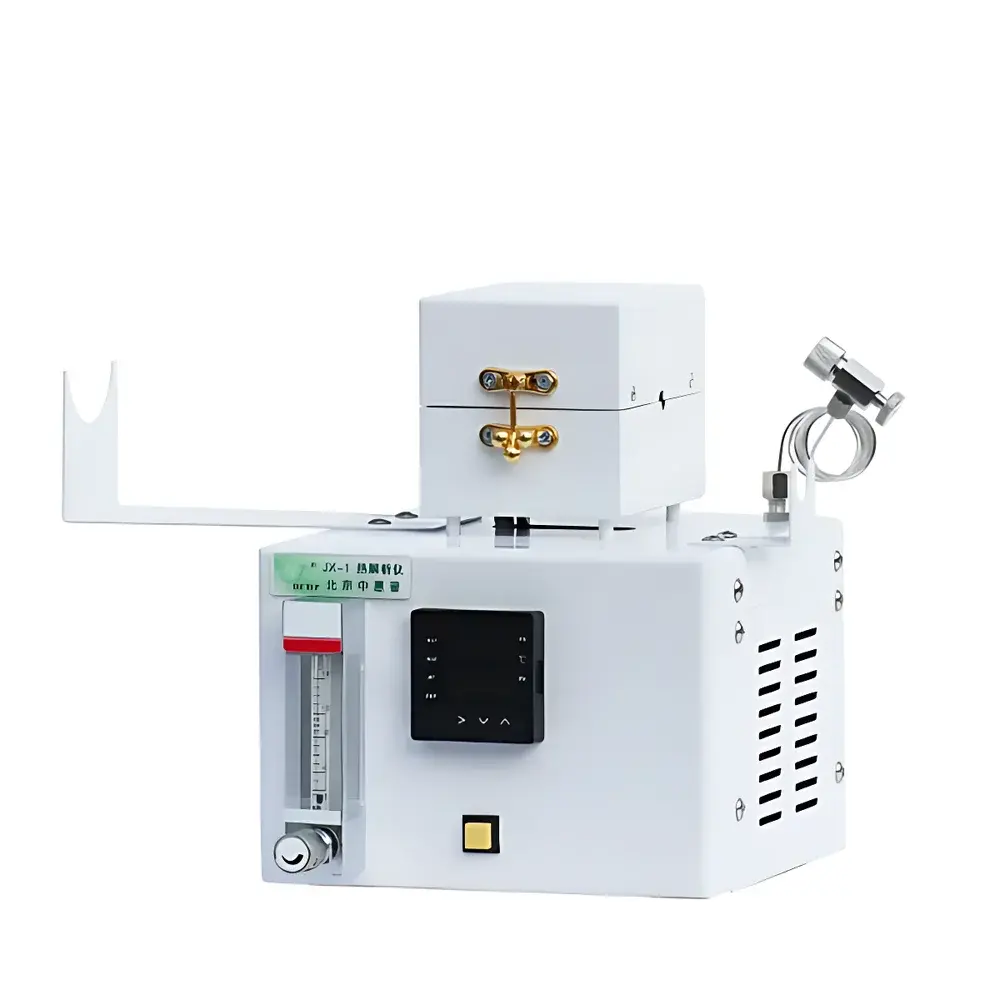
Zhonghuipu JX-1 Manual Thermal Desorber
| Brand | Zhonghuipu |
|---|---|
| Origin | Beijing, China |
| Manufacturer Type | Direct Manufacturer |
| Product Category | Domestic |
| Model | JX-1 |
| Instrument Type | Single-Stage Thermal Desorber |
| Automation Level | Manual |
| Desorption Temperature Range | Ambient to 400 °C |
| Temperature Control Accuracy | < ±0.5 °C |
| Sample Position Count | 1 |
| Desorption Flow Rate | 16–160 mL/min (adjustable) |
| Desorption Efficiency | ≥85% |
| Trap Tube Dimensions | Ø6 mm, length >120 mm |
| Carrier Gas | High-Purity N₂ (≥99.999%) |
| Power Supply | 220 V ±10%, 50–60 Hz |
| Operating Environment | 10–40 °C, ≤85% RH |
| Dimensions (W×D×H) | 170×200×150 mm |
| Gas Path Material | Passivated 316 Stainless Steel Tubing |
| Sealing Material | PTFE O-rings |
| Flow Control | Precision Rotameter |
Overview
The Zhonghuipu JX-1 Manual Thermal Desorber is a single-stage, benchtop thermal desorption unit engineered for precise, reproducible release of volatile and semi-volatile organic compounds (VOCs and SVOCs) from sorbent-packed tubes. Unlike automated or cryo-focused systems, the JX-1 employs resistive heating and direct gas-phase transfer—eliminating cold traps, valves, and complex pneumatic routing. Its design centers on compliance with Chinese occupational health standards (e.g., GBZ/T series), where manual, traceable, and method-locked workflows are required for workplace air monitoring. The instrument operates on the principle of controlled thermal desorption: analytes adsorbed onto sorbent media (e.g., Tenax TA, Carbopack B/C, or multi-bed traps) are thermally liberated under inert nitrogen flow, then transferred quantitatively into a gas-tight 100 mL glass syringe—ensuring zero dead volume and minimal analyte loss or degradation.
Key Features
- Manual, operator-controlled workflow—ideal for laboratories requiring full procedural transparency and audit-ready documentation per GLP/GMP-aligned practices.
- High-stability temperature control system with ±0.5 °C accuracy across the full 25–400 °C range, validated using NIST-traceable reference thermocouples.
- Integrated precision rotameter for adjustable carrier gas flow (16–160 mL/min), calibrated for nitrogen at standard temperature and pressure (STP).
- Entire gas pathway constructed from electropolished and passivated 316 stainless steel tubing, minimizing surface adsorption and metal-catalyzed decomposition.
- PTFE-sealed fittings and high-temperature-compatible O-rings ensure leak-tight integrity up to 400 °C and eliminate background contamination from elastomer outgassing.
- Direct coupling interface accepts standard 6 mm OD thermal desorption tubes (>120 mm length), enabling compatibility with widely used sorbent configurations in industrial hygiene sampling.
Sample Compatibility & Compliance
The JX-1 supports desorption of target analytes from common sorbent tubes used in workplace air sampling, including single-bed (e.g., Tenax TA for C6–C14 aromatics and aliphatics) and dual/multi-bed configurations (e.g., Carbopack B + Carbopack C for extended volatility range). It is explicitly designed and verified for use with national occupational exposure limit (OEL) methodologies, including but not limited to:
- GBZ/T 300.62–2017 — Determination of solvent gasoline, LPG, raffinate, and turpentine in workplace air
- GBZ/T 160.38–2004 — Determination of aliphatic hydrocarbons in workplace air
- GBZ/T 160.52–2007 — Determination of aliphatic ethers in workplace air
While not an FDA 21 CFR Part 11–compliant system due to its manual operation, the JX-1 supports full traceability when integrated into laboratory notebooks, SOP-driven workflows, and ISO/IEC 17025-accredited testing environments where instrument logs, calibration records, and analyst signatures constitute formal data governance.
Software & Data Management
The JX-1 operates without embedded firmware or proprietary software—reflecting its role as a dedicated, hardware-only desorption module. All operational parameters (temperature setpoint, dwell time, flow rate) are recorded manually by the analyst in standardized log sheets aligned with GBZ/T reporting templates. This analog control architecture ensures long-term stability, eliminates cybersecurity vulnerabilities, and simplifies validation for regulated industrial hygiene labs. For laboratories implementing electronic lab notebooks (ELN), the JX-1 integrates seamlessly via structured metadata entry (e.g., tube ID, batch number, desorption timestamp, ambient conditions) without requiring device-level connectivity.
Applications
- Workplace air quality assessment for VOCs in manufacturing, petrochemical, paint, printing, and adhesive application facilities
- Occupational exposure monitoring per Chinese national standards and enterprise EHS programs
- Method development and verification for thermal desorption–gas chromatography (TD–GC) workflows where manual transfer to syringe-based injection is preferred
- Calibration standard preparation via dynamic spiking of sorbent tubes followed by quantitative recovery assessment
- Educational and training use in analytical chemistry curricula focusing on sorptive sampling fundamentals and desorption physics
FAQ
Is the JX-1 compatible with GC autosamplers?
No—the JX-1 delivers desorbed analytes directly into a 100 mL gas-tight syringe; it does not feature a GC interface or split/splitless injection port. Syringe-based manual injection into GC systems is required.
Can I use helium instead of nitrogen as the desorption gas?
Yes, provided helium purity is ≥99.999% and system compatibility with He’s lower viscosity and higher thermal conductivity is confirmed; however, nitrogen remains the recommended carrier per GBZ/T methods.
What maintenance is required for long-term reliability?
Annual verification of temperature sensor calibration and rotameter flow accuracy is recommended; stainless steel lines require no routine cleaning unless exposed to highly reactive or particulate-laden samples.
Does the JX-1 support programmed temperature ramping?
No—it provides only isothermal desorption at a user-selected steady-state temperature; ramped desorption requires external controller integration not included with the base unit.
How is desorption efficiency validated?
Efficiency ≥85% is determined per GBZ/T 300.1–2017 Annex A using certified reference standards spiked onto sorbent tubes, followed by recovery analysis via GC–FID or GC–MS.




