
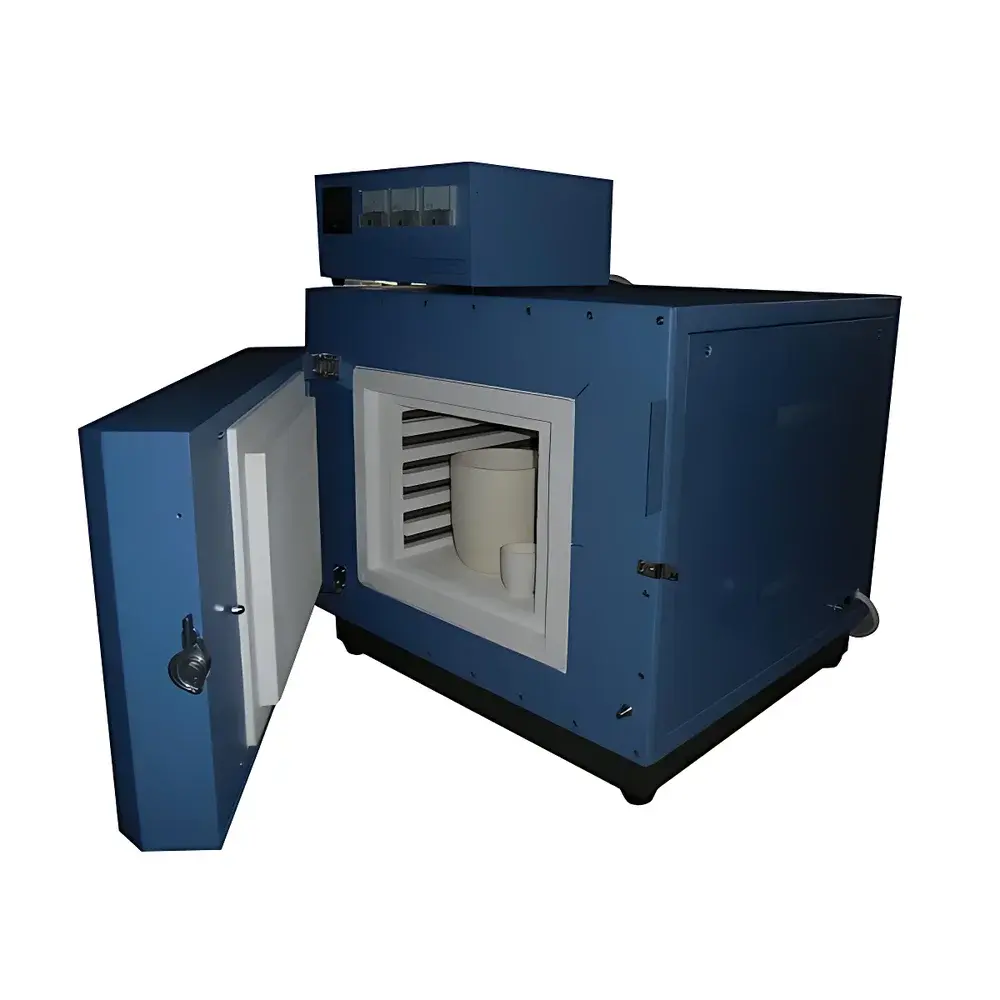
Zhongke Aobo TL2014 Intelligent Muffle Furnace
| Brand | Zhongke Aobo |
|---|---|
| Model | TL2014 |
| Type | Benchtop Box-Type Muffle Furnace |
| Max Operating Temperature | 1400 °C |
| Chamber Volume | 20 L |
| Heating Element | Resistance Wire (Ni-Cr Alloy) |
| Thermocouple Type | S-Type (Platinum-Rhodium) |
| Power Supply | 3-Phase 380 V AC, 16 A |
| Rated Power | 6 kW |
| Chamber Dimensions (W×D×H) | 250 × 400 × 200 mm |
| External Dimensions (W×D×H) | 660 × 770 × 595 mm |
| Net Weight | 85 kg |
| Temperature Uniformity | ±5 °C at 1300 °C |
| Control System | PID Programmable Controller with 50-step Ramp/Soak Profile |
| Surface Temperature (at 1000 °C hold) | ≤55 °C |
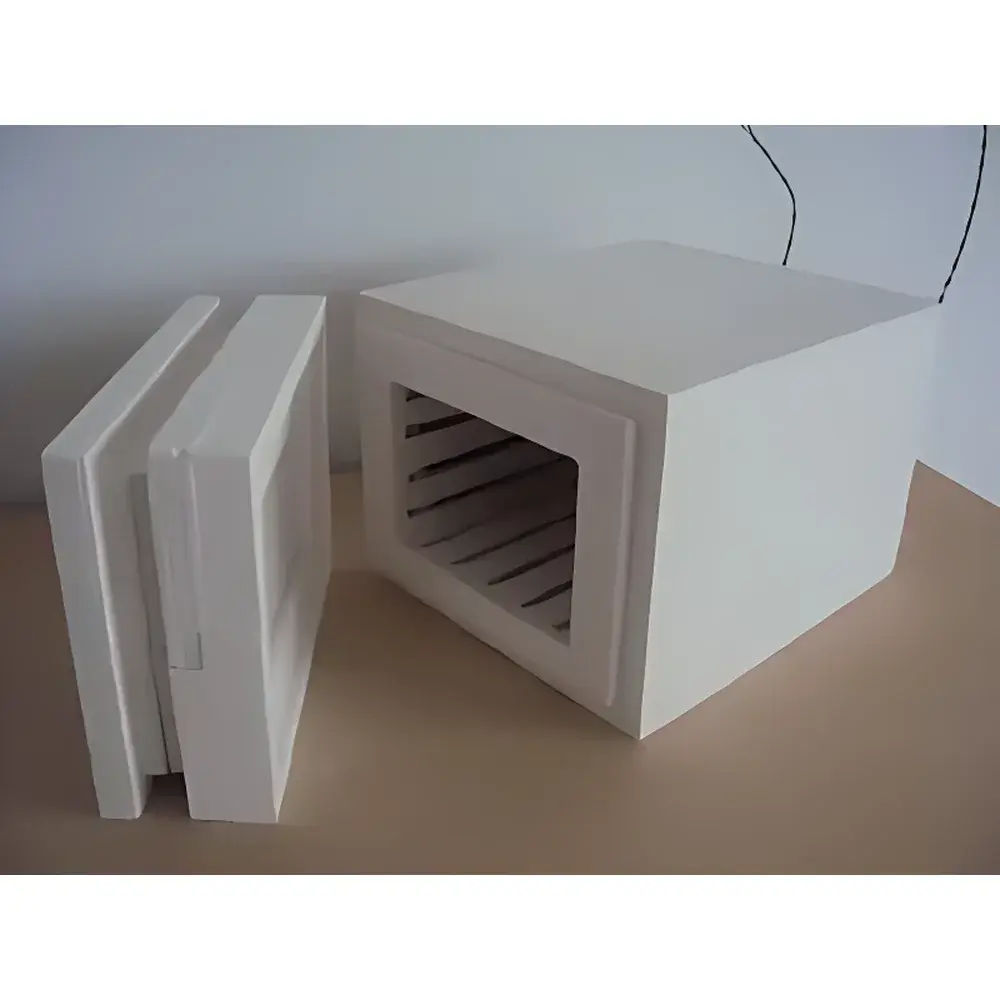
| Insulation | High-Density Ceramic Fiber (1400 °C Grade) |
| Compliance | Designed per IEC 61000-6-3 (EMC), GB/T 10066.1–2004 (Industrial Furnaces), and ISO/IEC 17025:2017 (for laboratory use environments) |
Overview
The Zhongke Aobo TL2014 Intelligent Muffle Furnace is a precision-engineered benchtop box-type furnace designed for high-reliability thermal processing in accredited laboratories and quality control facilities. Operating up to 1400 °C, it employs a robust ceramic fiber insulation architecture combined with dual-side embedded resistance heating elements (Ni-Cr alloy), enabling rapid, uniform heat distribution across its 20 L chamber. Its measurement principle relies on closed-chamber radiant heating under controlled atmospheric conditions—ideal for ashing, calcination, heat treatment, and thermal decomposition protocols where sample integrity and reproducible thermal history are critical. Unlike conventional refractory-brick furnaces, the TL2014 achieves <60-minute ramp from 100 °C to 1400 °C while maintaining surface temperatures below 55 °C during extended holds—minimizing ambient thermal load and enhancing operator safety. The furnace complies with fundamental electrical safety and electromagnetic compatibility requirements defined in IEC 61000-6-3 and GB/T 10066.1–2004, and its operational traceability supports alignment with ISO/IEC 17025:2017 clause 7.2.2 (method validation) when integrated into documented laboratory workflows.
Key Features
- Programmable PID temperature controller with 50-segment ramp/soak capability and digital setpoint input—reducing manual readout error and supporting GLP-compliant thermal profiles.
- Ceramic fiber insulation (1400 °C rated) reduces thermal mass by ~50% versus brick-lined equivalents, accelerating ramp rates and cutting energy consumption by up to 35%.
- Side-opening door with reinforced ceramic gasket ensures consistent seal integrity and minimizes thermal leakage during operation.
- Dual-sided heating element layout enables symmetrical heat flux distribution and extends heater service life—replacement requires no internal disassembly.
- Integrated ventilation port (standard) supports passive exhaust or optional gas-purged inert atmosphere configuration (N₂ or Ar) for oxidation-sensitive applications.
- Independent controller housing improves serviceability and reduces electromagnetic interference between power electronics and signal circuitry.
- Surface temperature remains ≤55 °C at steady-state 1000 °C operation—meeting occupational safety thresholds per ISO 13732-1 for contact surfaces.
Sample Compatibility & Compliance
The TL2014 accommodates crucibles up to Ø120 mm × 100 mm height within its 250 × 400 × 200 mm chamber, supporting standard ASTM G160, ISO 1171 (ash content), ASTM D3174 (coal ash), and USP residue-on-ignition procedures. Its S-type thermocouple (Pt-10%Rh / Pt) provides NIST-traceable calibration stability up to 1400 °C, with typical drift <±0.5 °C/year under routine use. For regulated environments, the furnace’s discrete analog output (4–20 mA) and RS485 Modbus RTU interface enable integration into LIMS or SCADA systems supporting 21 CFR Part 11 audit trails when paired with validated data acquisition software. It is not certified for Class I Div 1 hazardous locations but meets general-purpose lab installation standards per NFPA 70 (NEC) Article 424.
Software & Data Management
While the TL2014 operates autonomously via its front-panel controller, its RS485 serial interface permits bidirectional communication with third-party PC-based platforms (e.g., LabVIEW, MATLAB, or custom Python scripts) using open Modbus RTU protocol. Users may log real-time temperature, power status, and alarm events—including overtemperature cutoff, thermocouple break detection, and cooling-rate monitoring. Data export formats include CSV and XML; timestamps are synchronized to system clock with ±1 s accuracy. For audit-ready environments, optional firmware upgrades support configurable event logging (start/stop, parameter changes, fault codes) with user-accessible timestamped archives—facilitating compliance with GLP documentation requirements for thermal validation studies.
Applications
- Coal and coke analysis: Determination of moisture, ash, volatile matter, and fixed carbon per ASTM D3172–D3176 and ISO 1171.
- Environmental testing: Total suspended solids (TSS) residue ignition, heavy metal digestion pre-treatment (EPA Method 3010A), and soil organic matter loss-on-ignition (LOI).
- Pharmaceutical QC: Residue-on-ignition (USP ), catalyst recovery, and excipient thermal stability screening.
- Materials science: Pre-sintering of ceramic powders, binder burnout in investment casting, and thermal gravimetric analysis (TGA) sample preparation.
- Academic research: Controlled oxidation kinetics studies, phase transformation annealing, and metallurgical sample conditioning prior to SEM/EDS analysis.
FAQ
What is the maximum recommended continuous operating temperature?
The TL2014 is rated for continuous operation at 1300 °C; 1400 °C is specified as short-term peak temperature (≤2 hours per cycle) to preserve heating element longevity.
Can this furnace be used under inert or reducing atmospheres?
Yes—via optional gas inlet/outlet fittings installed on the rear panel; compatible with N₂, Ar, or forming gas (5% H₂/95% N₂) at flow rates up to 1 L/min.
Is the temperature controller compliant with FDA 21 CFR Part 11?
The base controller does not include electronic signature or audit trail functionality; however, full Part 11 compliance is achievable when interfaced with validated external data acquisition software meeting ALCOA+ principles.
How often should thermocouple calibration be performed?
Annual calibration against a reference standard (e.g., dry-well calibrator traceable to NIST) is recommended for GLP/GMP applications; more frequent checks are advised if used >4 hours/day at >1200 °C.
What maintenance is required for the ceramic fiber insulation?
No routine maintenance is needed—the material is non-hygroscopic and chemically inert below 1400 °C; avoid mechanical impact or exposure to liquid solvents that may compromise fiber integrity.



