
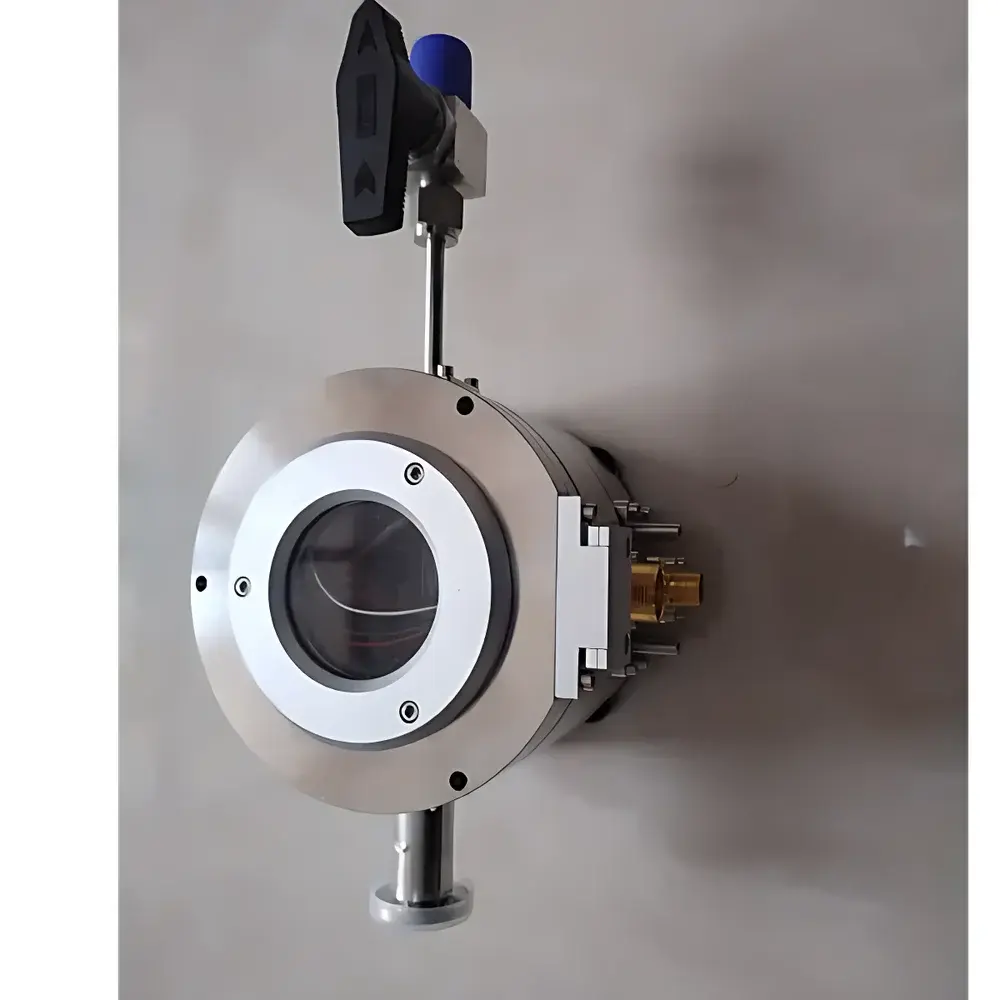
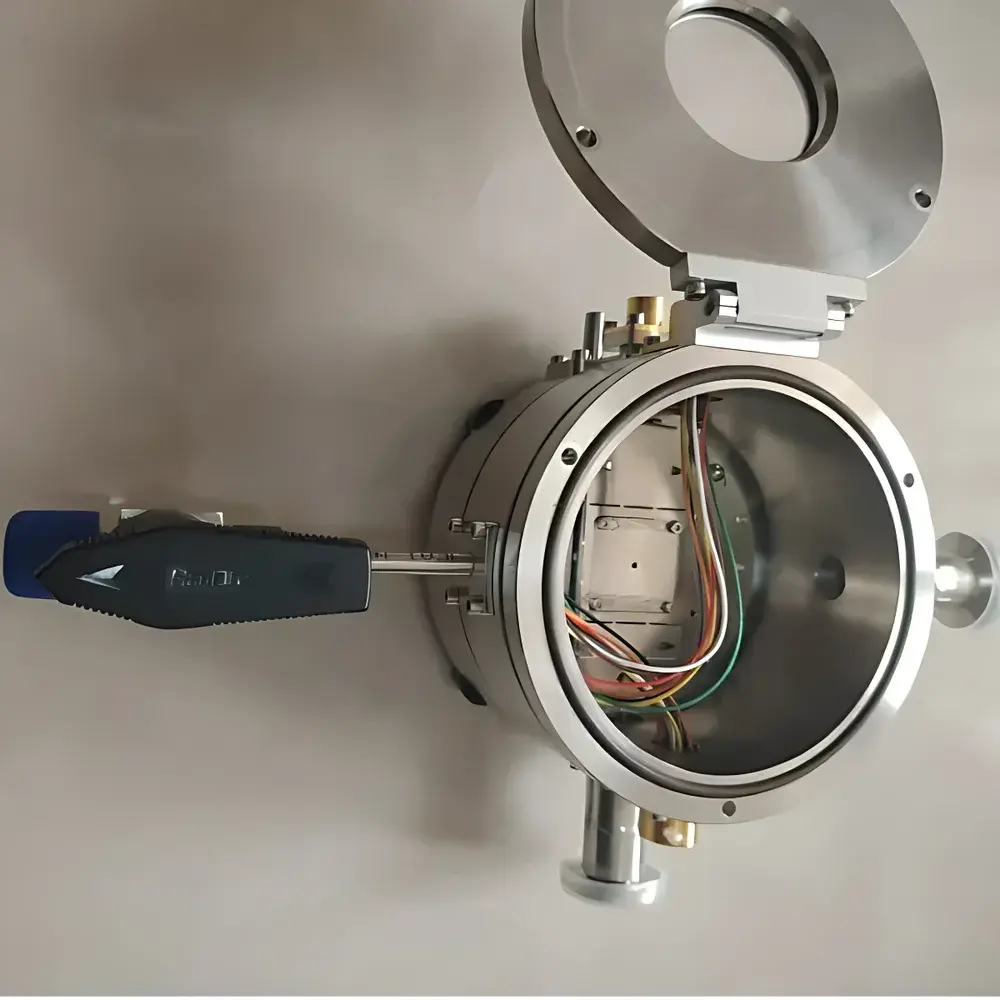
ZK95-50 High-Low Temperature Vacuum Test Chamber
| Brand | Zhongke Aobo |
|---|---|
| Origin | Beijing, China |
| Model | ZK95-50 |
| Temperature Range | −190 °C to 1000 °C |
| Temperature Accuracy | ±0.5 °C |
| Temperature Resolution | 0.1 °C |
| Chamber Internal Dimensions | Φ95 mm × 50 mm |
| Chamber Material | 304 Stainless Steel |
| Viewport Diameter | Φ47 mm |
| Vacuum Interface | KF25 (pumping), KF16 (vacuum gauge), 6 mm Ball Valve (inlet) |
| Electrical Feedthrough | Dual 8-pin hermetic signal connectors (4 A rating) |
| Maximum Positive Pressure | ≤0.1 MPa |
| Ultimate Vacuum | ≤5 Pa (mechanical pump, 5 min), ≤5×10⁻³ Pa (turbo-molecular pump, 30 min) |
| Sample Stage | 28 mm × 28 mm stainless steel, resistively heated, equipped with PT100 sensor |
| Heating Rate (High-Temp Mode) | up to 20 °C/min |
| Control System | 7-inch touchscreen HMI, 30-segment programmable PID with auto-tuning |
| Data Logging | Real-time & historical temperature curves, exportable CSV files |
| Optional Inputs | K/S/B-type thermocouples or RTD |
Overview
The ZK95-50 High-Low Temperature Vacuum Test Chamber is an engineered thermal test platform designed for precise in-situ environmental simulation under controlled vacuum and temperature conditions. It integrates semiconductor-based thermoelectric modules, resistive heating elements, and optional liquid nitrogen cooling pathways to achieve a broad operational range from −190 °C to 1000 °C—enabling characterization of material phase transitions, thin-film deposition kinetics, cryogenic electrical transport, and high-temperature oxidation behavior. The chamber employs a dual-zone thermal architecture: the main 304 stainless steel vacuum cavity maintains pressure integrity and thermal stability, while the independently regulated sample stage ensures localized thermal uniformity and minimal thermal lag. Its compact cylindrical form factor (Φ120 mm × 80 mm external) supports integration into optical tables, SEM/TEM sample stages, and custom vacuum manifolds without compromising mechanical rigidity or thermal isolation.
Key Features
- Wide thermal span: −190 °C (LN₂-cooled) to 1000 °C (resistive heating), with stage temperature accuracy of ±0.5 °C and resolution of 0.1 °C
- Vacuum-compatible construction: All-welded 304 stainless steel body with KF25 pumping port, KF16 vacuum gauge port, and sealed 6 mm ball valve gas inlet
- Optical access: Φ47 mm quartz viewport aligned coaxially with the 28 mm × 28 mm stainless steel sample stage (55–60 mm standoff)
- Dual hermetic electrical feedthroughs: 8-pin, 4 A-rated connectors for sensor wiring, heater control, or external instrumentation interfacing
- Programmable thermal profiling: 30-segment ramp-hold sequences with auto-tuned PID algorithm, implemented via 7-inch capacitive touchscreen HMI
- Real-time data management: Onboard logging of temperature vs. time; exportable CSV files support traceability for GLP/GMP-aligned workflows
- Modular thermal actuation: Configurable operation modes—pure heating, pure cooling, Peltier-assisted bidirectional control, or hybrid LN₂ + resistive heating
Sample Compatibility & Compliance
The ZK95-50 accommodates standard planar samples up to 28 mm × 28 mm and thicknesses compatible with the 55–60 mm stage-to-viewport clearance. Its internal volume (≈350 cm³) permits use with small-diameter fiber optics, MEMS devices, thin-film substrates, and semiconductor wafers. The chamber meets ISO 27401:2017 requirements for vacuum system cleanliness and complies with CE electromagnetic compatibility directives (2014/30/EU). Vacuum performance is validated per ASTM E517-22 for leak rate assessment and supports residual gas analysis when interfaced with quadrupole mass spectrometers. Pressure containment (≤0.1 MPa positive, ≤5×10⁻³ Pa base vacuum) enables studies compliant with ASTM F2627 (cryogenic materials testing) and ISO 11357-3 (DSC calibration under inert/vacuum environments).
Software & Data Management
The embedded controller firmware provides full local control without PC dependency. Temperature setpoints, ramp rates, dwell times, and alarm thresholds are configured directly on the HMI. Logged datasets include timestamped PT100 readings, heater output %, and optional vacuum gauge inputs (when connected via analog expansion module). Exported CSV files contain columns for absolute time (ms), stage temperature (°C), setpoint (°C), deviation (°C), and status flags—facilitating post-acquisition analysis in MATLAB, Python (NumPy/Pandas), or LabVIEW. Audit trails are retained onboard for ≥10,000 cycles; firmware supports remote firmware updates via USB-C. For regulated environments, the system can be integrated with third-party SCADA platforms supporting Modbus RTU over RS-485 (optional adapter).
Applications
- In-situ XRD and Raman spectroscopy under variable thermal-vacuum conditions
- Electrical resistivity and Hall effect measurements across cryogenic-to-high-temperature regimes
- Thermal cycling reliability testing of solder joints, die-attach materials, and packaging adhesives
- Outgassing rate quantification per ASTM E595 for space-grade components
- Calibration of thermocouples and RTDs against NIST-traceable reference standards
- Low-temperature photoluminescence (PL) and electroluminescence (EL) characterization of quantum dots and perovskites
- Accelerated aging studies of polymer films and OLED encapsulation layers under controlled partial pressures
FAQ
What vacuum pumps are recommended for achieving ≤5×10⁻³ Pa?
A turbo-molecular pump backed by a two-stage rotary vane pump is required; we recommend models compliant with ISO 8573-1 Class 2 for hydrocarbon-free operation.
Can the chamber be used under positive pressure with reactive gases?
Yes—rated for ≤0.1 MPa gauge pressure; however, gas compatibility must be verified against 304 SS corrosion charts (e.g., avoid Cl₂, moist HF, or concentrated HNO₃ above 60 °C).
Is the PT100 sensor calibrated to NIST standards?
The factory-installed PT100 is certified to IEC 60751 Class B (±0.3 °C at 0 °C); full NIST-traceable calibration certificates are available as an optional add-on.
Does the system support external triggering for synchronized measurements?
Yes—the HMI exposes TTL-level trigger outputs (start/stop) and accepts external gate signals via GPIO pins on the rear panel connector block.
How is thermal uniformity across the sample stage characterized?
Uniformity is specified as ±1.5 °C over the central 20 mm × 20 mm region at steady state (measured using a 5-point micro-thermocouple array per ISO 17025 procedures).



