
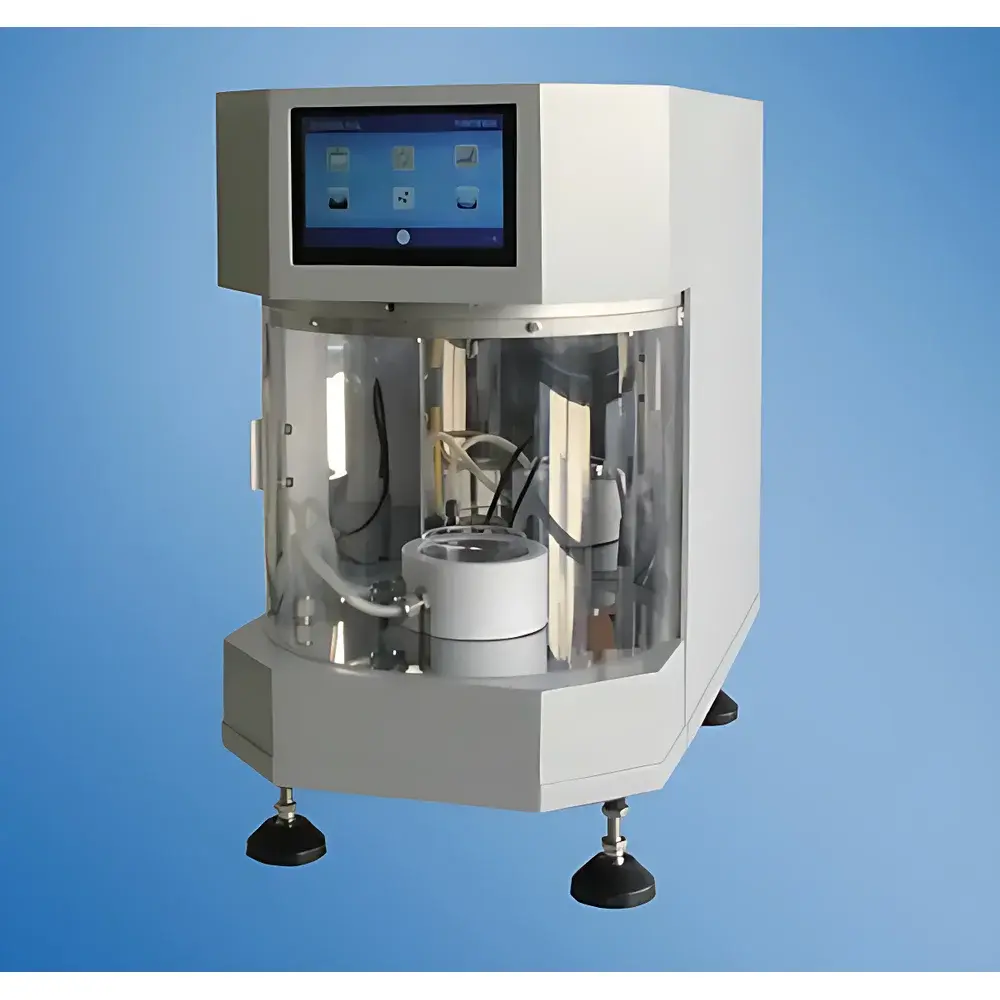
ZYKX JK99M Advanced Automatic Tensiometer & Interfacial Force Analyzer
| Brand | ZYKX |
|---|---|
| Origin | Beijing, China |
| Model | JK99M |
| Measurement Range | 0–1999.999 mN/m |
| Resolution & Sensitivity | 0.001 mN/m |
| Accuracy | ±0.001 mN/m |
| Method | Du Noüy Ring & Wilhelmy Plate |
| Sampling Interval | Ring: 20–150 s |
| Plate | 1–5 s |
| Force Sensor | METTLER high-precision electromagnetic balance (0.1 mg / 0.01 mg optional) |
| Vertical Stage Travel | 0–50 mm (up to 110 mm optional) |
| Stage Precision | 0.1 µm |
| Speed Control | 0.1–500 mm/min |
| Temperature Monitoring | ±0.01 °C (external probe or internal liquid sensor optional) |
| Data Acquisition Rate | 0.1 Hz (0.02 Hz optional) |
| Power Supply | AC 220 ±5 V, <150 W |
| Operating Humidity | 30–85% RH |
| Compliance | SY/T 5370–1999 |
Overview
The ZYKX JK99M Advanced Automatic Tensiometer & Interfacial Force Analyzer is a dual-mode, precision instrument engineered for the quantitative determination of surface tension (liquid–air) and interfacial tension (liquid–liquid), as well as auxiliary measurements including dynamic contact angle, CMC concentration, density, and adhesion force. It operates on two internationally standardized physical principles: the Du Noüy ring method—based on maximum pull-off force at the moment of detachment—and the Wilhelmy plate method—relying on continuous wetting force measurement via vertical immersion and buoyancy equilibrium. Both methods comply with SY/T 5370–1999, the Chinese petroleum industry standard for surface and interfacial tension measurement, and are fully compatible with ASTM D971, ISO 6295, and ISO 1409 methodologies. The instrument’s core architecture integrates a high-stability servo-controlled vertical stage, a METTLER-grade electromagnetic force transducer (certified to 0.1 mg resolution, optionally 0.01 mg), and real-time thermal monitoring—enabling reproducible, GLP-aligned measurements across diverse viscosities (including medium-to-high viscosity oils, inks, and polymer solutions) and complex multiphase systems.
Key Features
- Modular dual-method platform supporting both Du Noüy ring and Wilhelmy plate protocols—each optimized for specific fluid rheologies and interfacial kinetics.
- High-precision vertical motion system: 0.1 µm positional resolution, programmable speed range (0.1–500 mm/min), and travel up to 110 mm (standard 50 mm) for extended immersion depth control.
- Integrated temperature monitoring interface with ±0.01 °C accuracy; supports external circulation thermostats (e.g., Julabo or Huber units) via standardized mounting flange and digital I/O.
- Dual-mode operation: standalone mode with built-in LCD touchscreen and thermal printer (optional), or PC-controlled mode via RS-232/USB interface with full curve logging and time-stamped metadata.
- Automated zeroing routines—including hardware-triggered and software-initiated calibration cycles—as well as scheduled auto-zero intervals for long-duration kinetic studies.
- Onboard calculation engine with embedded correction algorithms (e.g., Harkins–Jordan ring correction, Zuidema–Waters plate correction, and Neumann–Zettlemoyer density compensation) eliminating manual post-processing.
- Rugged all-metal chassis with vibration-dampened base and low-noise stepper motor drive—designed for stable benchtop deployment in QC labs and pilot-scale R&D environments.
Sample Compatibility & Compliance
The JK99M accommodates a broad spectrum of sample types: Newtonian and non-Newtonian liquids (e.g., surfactant micellar solutions, crude oil emulsions, pharmaceutical formulations), immiscible liquid pairs (e.g., water–alkane, brine–solvent), powders (via sessile drop or Washburn analysis add-ons), fibers, and coated substrates. Its mechanical design permits integration with magnetic stirrers (standard), ionized air nozzles (optional), and quartz environmental shrouds—minimizing evaporation artifacts and electrostatic interference during dynamic surface aging experiments (15 ms–16 s range, optional). Regulatory alignment includes traceable calibration using NIST-traceable stainless steel weights and platinum reference rings/plates. Data integrity meets FDA 21 CFR Part 11 requirements when used with audit-trail-enabled software configurations and user-access controls.
Software & Data Management
The proprietary Windows-based acquisition suite (compatible with Win10/Win11 x64) provides synchronized multi-parameter logging—including real-time surface tension vs. time, mass vs. immersion depth, and temperature-corrected interfacial energy profiles. Raw data exports to CSV, TXT, and XML formats; graphical overlays support comparative kinetic analysis across concentration gradients or temperature ramps. Built-in statistical modules calculate mean, SD, CV%, and confidence intervals per test series. All measurement sessions are timestamped, user-ID tagged, and stored with instrument configuration snapshots—ensuring full traceability for ISO/IEC 17025 or GMP audits. Optional software modules enable automated CMC endpoint detection (via first-derivative inflection), dynamic contact angle hysteresis mapping, and density-compensated interfacial tension modeling.
Applications
- Enhanced oil recovery (EOR): Screening of surfactant–co-solvent–brine systems for ultra-low interfacial tension (<0.001 mN/m) targeting tertiary flood efficiency.
- Formulation science: Stability assessment of agrochemical emulsions, cosmetic microemulsions, and inkjet inks through surface age-dependent tension profiling.
- Materials R&D: Quantification of fiber wettability, powder dispersibility, and coating adhesion energetics under controlled humidity and temperature.
- Pharmaceutical development: Critical micelle concentration (CMC) determination for IV-compatible surfactants, compliance with USP and EP 2.9.38.
- Quality control: Routine verification of batch-to-batch consistency in lubricants, cutting fluids, and cleaning agents per ASTM D1331 and ISO 4787.
FAQ
Does the JK99M support both surface and interfacial tension measurements?
Yes—using either the Wilhelmy plate or Du Noüy ring method, it measures liquid–air surface tension and liquid–liquid interfacial tension with equal metrological rigor.
Can the instrument operate without a connected PC?
Yes—optional integrated LCD touchscreen and thermal printer enable fully autonomous operation, including method selection, parameter entry, and hardcopy output.
Is calibration traceable to international standards?
All force sensors are factory-calibrated against METTLER-certified reference masses; platinum components are certified per ISO 1409 Annex A, and software implements Harkins–Jordan corrections validated against NIST SRM 849a.
What temperature control options are available?
The base unit includes a stainless-steel thermostatic jacket; users may integrate external recirculating baths (e.g., Huber CC-K) or select the optional Omron PID-controlled heating platform for closed-loop ±0.1 °C stability.
How is data security ensured for regulated environments?
When configured with password-protected user roles, electronic signatures, and audit-trail logging, the system satisfies FDA 21 CFR Part 11 and EU Annex 11 requirements for electronic records and signatures.



