
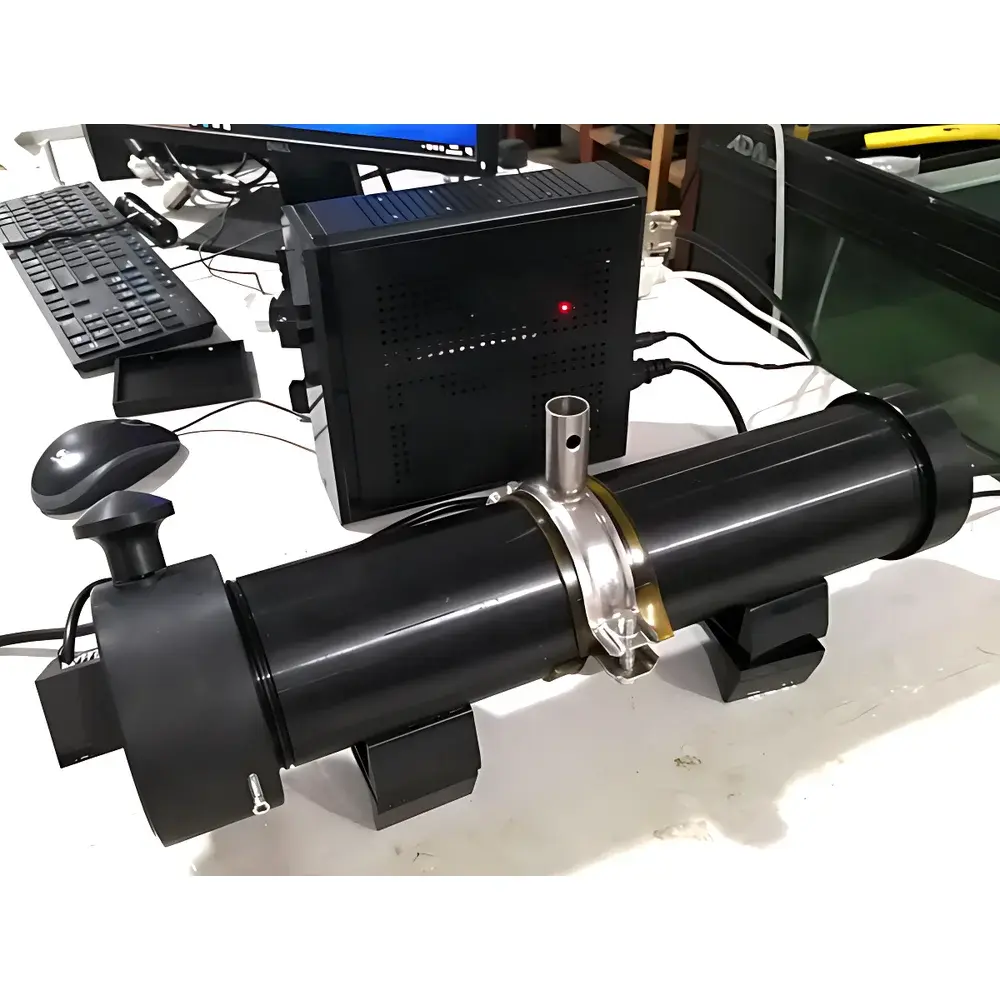
ZYKX ZYWNP-WJS-1 Underwater In-Line Real-Time Dynamic Microbubble Imaging System
| Brand | ZYKX |
|---|---|
| Origin | Shanghai, China |
| Model | ZYWNP-WJS-1 |
| IP Rating | IPX7 |
| Optical Resolution | 0.6–4 µm/pixel |
| Measurement Range | 1–100 µm (ISO-compliant microbubble diameter range) |
| Working Distance | 13 mm (from outer glass window to sample plane) |
| Zoom Ratio | 0.7–4.5× mechanical, 9-step motorized |
| Camera Frame Rate | 60 fps (standard), up to 2000 fps (optional high-speed configuration) |
| Dimensions (L×W×H) | 600 × 200 × 200 mm |
| Weight | ~10 kg |
| Power Supply | AC 220 V ±10 %, 50 Hz ±1 % |
Overview
The ZYKX ZYWNP-WJS-1 Underwater In-Line Real-Time Dynamic Microbubble Imaging System is an engineered optical instrumentation platform designed for in-situ, non-invasive visualization and quantitative morphological analysis of suspended microscale entities—specifically microbubbles (1–100 µm)—within flowing or static aqueous environments. Unlike conventional offline particle analyzers relying on extracted samples, this system operates directly inside the process stream or tank using a pressure-rated, optically sealed imaging head. Its core principle leverages high-fidelity brightfield microscopy coupled with real-time digital image acquisition and adaptive threshold-based segmentation algorithms. By eliminating sample transport artifacts—including bubble coalescence, dissolution, and surface adsorption—the ZYWNP-WJS-1 delivers metrologically traceable, time-resolved data on bubble size distribution, spatial density, velocity field (when paired with PIV-compatible frame rates), and dynamic behavior under operational conditions. This capability aligns with ISO/TC 281 standards for fine bubble characterization and supports GLP-compliant documentation workflows where process-representative measurements are mandatory.
Key Features
- True in-line operation: Fully submersible imaging head rated to IPX7, enabling direct deployment into tanks, reactors, pipelines, or aquaculture basins without flow interruption.
- Optical fidelity: Fixed working distance (13 mm) with calibrated magnification (0.7–4.5× mechanical zoom, 9-step motorized control) ensures repeatable pixel-to-micron mapping across all measurement sessions.
- Real-time imaging architecture: Standard 60 fps CCD camera; optional ultra-high-speed configuration (up to 2000 fps) supports transient event capture such as bubble nucleation, collapse, or interfacial interaction—requires synchronized high-intensity LED illumination and SSD-based frame buffering.
- Intelligent particle discrimination: Proprietary “pore-aware auto-segmentation” algorithm distinguishes gas-filled microbubbles from solid particles and colloidal aggregates based on edge topology, internal homogeneity, and refractive index contrast—minimizing false positives in complex matrices.
- Robust mechanical design: Stainless-steel housing with borosilicate optical window; corrosion-resistant sealing compliant with industrial wastewater and saline environments.
- Modular integration: Waterproof data interface (M12 connector) enables seamless connection to external control PCs or PLC-linked SCADA systems for automated data logging and alarm-triggered imaging.
Sample Compatibility & Compliance
The ZYWNP-WJS-1 is validated for use in turbid, aerated, and chemically aggressive liquid media—including municipal wastewater, aquaculture effluent, agricultural nutrient solutions, and bioreactor broths. It does not require dilution, filtration, or staining, preserving native bubble interfacial properties (e.g., zeta potential, surface charge stability). The system conforms to ISO 20480-1:2019 (Fine bubbles — Vocabulary and definitions) and supports measurement traceability per ISO/IEC 17025 requirements when used with NIST-traceable stage micrometers for calibration. While not certified for hazardous area (ATEX/IECEx) deployment, its electrical isolation and encapsulated optics meet IEC 61000-6-2 immunity standards for industrial electromagnetic environments. Data integrity complies with ALCOA+ principles; audit trails, user access logs, and electronic signature support are embedded in the optional FDA 21 CFR Part 11–compliant software module.
Software & Data Management
The bundled ZYKX ImageQuant Pro software provides a unified interface for acquisition, calibration, segmentation, and statistical reporting. Key modules include: (i) dynamic magnification calibration using certified stage rulers; (ii) multi-threshold adaptive binarization optimized for low-contrast bubble boundaries; (iii) pore-aware split-merge logic to resolve clustered or overlapping microbubbles; (iv) export of ISO-standardized particle statistics (D10, D50, D90, span, number concentration per mL); and (v) time-series overlay for longitudinal trend analysis. All raw images and processed metadata are stored in vendor-neutral TIFF/HDF5 formats. Batch processing scripts support unattended overnight acquisition across multiple time points. For regulated environments, the optional GxP Edition adds electronic signatures, role-based permissions, change control logs, and 21 CFR Part 11–compliant audit trail generation.
Applications
This system serves critical analytical functions across sectors where microbubble functionality is process-determinative. In aquaculture, it verifies oxygen-transfer efficiency and bubble residence time in recirculating aquaculture systems (RAS). In wastewater treatment, it quantifies bubble size distribution in dissolved air flotation (DAF) units and membrane bioreactors (MBRs), correlating performance with floc adhesion kinetics. In agriculture, it validates nanobubble-enhanced irrigation systems by tracking bubble persistence in nutrient solutions. In food & beverage processing, it monitors gas dispersion uniformity in carbonation or foam stabilization lines. In pharmaceutical manufacturing, it characterizes bubble-induced shear stress in bioreactor sparging—supporting QbD-based process validation. Additional use cases include R&D for ozone-based disinfection systems, hydrogen microbubble delivery in biohydrogen production, and quality control of microbubble contrast agents in preclinical ultrasound studies.
FAQ
Can the ZYWNP-WJS-1 detect nanobubbles (<1 µm)?
No—this model is optimized for the ISO-defined microbubble range (1–100 µm). Nanobubble detection requires complementary techniques such as nanoparticle tracking analysis (NTA) or resonant mass measurement (RMM), which are addressed in ZYKX’s separate UFB-series instruments.
Is calibration required before each measurement session?
Yes—optical calibration using a certified stage micrometer is mandatory prior to any quantitative analysis to maintain pixel-to-micron accuracy across zoom settings and thermal drift conditions.
Does the system support automatic bubble counting in highly concentrated suspensions?
It does, provided the suspension opacity permits sufficient light transmission. At volume fractions exceeding ~5%, image preprocessing (e.g., background subtraction, CLAHE enhancement) and iterative deconvolution may be necessary—functions included in the advanced analysis module.
Can data be exported to LIMS or MES platforms?
Yes—CSV, XML, and JSON exports are natively supported. OPC UA and Modbus TCP interfaces are available via optional industrial communication gateway firmware.
What maintenance is required for long-term underwater operation?
Quarterly inspection of O-ring integrity and optical window cleanliness is recommended. No internal consumables or alignment adjustments are needed under normal operating conditions.
Related Products



