
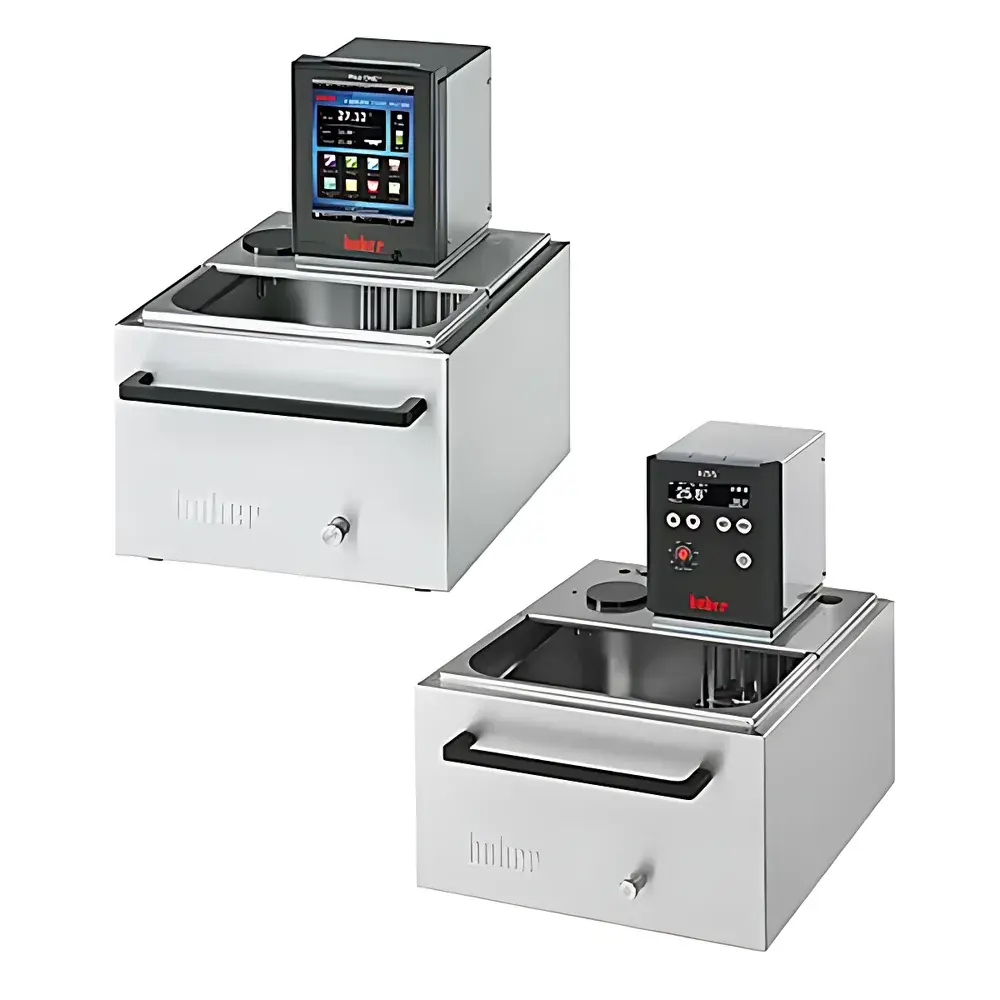
Huber CC & KISS Series Stainless Steel Heating Circulators
| Brand | Huber |
|---|---|
| Origin | Germany |
| Model Range | CC-208B, CC-212B, CC-215B, CC-220B, CC-225B, KISS 208B, KISS 212B, KISS 215B, KISS 220B, KISS 225B |
| Temperature Range | −30 °C to +200 °C |
| Heating Power | 1.5–2.1 kW |
| Bath Volume | 7.5–23.5 L |
| Bath Depth | 150–200 mm |
| Opening Dimensions (W×D) | 230×127 mm to 290×329 mm |
| Temperature Stability | ±0.02 K (CC series), ±0.05 K (KISS series) |
| Pressure Pump Flow Rate | 27 L/min @ 0.72 bar (CC), 14 L/min @ 0.25 bar (KISS) |
| Suction Pump Flow Rate | 10.5 L/min @ 0.7 bar (CC & KISS) |
| External Dimensions (W×D×H) | 290×350×375 mm to 350×555×425 mm |
| Construction | AISI 304 stainless steel bath tank |
| Cooling Requirement | External chiller required for operation below ambient or at sustained low temperatures |
Overview
The Huber CC and KISS Series Stainless Steel Heating Circulators are precision-engineered temperature control systems designed for demanding laboratory and industrial applications requiring stable, uniform thermal environments from −30 °C to +200 °C. These units operate on the principle of forced convection via integrated high-efficiency circulation pumps, delivering consistent heat transfer to external processes—such as jacketed reactors, analytical instruments, or material testing fixtures—through closed-loop fluid circuits. Unlike basic water baths, Huber circulators employ double-walled, vacuum-insulated stainless steel (AISI 304) bath tanks to minimize thermal loss and ensure long-term corrosion resistance—even when operating with silicone oils or other high-boiling-point heat transfer fluids. The CC series delivers enhanced temperature stability (±0.02 K) and higher pressure head capability, while the KISS series offers optimized energy efficiency and compact footprint for space-constrained installations. Both lines comply with IEC 61000-6-3 (EMC) and IEC 61010-1 (safety), and are constructed in accordance with German engineering standards for reliability under continuous operation.
Key Features
- Robust AISI 304 stainless steel bath tank with vacuum insulation for superior thermal retention and chemical compatibility with water, glycols, and silicone oils
- Precise digital PID temperature control with real-time monitoring and programmable ramp/soak profiles via intuitive front-panel interface
- Integrated dual-mode pump system: pressure pump (up to 27 L/min @ 0.72 bar) and suction pump (10.5 L/min @ 0.7 bar), both speed-adjustable on Pilot ONE–equipped models
- Modular design supports integration with external chillers (required for sub-ambient operation), liquid level sensors, and process adapters for open- or closed-loop configurations
- Comprehensive safety architecture including overtemperature cutoff, dry-run protection, leak detection circuitry, and automatic pump shutdown on flow interruption
- CE-marked, RoHS-compliant, and manufactured in Germany under ISO 9001-certified quality management systems
Sample Compatibility & Compliance
These circulators accommodate a broad range of heat transfer media—including deionized water, aqueous glycol mixtures, and synthetic silicone oils—with viscosity tolerance up to 500 cSt at 20 °C. The stainless steel wetted surfaces ensure compatibility with pH 2–12 solutions and eliminate leaching risks critical for pharmaceutical QC, polymer synthesis, or catalyst evaluation workflows. All models meet essential requirements of EN 61000-6-2 (immunity) and EN 61000-6-4 (emission), and support GLP/GMP documentation through optional audit-trail-enabled controllers (e.g., Huber Unistat Pilot ONE with 21 CFR Part 11–compliant software). While not intrinsically rated for hazardous areas, they may be deployed in Class 1 Div 2 environments when installed per NEC Article 500 guidelines and paired with certified external cooling units.
Software & Data Management
When equipped with the Huber Pilot ONE controller, the CC and KISS series support full remote operation via Ethernet or USB. The embedded web server enables real-time parameter visualization, event logging (including temperature deviations, pump status, and alarm history), and CSV export for traceability. Data integrity is preserved through time-stamped records with user authentication (role-based access control), electronic signatures, and tamper-proof storage—fully aligned with FDA 21 CFR Part 11 Annex 11 expectations. Optional LabVIEW™ and Modbus TCP drivers facilitate seamless integration into LIMS, SCADA, or automated reaction platforms. All firmware updates are digitally signed and delivered via secure HTTPS channels.
Applications
- Calibration of thermocouples, RTDs, and infrared sensors across extended temperature ranges per ASTM E220 and ISO/IEC 17025 protocols
- Temperature conditioning of HPLC columns, viscometers, and DSC sample stages to ensure measurement repeatability
- Controlled heating of glass-lined reactors during exothermic polymerization or crystallization studies
- Thermal cycling of electronic components and PCB assemblies per IPC-9701 and JEDEC JESD22-A108
- Material testing of elastomers, adhesives, and composites under ISO 62, ISO 11357, and ASTM D648 conditions
- Support of accelerated stability programs in pharmaceutical development (ICH Q1A–Q1E)
FAQ
Do these circulators require an external chiller to operate below 25 °C?
Yes. The CC and KISS series are heating-dominant systems; sub-ambient operation necessitates connection to a compatible refrigerated chiller via the auxiliary cooling port.
What is the maximum allowable viscosity of heat transfer fluid?
For optimal pump performance and thermal response, Huber recommends fluids with dynamic viscosity ≤500 cSt at 20 °C. Higher-viscosity oils may reduce flow rate and increase thermal lag.
Can the bath be used in open-bath mode without external circulation?
Yes—when fitted with the optional open-bath adapter kit, the unit functions as a high-stability immersion bath with liquid-level sensing and overflow protection.
Is validation documentation available for GxP environments?
Factory-issued IQ/OQ protocols, calibration certificates (traceable to PTB/NIST), and risk assessments are provided upon request. Full 21 CFR Part 11 compliance requires Pilot ONE firmware v3.2+ and configured audit trail settings.
How often does the circulating fluid require replacement?
Under normal use with silicone oil, replacement is recommended every 12–18 months or after 2,000 operating hours—whichever occurs first—to maintain thermal stability and prevent oxidation-induced viscosity drift.



