
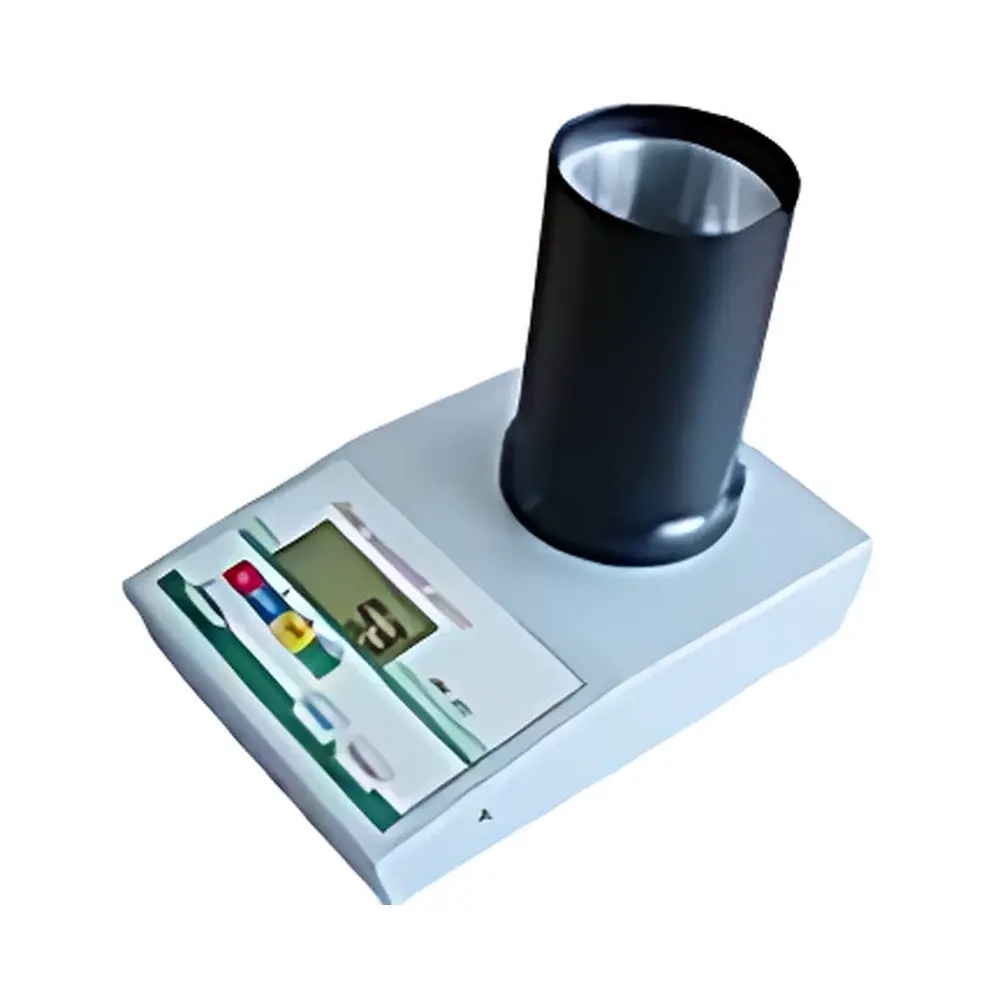
G-WON GMK-305T Capacitance-Based Tea Moisture Analyzer
| Brand | G-WON |
|---|---|
| Origin | South Korea |
| Model | GMK-305T |
| Measurement Range | 3.5–18.0% (w/w) |
| Accuracy | ±0.5% |
| Resolution | 0.1% |
| Temperature Compensation | Automatic |
| Display | LCD |
| Power | 4 × 1.5 V DC (AA batteries) |
| Dimensions | 220 × 148 × 60 mm (L×W×H) |
| Sample Chamber Diameter × Height | 80 × 130 mm |
| Weight | Approx. 2.0 kg |
Overview
The G-WON GMK-305T is a dedicated capacitance-based moisture analyzer engineered for rapid, non-destructive quantification of moisture content in loose-leaf and processed tea products. Unlike thermogravimetric (loss-on-drying) or Karl Fischer titration methods, the GMK-305T employs high-frequency dielectric sensing technology—measuring changes in capacitance induced by water’s polar dielectric properties within the sample matrix. This principle enables real-time, operator-independent readings without sample heating, solvent use, or consumables. Designed specifically for tea processing facilities, quality control laboratories, and export inspection units, the instrument delivers consistent results across common tea types—including green, black, oolong, white, and pu-erh—where moisture levels directly impact shelf life, microbial stability, oxidation kinetics, and compliance with international trade standards (e.g., ISO 15752:2017, Codex Alimentarius STAN 193-1995).
Key Features
- Capacitance-sensing architecture optimized for heterogeneous, low-density botanical matrices—minimizing density-dependent bias common in RF-based systems.
- Automatic temperature compensation algorithm calibrated across 10–40 °C ambient range, ensuring measurement stability under variable warehouse or field conditions.
- Dedicated sample chamber geometry (Ø80 mm × 130 mm height) accommodates representative bulk samples (typically 30–50 g), reducing sampling error and supporting ASTM D4442-compliant sub-sampling protocols.
- High-contrast monochrome LCD display with backlight-independent operation, enabling readability in low-light grading rooms or mobile field use.
- Battery-powered design (4 × AA, 1.5 V DC) ensures portability and operational continuity during power outages—critical for on-site factory floor or auction house deployment.
- Robust ABS housing rated IP52 for dust resistance and incidental moisture exposure, suitable for humid processing environments typical in tea drying and storage areas.
Sample Compatibility & Compliance
The GMK-305T is validated for use with whole-leaf, broken-leaf, granular, and powdered tea forms, including fermented and semi-fermented varieties. It is not intended for highly compressed cakes (e.g., raw pu-erh bricks) without prior mechanical disaggregation. While not certified to GLP or ISO/IEC 17025 as a standalone analytical instrument, its measurement repeatability (RSD < 1.2% at 8.5% moisture, n=10) meets internal QC requirements aligned with ISO 5725-2:2019 precision criteria. Data output complies with traceability prerequisites for HACCP-based food safety plans and supports documentation required under EU Regulation (EC) No 852/2004 for moisture-related hazard control.
Software & Data Management
The GMK-305T operates as a standalone hardware unit with no embedded software or digital connectivity. All measurements are displayed and retained only on the LCD screen; no internal memory, USB interface, or Bluetooth capability is provided. Users must manually record results in laboratory notebooks or external LIMS systems. This architecture eliminates firmware validation burdens and aligns with regulated environments where uncontrolled software updates or data export pathways are restricted per FDA 21 CFR Part 11 Annex 11 interpretation for non-critical process monitoring devices.
Applications
- Pre-shipment moisture verification for exporters complying with destination-country limits (e.g., ≤8.0% for Japanese green tea imports; ≤12.5% for USFDA guidance on dried botanicals).
- In-process monitoring during withering, rolling, and drying stages to optimize energy consumption and prevent over-drying-induced flavor loss.
- Storage condition assessment—tracking moisture drift in silos or jute bags to trigger re-drying interventions before mold risk exceeds 14.5% (Aspergillus spp. threshold).
- Supplier qualification testing where rapid pass/fail decisions are needed without lab turnaround delays.
- Training and calibration support for sensory panels, correlating instrumental moisture values with tactile leaf crispness and aroma volatility profiles.
FAQ
Does the GMK-305T require calibration with NIST-traceable standards?
No—capacitance analyzers like the GMK-305T are factory-calibrated against reference tea samples with gravimetrically verified moisture content. Field recalibration is not supported; users should verify performance annually using in-house reference materials prepared per AOAC 950.46.
Can it measure moisture in herbal blends containing non-tea ingredients?
Results may deviate significantly for mixtures with high essential oil, starch, or mineral content (e.g., ginger, lemongrass, or licorice root), as dielectric response varies across botanical chemistries. Dedicated calibration curves are required for such matrices.
Is the instrument suitable for regulatory submission data?
It serves as a screening tool—not a primary method—for regulatory filings. Final compliance testing must follow official methods (e.g., AOAC 950.46, ISO 15752) unless local authorities explicitly accept capacitance-based screening under defined SOPs.
What maintenance is required?
Routine cleaning of the sample chamber with dry lint-free cloth; battery replacement every 6–12 months depending on usage frequency. No sensor recalibration or internal servicing is user-accessible.
How does ambient humidity affect readings?
The automatic temperature compensation does not correct for ambient RH. Measurements should be conducted in environments with RH < 70% to avoid condensation on electrodes or surface moisture adsorption during loading.





