
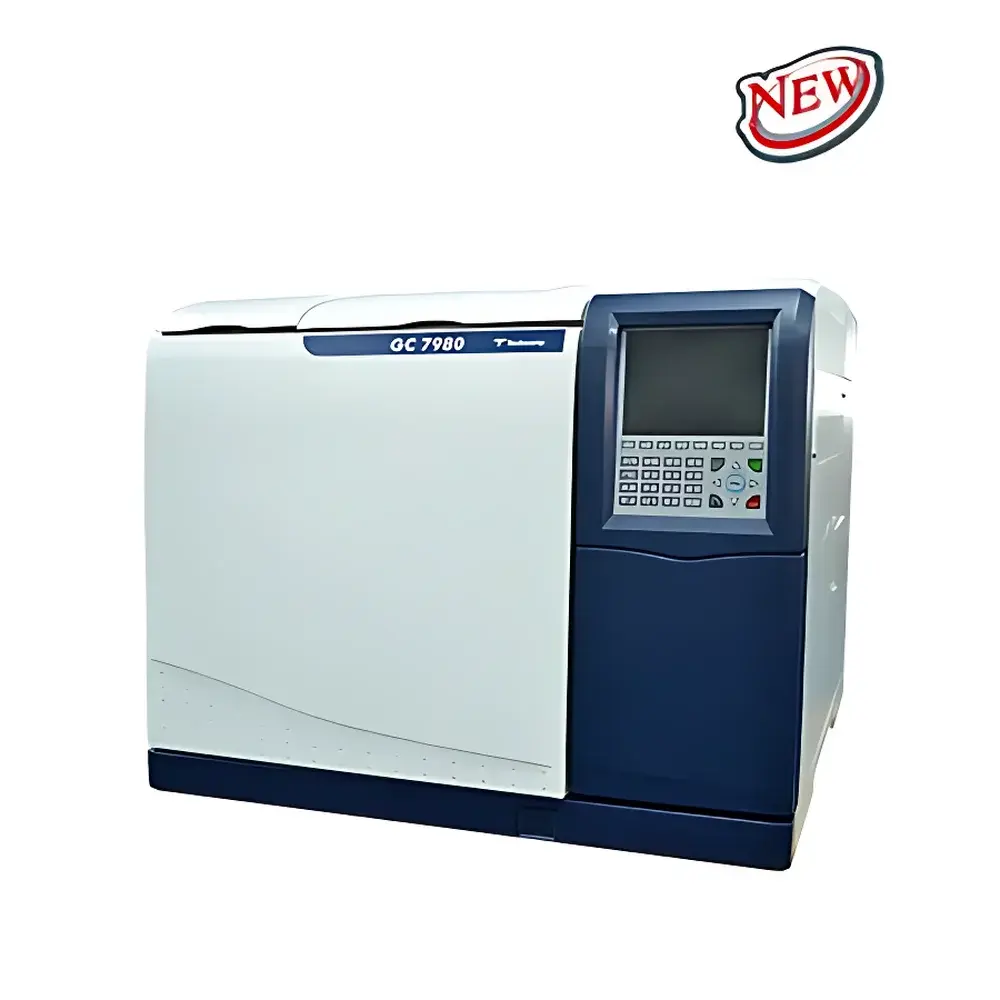
Techcomp GC7980Plus Laboratory Gas Chromatograph
| Brand | Techcomp |
|---|---|
| Origin | Shanghai, China |
| Manufacturer Type | Original Equipment Manufacturer (OEM) |
| Instrument Type | Laboratory Gas Chromatograph |
| Application Scope | General-Purpose |
| Oven Temperature Range | Ambient to 450 °C |
| Carrier Gas Flow Control Range | 0–1500 mL/min |
| Carrier Gas Pressure Control Range | 0–150 psi |
| Injector Maximum Operating Temperature | 450 °C |
| Injector Pressure Setting Range | 0–150 psi |
| Injector Total Flow Setting Range | 0–1500 mL/min |
Overview
The Techcomp GC7980Plus is a high-performance, general-purpose laboratory gas chromatograph engineered for precision, robustness, and regulatory compliance in routine and method-developed analytical workflows. Built upon the proven GC7980 platform and enhanced with select core technologies licensed from Thermo Fisher Scientific’s former Serian division, the GC7980Plus implements a fully electronic pressure and flow control (EPC/EFC) architecture—enabling reproducible carrier gas delivery across wide dynamic ranges. Its measurement principle relies on differential partitioning of volatile and semi-volatile analytes between a mobile phase (inert carrier gas) and a stationary phase (capillary column), followed by selective detection—primarily via flame ionization detection (FID). Designed for 24/7 operation in QC, environmental, pharmaceutical, and forensic laboratories, the system delivers consistent retention time stability (<0.02 min RSD), baseline noise 10⁷ for FID—meeting essential performance criteria defined in ASTM D3606, ISO 10301, and USP .
Key Features
- Electronic Flow Control (EFC) modules with pressure resolution down to 0.001 psi—ensuring sub-mL/min repeatability across temperature gradients and column backpressure fluctuations.
- Modular hardware architecture: independently replaceable oven, injector, detector, and gas control units—minimizing downtime during maintenance or functional upgrades.
- High-throughput split/splitless inlet with active pressure regulation, capable of handling sample volumes from 0.1–10 µL and supporting fast-cycle injection sequences (≤15 s cycle time).
- FID with ceramic jet nozzle and optimized hydrogen–air mixing geometry—delivering symmetric peak shapes, reduced carbon buildup, and extended detector lifetime (>12 months under standard operating conditions).
- Open hardware interface compliant with IEEE 488.2 and RS-232/USB protocols—enabling integration with third-party autosamplers, valve controllers, and hyphenated systems (e.g., GC–MS prep interfaces).
- CompassCDS Chromatography Data System (CDS) with bilingual UI (English/Chinese), full audit trail, electronic signatures, and built-in FDA 21 CFR Part 11 compliance tools—including user role-based access control, instrument event logging, and immutable raw data archiving.
Sample Compatibility & Compliance
The GC7980Plus supports a broad spectrum of volatile organic compounds (VOCs), residual solvents, hydrocarbons, pesticides, fatty acid methyl esters (FAMEs), and dissolved gases—compatible with fused-silica capillary columns (0.1–0.53 mm ID, up to 60 m length). It meets GLP/GMP operational requirements through hardware-level interlocks (oven overtemperature cutoff, detector flame-out sensing) and software-enforced workflow controls. All system validation documentation—including IQ/OQ/PQ templates, calibration certificate traceability to NIST SRMs, and 21 CFR Part 11 configuration reports—is supplied as standard. The instrument conforms to IEC 61010-1 safety standards and electromagnetic compatibility (EMC) per EN 61326-1.
Software & Data Management
CompassCDS provides a validated, single-platform environment for method development, acquisition, processing, reporting, and long-term data governance. Raw data files (.cdf) are stored in vendor-neutral format with embedded metadata (instrument parameters, sequence logs, user actions). The system supports automated report generation compliant with ISO/IEC 17025 clause 7.8.2, including uncertainty estimation for quantitative results. Audit trails record all critical events—method edits, integration parameter changes, reprocessing actions—with timestamp, operator ID, and IP address. Data backup and restoration follow AES-256 encryption protocols; archive integrity is verified via SHA-256 checksums.
Applications
- Food safety: Pesticide multiresidue analysis (EU MRLs), mycotoxin derivatization, and flavor volatile profiling.
- Pharmaceutical QC: Residual solvent testing per ICH Q3C guidelines (Classes 1–3), extractables/leachables screening in packaging studies.
- Clinical toxicology: Quantitative ethanol and volatile substance analysis in whole blood (forensic BAC protocols).
- Environmental monitoring: EPA TO-17 compliant analysis of ambient air VOCs (e.g., benzene, toluene, xylenes) and indoor TVOC assessment.
- Petrochemical QA: Gasoline oxygenates (MTBE, ETBE, TAME), hydrocarbon type analysis (PIONA), and refinery gas composition (C1–C5).
- Electrical insulation diagnostics: Dissolved gas analysis (DGA) in transformer oil per ASTM D3612 and IEC 60567—detecting H₂, CH₄, C₂H₂, C₂H₄, C₂H₆, CO, and CO₂.
FAQ
Is the GC7980Plus compatible with third-party mass spectrometers?
Yes—the system features standard GC–MS interface dimensions (7/16″-20 UNF) and analog/digital signal outputs (TTL-ready detector triggers, 0–10 V analog output) for seamless coupling with benchtop and quadrupole MS detectors.
Does CompassCDS support LIMS integration?
Yes—via ASTM E1578-compliant middleware and configurable ODBC drivers; validated interfaces exist for Thermo Fisher SampleManager, LabWare LIMS, and STARLIMS.
What column oven ramp rates are supported?
Programmable heating rates from 0.1 °C/min to 120 °C/min, with up to 32 temperature segments per method and hold times from 0.01 to 999.99 min.
Can the system operate unattended overnight?
Yes—equipped with auto-shutdown logic, flame-out recovery, and sequence queue management supporting up to 999 sample injections per batch with real-time error logging.
Is hardware calibration traceable to international standards?
All factory calibrations (temperature, flow, pressure, detector response) are traceable to NIST-certified reference materials and documented per ISO/IEC 17025 Annex A.2 requirements.



