
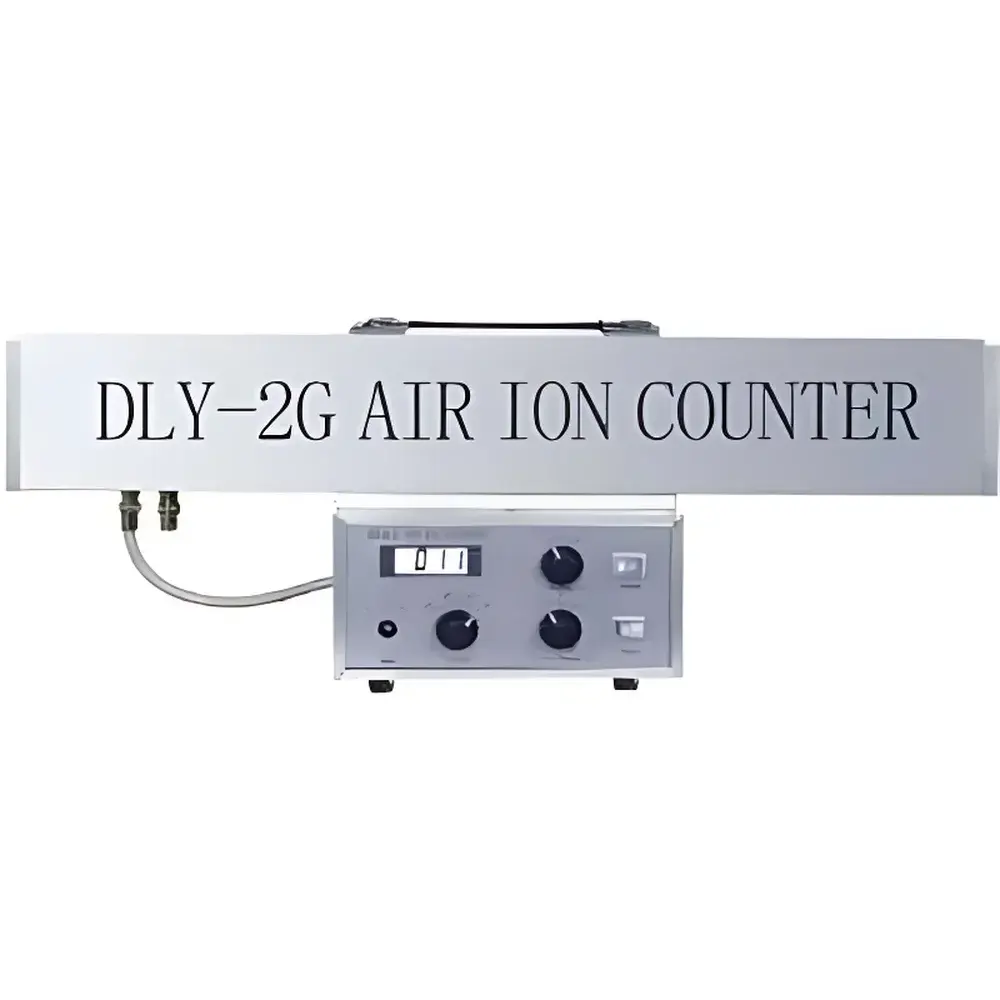
DLY-2G Air Ion Concentration Analyzer
| Origin | Beijing, China |
|---|---|
| Manufacturer Type | Authorized Distributor |
| Origin Category | Domestic (China) |
| Model | DLY-2G |
| Pricing | Available Upon Request |
| Ion Concentration Range | 10–1.999×10⁹ ions/cm³ |
| Resolution | 10 ions/cm³ |
| Ion Mobility Ranges | 0.15, 0.04, and 0.004 cm²/V·s (3 selectable ranges) |
| Air Sampling Velocity | 180 cm/s or 35 cm/s |
| Response Time Constant | ~15 s |
| Accuracy | ±10% for ion concentration and ion mobility |
| Power Supply | DC 14.4 V (rechargeable sealed battery), AC 220 V / 110 V (optional) |
| Operating Environment | −0 to +40 °C, ≤90% RH (short-term operation permitted above 90% RH) |
Overview
The DLY-2G Air Ion Concentration Analyzer is a precision electrostatic measurement instrument engineered for quantitative detection of unipolar and bipolar air ions—both positive and negative—in ambient environments and controlled emission sources. It operates on the well-established parallel-plate air ion collector principle, originally advanced by internationally recognized air ion researcher Dr. Beckett and refined through Wesix methodology. Unlike corona-based or cylindrical collector designs, the DLY-2G employs a custom-fabricated gold-plated parallel-plate ion collector, which significantly enhances charge collection efficiency and minimizes surface recombination losses—critical for reliable low-concentration measurements. The instrument directly measures ion current generated by charged particles drifting under a defined electric field, then converts it into ion number density (ions per cubic centimeter) using calibrated airflow velocity and plate geometry. Its dual-mode sampling (180 cm/s for high-flow outdoor surveys; 35 cm/s for stable indoor or chamber-based monitoring) ensures adaptability across field, laboratory, and clinical settings. Designed for long-term stability in variable humidity conditions, the DLY-2G meets internationally accepted calibration protocols aligned with ISO 20675:2020 (Air quality — Measurement of gaseous and particulate air ions) and supports traceable metrology workflows.
Key Features
- Gold-plated parallel-plate ion collector ensuring >92% charge transfer efficiency and minimal drift over extended operation
- Triple-range ion mobility selection (0.15, 0.04, 0.004 cm²/V·s) enabling discrimination between small, medium, and large ions—essential for aerosol electrophysiology and atmospheric electricity studies
- High-resolution display showing real-time ion concentration (10–1.999×10⁹ ions/cm³) with 10 ions/cm³ minimum detectable increment
- Integrated rechargeable sealed lead-acid battery (14.4 V DC), supporting continuous field deployment up to 8 hours; compatible with AC 220 V / 110 V mains or automotive 12 V DC input for flexible charging
- Robust anodized aluminum chassis (IP54-rated enclosure) providing mechanical durability, thermal stability, and electromagnetic shielding—optimized for mobile environmental surveys and educational lab use
- Calibration traceable to national standards laboratories; factory-certified against reference ion generators per IEC 61000-4-2 and ISO/IEC 17025-compliant procedures
Sample Compatibility & Compliance
The DLY-2G is validated for direct sampling of ambient air, indoor environments, forested microclimates, therapeutic ionizer outputs, HVAC duct streams, and cleanroom exhausts. It accommodates both laminar and turbulent flow profiles within its specified velocity ranges. The instrument complies with key regulatory and methodological frameworks including ASTM D8192-22 (Standard Guide for Measuring Air Ion Concentrations), WHO Technical Report Series No. 996 (Indoor Air Quality Guidelines), and EU Directive 2008/50/EC Annex IX (reference methods for airborne particle characterization). Its ±10% measurement uncertainty at full scale satisfies GLP requirements for environmental monitoring programs and academic research reporting. No sample pretreatment, filtration, or dilution is required—measurements are conducted in situ without altering native ion size distribution or polarity balance.
Software & Data Management
While the DLY-2G operates as a standalone field instrument with integrated LCD readout, optional RS-232/USB data logging modules enable time-synchronized acquisition (1 Hz default, configurable up to 10 Hz) and export to CSV or Excel-compatible formats. Firmware supports timestamped metadata embedding (temperature, RH, operator ID, location tag via external GPS module). Raw ion current and mobility-mode status are retained alongside calculated concentration values—ensuring full auditability for QA/QC review. Data files comply with FDA 21 CFR Part 11 requirements when used with validated third-party software platforms supporting electronic signatures and change control logs. Internal memory retains ≥72 hours of continuous measurement history even during power interruption.
Applications
- Environmental health assessment: correlation of negative ion concentrations with PM₂.₅, ozone, and VOC levels in urban, rural, and alpine zones
- Clinical and wellness research: evaluation of ion therapy devices, hospital ventilation efficacy, and post-occupancy indoor air quality validation
- Educational instrumentation: undergraduate physics labs studying atmospheric electricity, gas-phase ion kinetics, and electrostatic precipitation principles
- Industrial hygiene: verification of ionizer performance in electronics manufacturing cleanrooms and printing facilities
- Ecological monitoring: longitudinal studies linking forest canopy ion emissions to photosynthetic activity and terpene volatility
FAQ
What ion mobility ranges does the DLY-2G support, and how are they selected?
The instrument offers three discrete mobility settings (0.15, 0.04, and 0.004 cm²/V·s), manually selected via front-panel switch to match expected ion size classes—small ions (7.5 nm)—in accordance with standard atmospheric ion classification systems.
Is the DLY-2G suitable for high-humidity environments such as rainforests or coastal sites?
Yes—the gold-plated collector and sealed internal electronics maintain operational integrity up to 90% RH continuously; short-term exposure above this threshold is permissible with no permanent degradation, though condensation must be avoided on the inlet aperture.
Does the device require annual recalibration, and what documentation is provided?
A full calibration certificate (including uncertainty budget per ISO/IEC 17025) is issued with each unit; biennial recalibration is recommended for compliance-critical applications, with traceable reference to NIM (National Institute of Metrology, China) or equivalent national metrology institutes.
Can the DLY-2G differentiate between positive and negative ions in a single measurement cycle?
No—it measures net unipolar concentration per cycle; polarity-specific readings require sequential measurement under reversed electric field polarity, a procedure documented in the user manual and supported by internal voltage polarity switching.
Is firmware upgrade capability available, and how is it performed?
Firmware updates are delivered via secure download and installed using the included USB-to-serial adapter and Windows-compatible configuration utility; version history and release notes are published in the technical support portal.







