
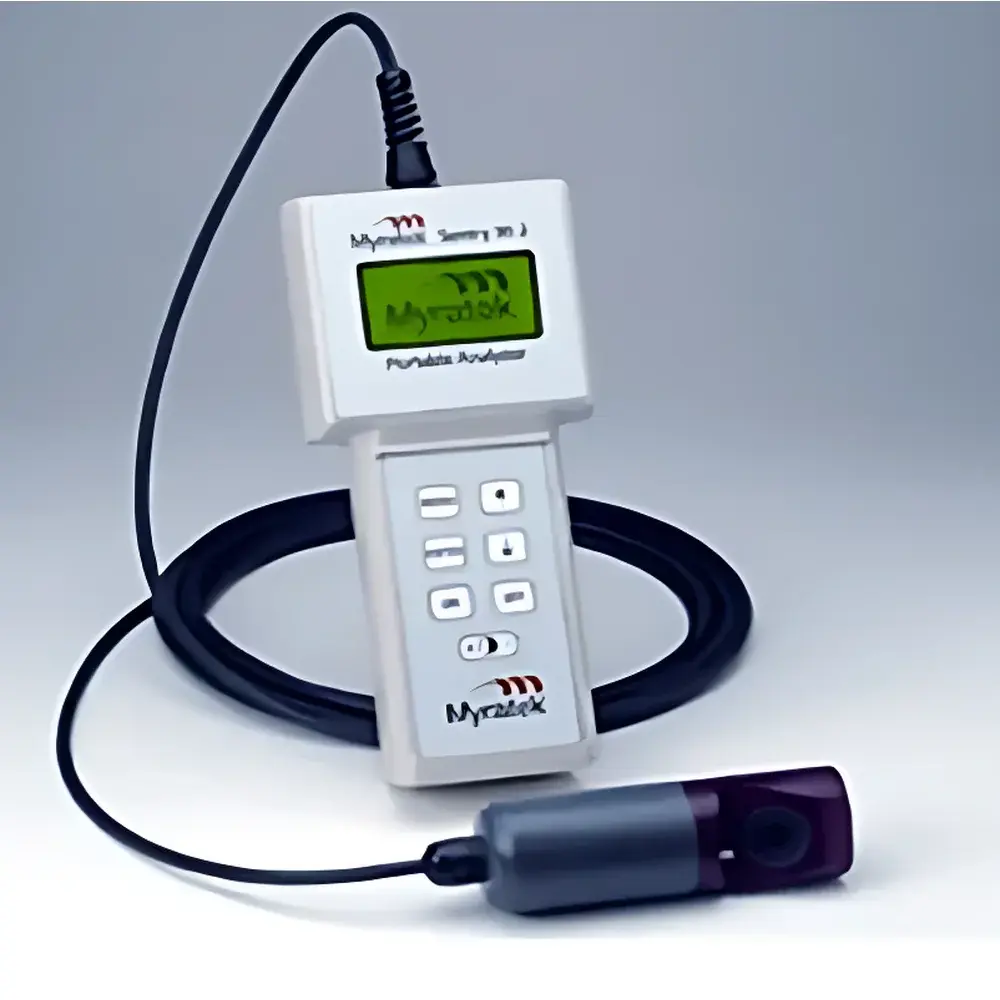
MSS-2 Portable Suspended Solids (SS) Analyzer – Imported from USA
| Origin | USA |
|---|---|
| Manufacturer Type | Authorized Distributor |
| Import Status | Imported |
| Model | MSS-2 |
| Instrument Type | Portable |
| Measurement Principle | Infrared Absorption Photometry |
| Range | 0–30,000 mg/L (standard), 0–1,500 mg/L (low-range option) |
| Accuracy | ±3% of reading or ±20 mg/L (whichever is greater) |
| Resolution | 1 mg/L (<1,000 mg/L), 10 mg/L (1,000–9,999 mg/L), 100 mg/L (≥10,000 mg/L) |
| Repeatability | ±0.5% |
| Drift | <1% per year |
| Operating Temperature (Sensor) | 0–65°C |
| Ambient Temperature | −20–70°C |
| Humidity | 0–100% RH |
| IP Rating | IP66 |
| Pressure Rating | 100 PSI |
| Sensor Cable Length | 6.0 m |
| Display | Backlit graphical LCD with adjustable contrast |
| Data Storage | 50 internal records |
| Output Interface | RS-232 (optional) |
| Power | Rechargeable battery |
| Weight | ~1.8 kg |
Overview
The MSS-2 Portable Suspended Solids (SS) Analyzer is an industrial-grade, field-deployable optical instrument engineered for rapid, on-site quantification of total suspended solids in aqueous matrices. Designed and manufactured in the United States, it operates on the principle of infrared absorption photometry—employing a single-beam, dual-wavelength infrared emitter to minimize interference from water color, turbidity, and organic chromophores. Unlike nephelometric or gravimetric methods, the MSS-2 delivers real-time concentration values (in mg/L) without sample filtration, centrifugation, or drying steps. Its microprocessor-controlled architecture integrates automatic temperature compensation, self-diagnostic sensor verification, and real-time clock synchronization—enabling traceable, time-stamped measurements compliant with routine operational monitoring requirements in wastewater treatment, surface water assessment, and process control environments.
Key Features
- Infrared optical sensing technology optimized to reduce spectral interference from colored dissolved organic matter (CDOM) and particulate absorbance
- Two calibrated measurement ranges: standard (0–30,000 mg/L) and low-range (0–1,500 mg/L) for enhanced resolution in activated sludge (MLSS) and return activated sludge (RAS) applications
- IP66-rated rugged housing constructed from epoxy-coated aluminum, polyurethane, and PVC—certified for outdoor, wet, and chemically aggressive environments
- Backlit graphical LCD with user-adjustable contrast and intuitive menu navigation—designed for glove-compatible operation in low-light field conditions
- Integrated rechargeable battery system supporting continuous operation for >12 hours; includes low-battery warning and auto-sleep mode
- Onboard real-time clock (RTC) with date/time stamping for all stored measurements—critical for trend analysis and regulatory log integrity
- Automatic sensor health diagnostics—including LED intensity verification, ambient light rejection check, and thermal drift validation
Sample Compatibility & Compliance
The MSS-2 is validated for direct immersion measurement in diverse water matrices: secondary effluent, aerated mixed liquor, primary clarifier outflow, RAS streams, and natural surface waters. It does not require sample homogenization or dilution for concentrations within its specified range. The sensor’s optical path geometry and infrared wavelength selection (typically 850 nm) conform to ASTM D5907–22 guidelines for suspended solids estimation where rapid field screening is acceptable prior to laboratory confirmation. While not a replacement for gravimetric SS (EPA Method 160.2), the MSS-2 meets performance criteria for operational control under ISO 5667-3:2018 (water sampling — guidance on preservation and handling) and supports GLP-aligned data capture when used with timestamped logging. Its IP66 enclosure and 100 PSI pressure rating ensure reliable deployment in submersible or pressurized conduit applications.
Software & Data Management
Data output is supported via optional RS-232 serial interface, enabling direct connection to portable PCs, data loggers, or SCADA front-ends using standard ASCII protocols. Internal memory retains up to 50 measurement records—including concentration value, timestamp, temperature reading, and sensor status flag—with no external storage dependency. All entries are immutable post-capture; no editing or deletion functionality is provided to preserve audit trail integrity. When integrated into facility-wide monitoring systems, the MSS-2 supports alignment with FDA 21 CFR Part 11 requirements through externally managed electronic signatures and access-controlled data export workflows. Firmware updates are performed via secure UART interface under controlled engineering procedures.
Applications
- Real-time monitoring of MLSS and RAS concentrations in activated sludge basins to optimize aeration and sludge wasting rates
- Effluent quality verification at wastewater treatment plant discharge points—supporting NPDES permit compliance reporting
- Rapid assessment of sediment resuspension events in rivers, reservoirs, and stormwater retention ponds
- Sludge blanket depth profiling in clarifiers using vertical probe profiling (with optional extension cable)
- Calibration verification and cross-validation against lab-based gravimetric SS measurements during QA/QC audits
- Field surveys for environmental impact assessments (EIAs) and watershed management programs requiring spatially distributed SS mapping
FAQ
Does the MSS-2 require periodic calibration with reference standards?
Yes—initial two-point calibration (zero and span) is required before first use and recommended after every 30 days of continuous operation or following exposure to fouling-prone samples. NIST-traceable SS suspensions (e.g., Formazin or polymer-based standards) are advised.
Can the MSS-2 be used in seawater or high-salinity brines?
The sensor is rated for freshwater and secondary-treated wastewater. Salinity >5,000 µS/cm may affect baseline stability due to refractive index shifts; empirical recalibration is advised for marine applications.
Is the 6-meter cable length fixed, or can it be extended?
The standard cable is integral and non-modifiable. Custom-length cables (up to 30 m) are available as factory-configured options with signal integrity validation.
How does the instrument compensate for temperature-induced LED drift?
An integrated thermistor continuously monitors emitter junction temperature; firmware applies real-time gain correction to maintain optical output consistency across 0–65°C.
What maintenance is required between field deployments?
Rinse the optical window with deionized water after each use; inspect for scratches or biofilm; store with protective cap in dry, ambient conditions. Quarterly cleaning with isopropyl alcohol is recommended for heavy-duty use.
Related Products







