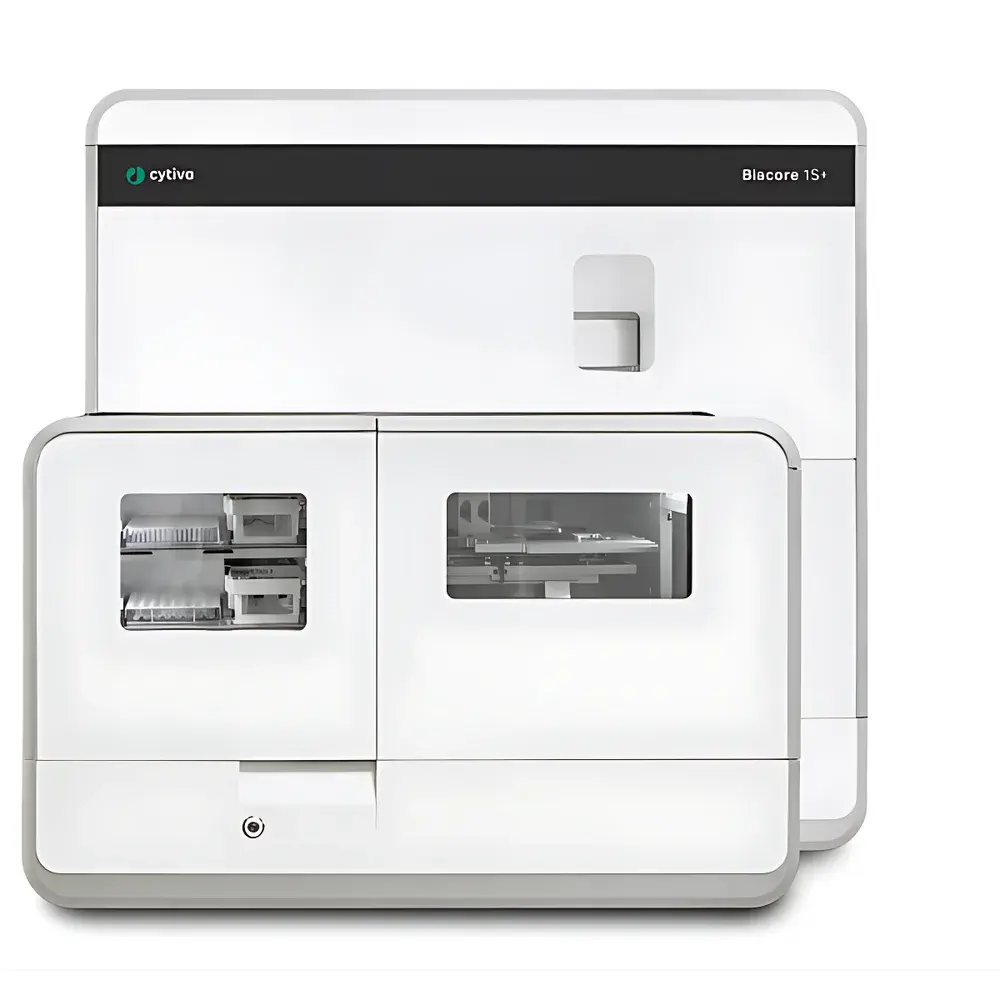
Cytiva Biacore 1S+ Surface Plasmon Resonance (SPR) Molecular Interaction System
| Brand | Cytiva |
|---|---|
| Origin | Sweden |
| Manufacturer Type | Authorized Distributor |
| Origin Category | Imported |
| Model | Biacore 1S+ SPR System |
| Instrument Type | Surface Plasmon Resonance (SPR) |
| Flow Cell Configuration | Six parallel flow cells |
| Detection Range | fM to mM |
| Sample Capacity | Up to two 96-well or 384-well microplates plus 21–43 additional sample positions |
| Analysis Time per Cycle | 2–15 minutes |
| Temperature Control Range | 4–37°C |
Overview
The Cytiva Biacore 1S+ is a single-injection, six-flow-cell surface plasmon resonance (SPR) biosensor system engineered for high-sensitivity, label-free molecular interaction analysis in life science research and early-stage biopharmaceutical development. Based on the physical principle of refractive index changes at a gold sensor surface upon biomolecular binding, the Biacore 1S+ detects real-time association and dissociation kinetics without requiring fluorescent or enzymatic labels. Its optical architecture leverages angular interrogation of SPR shifts with sub-arcsecond resolution, enabling quantitative measurement of binding affinities (KD), rate constants (ka, kd), stoichiometry, and concentration across a broad dynamic range—from femtomolar (fM) to millimolar (mM). Designed for robustness in shared core facilities and regulated environments, the system integrates precision fluidics, thermally stabilized sensor surfaces, and low-drift optical detection to ensure high reproducibility between runs and across laboratories.
Key Features
- Single-injection, six-flow-cell architecture: Enables sequential or parallel analysis of up to six ligand-analyte pairs per cycle—ideal for comparative binding studies, epitope binning, or concentration series without re-injection.
- Enhanced sensitivity and kinetic resolution: Optimized sensor chip surface chemistry and signal-to-noise ratio support reliable detection of weak, transient, or low-abundance interactions—including membrane proteins, intrinsically disordered regions, and small-molecule binders.
- Expanded sample handling capacity: Accommodates up to two standard 96-well or 384-well microplates, plus 21–43 auxiliary positions for standards, controls, or regeneration solutions—reducing manual intervention during unattended overnight runs.
- Programmable temperature control (4–37°C): Maintains thermal stability ±0.1°C across the entire sensor surface, critical for studying temperature-dependent binding thermodynamics or mimicking physiological conditions.
- Integrated buffer selection and automated priming: A 12-position buffer selector enables seamless switching between running buffers, regeneration solutions, and reference corrections—minimizing carryover and improving assay robustness.
Sample Compatibility & Compliance
The Biacore 1S+ supports diverse biomolecular classes including monoclonal antibodies, recombinant proteins, peptides, nucleic acids, glycans, and small molecules (MW < 200 Da). Sensor chips (e.g., CM5, SA, NTA, L1) are compatible with amine coupling, streptavidin-biotin, Ni-NTA, and liposome capture strategies. The system meets essential regulatory requirements for method development and characterization: it supports audit trails, electronic signatures, and data integrity features when configured with the optional GxP Software Package—enabling compliance with FDA 21 CFR Part 11, EU Annex 11, and ICH guidelines. All instrument firmware and software updates follow Cytiva’s formal change control process, documented via Change Control Notifications (CCN) accessible through the Regulatory Support Portal.
Software & Data Management
Biacore Insight™ software provides an integrated platform for experimental design, real-time monitoring, automated data processing, and reporting. It includes preconfigured analysis templates for steady-state affinity, global kinetic fitting, heterogeneity modeling, and epitope mapping. Raw sensorgrams are stored in vendor-neutral .txt and .xml formats; processed results export to Excel, PDF, or CSV for integration into LIMS or ELN systems. The software supports batch processing of hundreds of cycles and includes built-in quality metrics (e.g., Rmax deviation, χ² residuals, double-referencing efficiency) to flag outliers prior to interpretation. For regulated workflows, the GxP Software Package adds role-based access control, electronic signature enforcement, and full audit trail logging compliant with ALCOA+ principles.
Applications
- Characterization of antibody-antigen binding kinetics and affinity during lead selection
- Epitope binning and mapping using competition assays with orthogonal immobilization chemistries
- Small-molecule fragment screening against challenging targets (e.g., protein-protein interfaces)
- Stability assessment of binding complexes under varied pH or temperature conditions
- Quantitative determination of active concentration in crude expression supernatants or purified fractions
- Method validation for QC release testing of biologics in non-GMP or GMP-adjacent settings
FAQ
What sensor chips are compatible with the Biacore 1S+?
The system supports all standard Biacore sensor chips—including CM5 (amine coupling), SA (streptavidin), NTA (Ni²⁺-NTA for His-tagged proteins), L1 (liposome capture), and C1 (carboxymethylated dextran for direct immobilization).
Can the Biacore 1S+ be used in a GLP or GMP environment?
Yes—when equipped with the optional GxP Software Package and operated under validated SOPs, the system supports data integrity requirements for GLP studies and early-phase GMP process characterization.
Is remote monitoring or unattended operation supported?
Yes—the system supports overnight and weekend runs with full status logging. Remote access to run status and sensorgram previews is available via secure network connection using Biacore Insight Web Client.
How does the six-flow-cell configuration improve experimental throughput?
It allows multiplexed referencing, internal controls, and simultaneous comparison of multiple analytes or ligands—reducing total assay time by up to 60% compared to single-channel SPR systems performing equivalent experiments serially.
What service options are available for long-term instrument maintenance?
Cytiva OptiRun™ service plans provide customizable coverage—including preventive maintenance, priority technical support, calibration verification, and extended warranty—aligned with laboratory asset management goals and operational continuity requirements.