
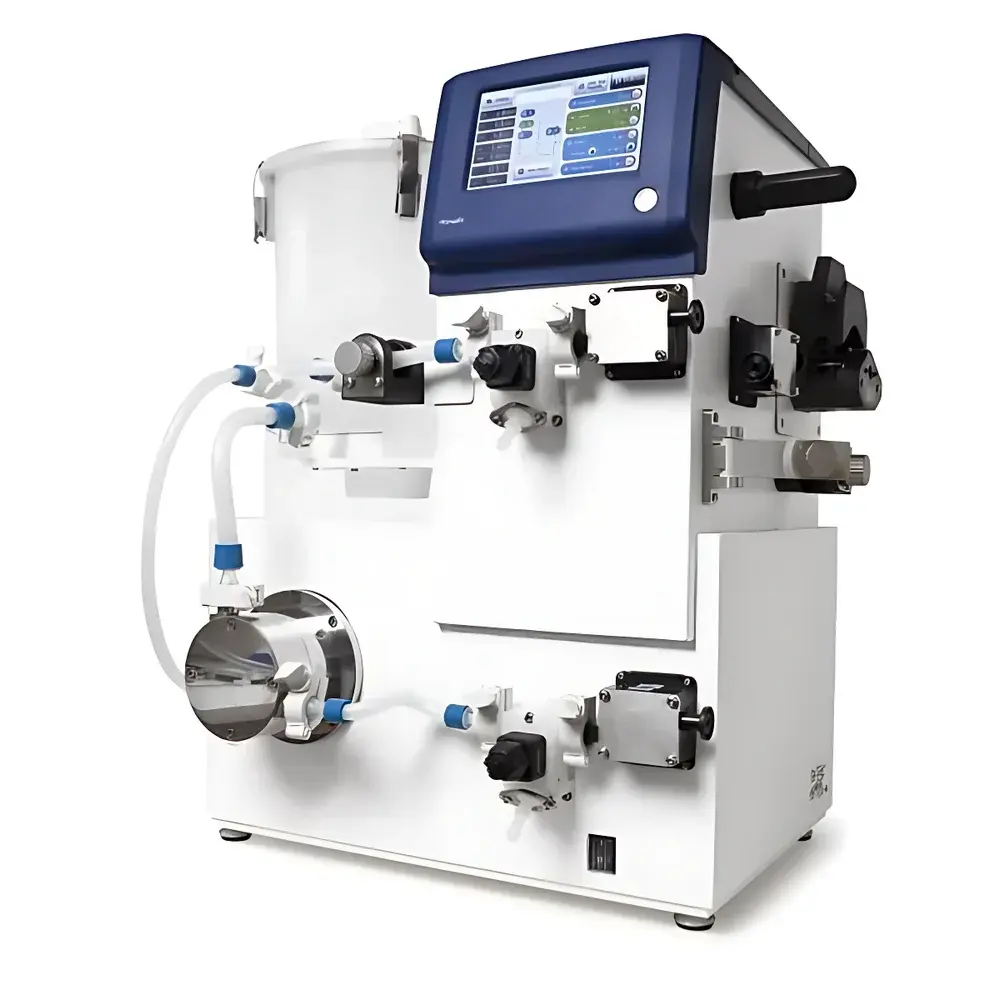
Cytiva ÄKTA flux 6 Tangential Flow Filtration System
| Brand | Cytiva |
|---|---|
| Origin | Sweden |
| Model | ÄKTA flux 6 |
| Application Scope | Process Development & Small-Scale Production |
| Control Mode | Automated Endpoint & Constant Retentate Volume (CRV) |
| Data Handling | Real-Time Logging with Audit-Trail-Capable Software |
| Regulatory Compliance | Designed for GMP Environments |
| Installation & Qualification | IQ/OQ Support Available by Certified Engineers |
| User Interface | Integrated Touchscreen HMI |
Overview
The Cytiva ÄKTA flux 6 Tangential Flow Filtration (TFF) System is an engineered platform for scalable, reproducible bioprocess operations including cell harvest, clarification, concentration, and buffer exchange (diafiltration). Based on the well-established principle of tangential flow—where feed stream flows parallel to the membrane surface to minimize fouling and maintain stable transmembrane pressure—the system enables high recovery yields and consistent product quality across development and early-stage manufacturing workflows. Unlike dead-end filtration, TFF preserves macromolecular integrity by reducing shear-induced aggregation and membrane clogging, making it particularly suitable for sensitive biologics such as monoclonal antibodies, viral vectors, exosomes, and recombinant proteins. The ÄKTA flux 6 integrates seamlessly into end-to-end purification strategies, serving as a validated companion to Cytiva’s ÄKTA chromatography platforms for integrated upstream–downstream process development.
Key Features
- Automated endpoint control: Programmable termination criteria based on volume reduction ratio, conductivity, UV absorbance, or time—ensuring precise process consistency across runs.
- Constant Retentate Volume (CRV) mode: Maintains defined retentate volume during diafiltration via real-time permeate flow modulation, critical for maintaining solute stability and minimizing concentration polarization.
- Low minimum working volume: Supports processing down to 50 mL retentate volume, enabling efficient use of precious samples during process optimization and clone screening.
- Modular membrane compatibility: Accepts standard single-use cassettes (e.g., Pellicon® 3, Sartocon® Slice) and hollow-fiber modules (e.g., 10–500 kDa MWCO), with quick-connect fluid paths and integrated air bubble detection.
- GMP-aligned architecture: Constructed with 316L stainless steel wetted parts, EPDM/silicone-free fluidic pathways, and electropolished surfaces compliant with ASME BPE-2022 surface finish standards.
- Integrated touchscreen HMI: 10.4-inch resistive touch display with intuitive workflow navigation, preloaded method templates, and password-protected user roles (Operator, Supervisor, Administrator).
Sample Compatibility & Compliance
The ÄKTA flux 6 accommodates a broad range of biological feedstreams—including mammalian and microbial cell culture harvests, clarified lysates, virus-containing supernatants, and purified protein solutions—without requiring pre-filtration beyond 0.22 µm depth filtration. It supports both low-flux microfiltration (0.1–0.45 µm) and high-selectivity ultrafiltration (1–500 kDa MWCO). All system documentation—including Design Qualification (DQ), Factory Acceptance Test (FAT), and Site Acceptance Test (SAT) protocols—is structured to align with ICH Q5A(R2), ISO 20387:2018 (biobanking), and EU Annex 11 requirements. When deployed in regulated environments, the system supports 21 CFR Part 11-compliant electronic records through UNICORN software integration, including audit trail generation, electronic signatures, and data integrity validation per ALCOA+ principles.
Software & Data Management
Control and monitoring are executed via UNICORN 7.4 or later, Cytiva’s validated chromatography and filtration software platform. UNICORN provides full method scripting capability, real-time parameter visualization (TMP, flux, retentate volume, conductivity), and automated report generation in PDF/CSV formats. All process events—including pump start/stop, valve actuation, alarm triggers, and manual interventions—are timestamped and logged with immutable audit trails. Data export adheres to ASTM E2500-13 guidelines for raw data preservation, and backup routines support network-based storage with role-based access control. Optional integration with MES/SCADA systems is available via OPC UA protocol.
Applications
- Upstream clarification: Harvesting CHO or HEK293 cells at pilot scale with >95% viability retention and minimal hemolysis.
- Downstream concentration: Achieving 5–20× concentration factors for mAb intermediates prior to Protein A chromatography.
- Buffer exchange: Performing multi-cycle diafiltration for formulation buffer transition while maintaining pH and osmolality within ±0.1 unit and ±5 mOsm/kg tolerance.
- Viral vector processing: Clarifying lentiviral or AAV preparations using 0.22 µm microfiltration cassettes under laminar flow conditions.
- Process characterization studies: Generating design space maps for flux vs. TMP, shear rate vs. particle aggregation, and membrane fouling kinetics under DoE frameworks.
FAQ
Is the ÄKTA flux 6 suitable for sterile filtration applications?
No—it is not designed for final sterile filtration; it supports pre-sterile clarification and concentration. Final sterilization requires a dedicated 0.22 µm rated filter installed downstream.
Can the system be validated for GMP manufacturing?
Yes—Cytiva provides IQ/OQ documentation packages and qualified field engineers for installation and operational qualification in compliance with FDA and EMA expectations.
What membrane formats are natively supported?
Pellicon® 3 cassettes (MilliporeSigma), Sartocon® Slice (Sartorius), and Spectrum Labs hollow-fiber modules—with automatic recognition via RFID tags on select consumables.
Does the system support remote monitoring?
Remote access is enabled via secure VPN connection to UNICORN’s web-based interface, subject to local IT security policy and firewall configuration.
How is cleaning-in-place (CIP) performed?
CIP is executed programmatically using configurable NaOH, citric acid, or ethanol sequences with temperature and flow-rate control; validation reports include rinse water conductivity and TOC testing protocols.




