
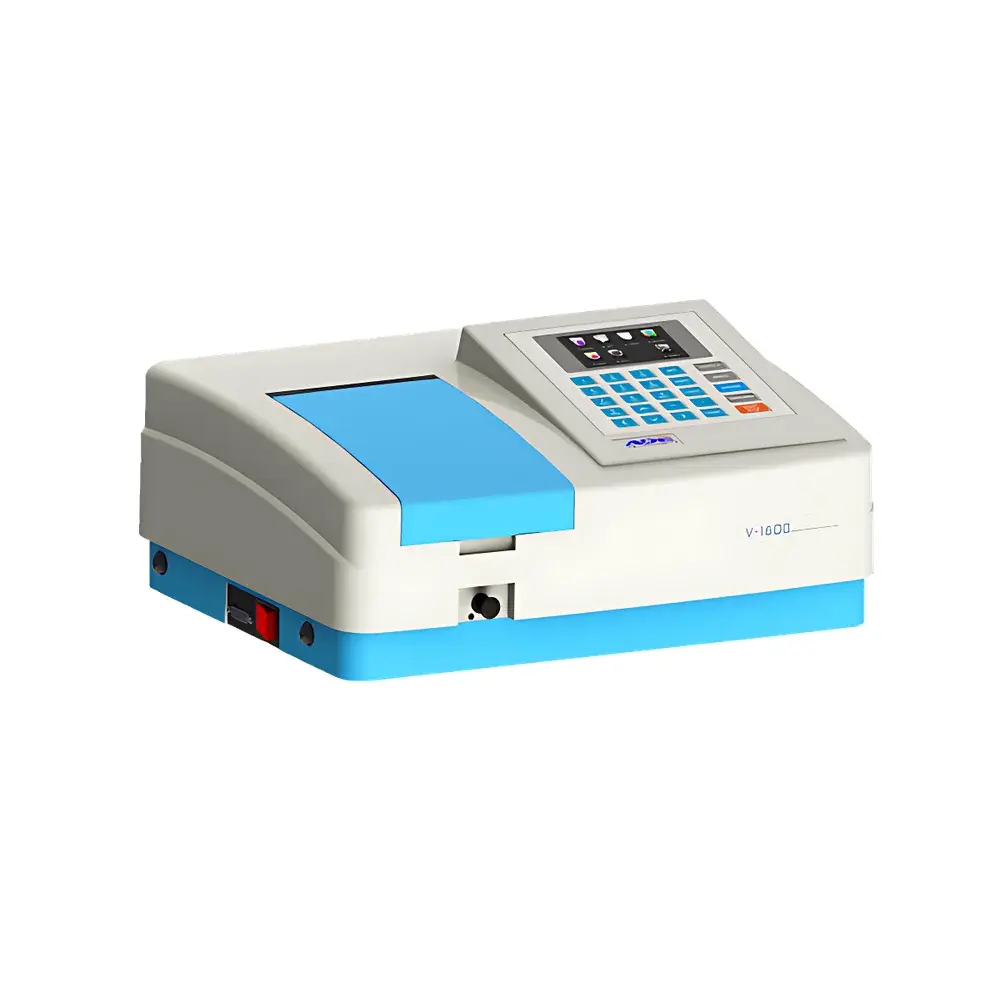
AOE V-1600PC Visible Spectrophotometer
| Brand | AOE |
|---|---|
| Origin | Shanghai, China |
| Manufacturer Type | Authorized Distributor |
| Country of Origin | China |
| Model | V-1600PC |
| Optical System | Pseudo-Double-Beam (Ratio-Monitoring) |
| Detector Type | Silicon Photocell |
| Wavelength Range | 320–1100 nm |
| Wavelength Accuracy | ±0.4 nm |
| Spectral Bandwidth | 4.0 nm |
| Stray Light | ≤0.04% T @ 360 nm |
| Wavelength Repeatability | ≤0.2 nm |
| Display | 480 × 272 pixel, 65K-color TFT LCD |
| Data Storage | 240 calibration curves (240 data points each) onboard |
| Interface | Dual USB 2.0 ports (data export & printer), USB 1.0 for PC connectivity |
| Software | AOE Basic Spectroscopy Suite (certified under China Copyright Protection Center, Registration No. 2021SRXXXXXX) |
| Compliance | ISO 9001:2015, CE, CMC, RoHS |
Overview
The AOE V-1600PC Visible Spectrophotometer is a precision optical instrument engineered for quantitative absorbance and transmittance measurements across the visible and near-infrared spectrum (320–1100 nm). It employs a pseudo-double-beam optical architecture with ratio-monitoring capability—utilizing a high-efficiency holographic grating (1200 lines/mm) to ensure stable photometric performance and minimize baseline drift during extended operation. Unlike true double-beam systems that split light temporally or spatially, this design uses a single beam with real-time reference monitoring via synchronized detector sampling, delivering high reproducibility without mechanical choppers or moving mirrors. The instrument operates in four fundamental modes: Absorbance (A), Transmittance (%T), Concentration (C), and Energy (E), supporting routine QC analysis, method validation, and educational laboratory applications where robustness, ease of use, and regulatory traceability are essential.
Key Features
- 65K-color 480 × 272-pixel TFT LCD display with intuitive graphical interface for real-time spectral visualization and menu navigation
- Onboard data storage capacity for up to 240 calibration curves, each accommodating 240 measurement points—enabling full method archiving without external software dependency
- Dual USB 2.0 interfaces: one dedicated to PCL-compatible A4 thermal or dot-matrix printer output; the other for direct U disk-based data export in CSV format
- Firmware upgrade capability via USB flash drive using authenticated firmware packages downloaded from AOE’s official support portal (instrument serial number required for access)
- Compliance-certified optical path design featuring low-stray-light optics (≤0.04% T at 360 nm) and wavelength accuracy maintained within ±0.4 nm across the full range
- Integrated silicon photocell detector optimized for stability and linearity over 0–100% T (equivalent to 0–3.0 A), with wavelength repeatability ≤0.2 nm
Sample Compatibility & Compliance
The V-1600PC accepts standard 10 mm square quartz or glass cuvettes (pathlength: 10 mm), compatible with aqueous, organic, and mildly corrosive solutions. Its optical design excludes UV-C (1100 nm), making it suitable for colorimetric assays (e.g., Bradford, Lowry, BCA), enzyme kinetics (NADH/NADPH at 340 nm), dye concentration profiling, and water quality parameters (e.g., nitrate at 355 nm, phosphate at 880 nm). Regulatory compliance includes ISO 9001:2015 certified manufacturing, CE marking per Directive 2014/30/EU (EMC) and 2014/35/EU (LVD), China Metrology Certification (CMC), and RoHS 2011/65/EU conformity. While not FDA 21 CFR Part 11–enabled out-of-the-box, its audit-ready firmware logging (timestamped calibration events, user ID tagging via optional login module) supports GLP/GMP-aligned documentation practices when deployed with controlled SOPs.
Software & Data Management
The included AOE Basic Spectroscopy Software is a Windows-compatible application registered with the China National Copyright Administration (Certificate No. 2021SRXXXXXX), ensuring intellectual property integrity and eliminating risks associated with unlicensed or cloned control platforms. The software enables spectral scanning, kinetic time-course acquisition, multi-wavelength quantitation, and Beer-Lambert curve fitting with residual error reporting. All exported CSV files contain metadata headers (wavelength, absorbance, date/time stamp, operator ID if logged), facilitating integration into LIMS environments or statistical analysis tools such as JMP or Minitab. Firmware updates preserve historical calibration coefficients and user-defined methods, maintaining continuity across version iterations without revalidation overhead.
Applications
- Pharmaceutical QC: Assay of active pharmaceutical ingredients (APIs) with characteristic visible chromophores (e.g., iron complexes, azo dyes, transition metal salts)
- Environmental testing: Quantification of heavy metals (e.g., Cr(VI) via diphenylcarbazide method at 540 nm), turbidity correction, and nutrient analysis (phosphate, silicate)
- Food & beverage: Color index measurement (CIE L*a*b* conversion supported), preservative concentration (e.g., nitrite), and enzymatic activity (peroxidase, polyphenol oxidase)
- Academic teaching: Demonstration of Beer-Lambert law, spectral deconvolution of mixtures, and validation of instrumental linearity per ASTM E275 and ISO 6059
- Industrial process control: In-line dye bath monitoring, pigment dispersion uniformity assessment, and polymer additive concentration verification
FAQ
Is the V-1600PC compliant with international pharmacopoeial standards such as USP <857>?
Yes—the instrument meets core requirements for photometric accuracy, wavelength verification, and stray light limits specified in USP <857> and EP 2.2.25 when operated with NIST-traceable holmium oxide and didymium filters for periodic qualification.
Can the onboard memory retain calibration data after power cycling?
Yes—calibration curves, zero/baseline settings, and wavelength alignment offsets are retained in non-volatile memory without battery backup.
Does the USB printer interface support modern Windows drivers?
It natively supports legacy PCL Level 3 printers; for newer models, a generic PCL5e driver or virtual printer-to-CSV redirection is recommended.
What is the maximum scan speed for full-spectrum acquisition?
Scanning at 1 nm intervals across 320–1100 nm takes approximately 120 seconds with default averaging (2 scans); speed can be adjusted via software configuration.
Is third-party software integration possible via RS-232 or Ethernet?
No—only USB 1.0 (PC link) and dual USB 2.0 (printer/data) are provided; no serial or network interface is embedded in the V-1600PC hardware platform.



