
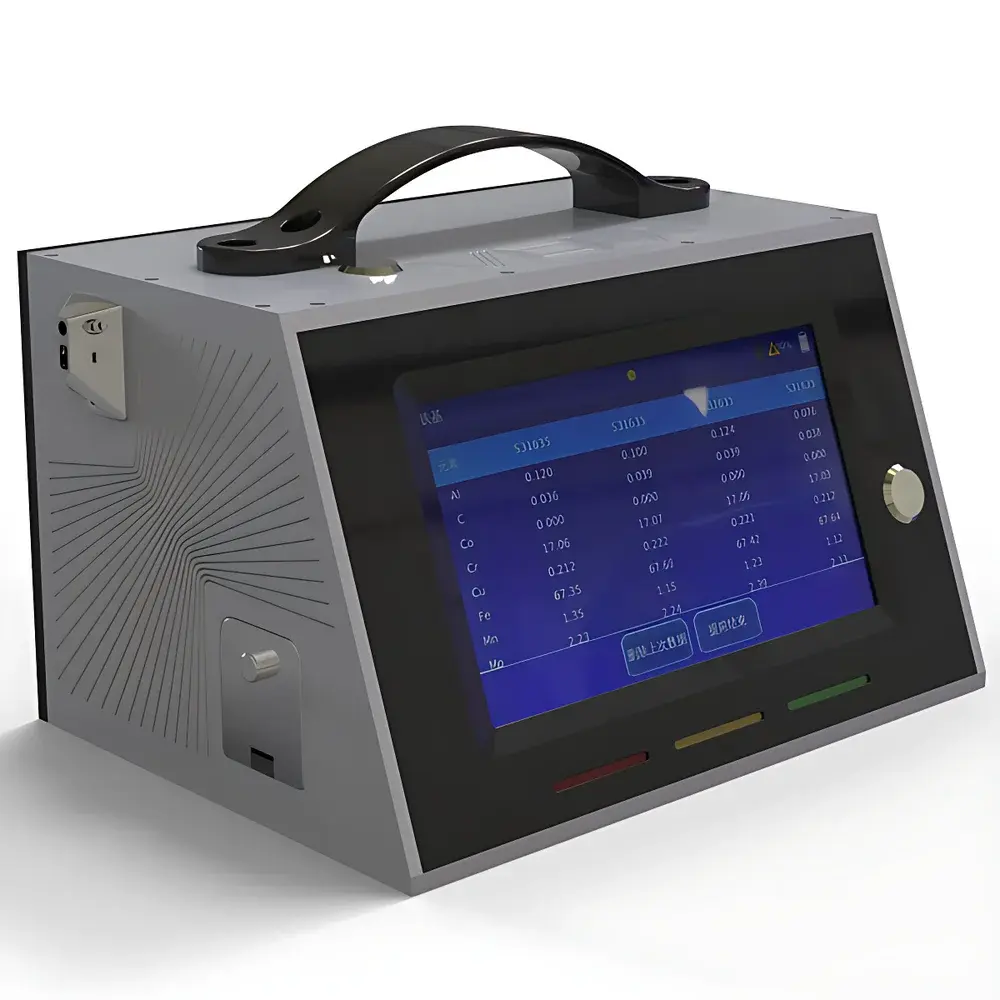
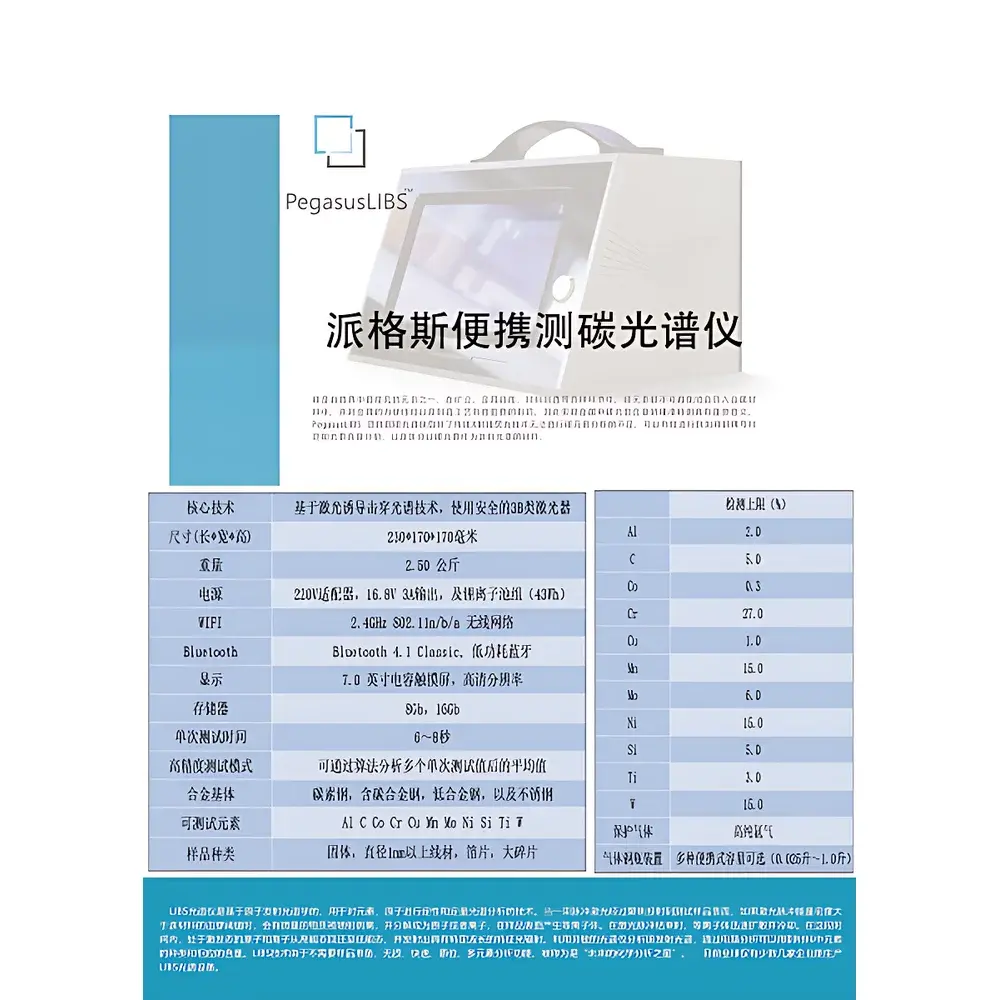
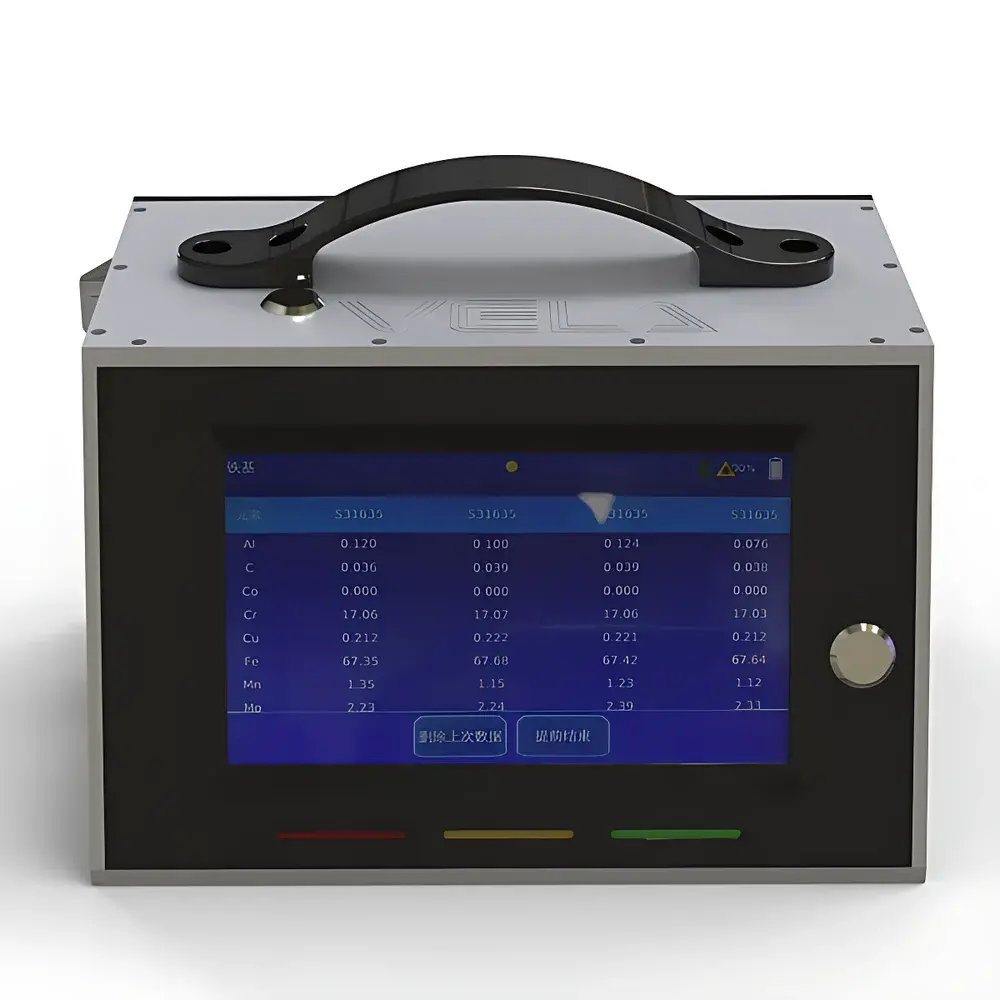
Velainstruments PEGASUS LIBS Desktop Carbon Analysis Spectrometer
| Brand | Velainstruments |
|---|---|
| Origin | Jiangsu, China |
| Manufacturer Type | Direct Manufacturer |
| Product Category | Domestic |
| Model | DESK PRO |
| Price Range | USD 14,000–43,000 |
| Instrument Type | Benchtop |
| Integration | Fully Integrated System |
| Laser Energy | 2–10 mJ |
| Laser Wavelength | 1064 nm |
| Elemental Detection Range | Al, C, Cr, Cu, Fe, Mn, Mo, Ni, Si, Ti, V, W |
| Operating Temperature | 0–40 °C |
| Display | Color Resistive Touchscreen |
| Connectivity | Bluetooth, Wi-Fi |
| Internal Memory | 512 MB RAM / 8 or 16 GB Industrial-Grade Flash Storage |
| OS | Linux-based Embedded System |
| Security | Password-Protected User Access Control |
| Supported Languages | English, Chinese, Japanese, Korean, German, French, Italian, Russian |
| Standard Accessories | Lockable Shielded Explosion-Proof Carrying Case |
| Ambient Gas Requirement | Argon Purge |
Overview
The Velainstruments PEGASUS LIBS Desktop Carbon Analysis Spectrometer (Model DESK PRO) is a benchtop laser-induced breakdown spectroscopy (LIBS) instrument engineered for quantitative and semi-quantitative elemental analysis—with particular emphasis on carbon determination in metallic alloys. Unlike conventional optical emission spectroscopy (OES) systems requiring vacuum or inert gas purging of the entire optical path, this system employs a localized argon purge directly at the sample ablation zone, enabling robust carbon signal enhancement while maintaining operational simplicity and reduced infrastructure dependency. The core measurement principle relies on nanosecond-pulsed 1064 nm laser irradiation to generate transient microplasmas on conductive solid samples; emitted atomic and ionic line spectra are collected via high-throughput Czerny–Turner spectrometer optics and resolved using a CCD detector with spectral coverage from 190 nm to 850 nm. Carbon detection—historically challenging due to its weak UV emission lines (e.g., C I at 247.86 nm) and strong atmospheric absorption—is stabilized through controlled argon shielding, optimized laser fluence (2–10 mJ), and proprietary spectral deconvolution algorithms trained on certified reference materials (CRMs) for stainless steels, aluminum alloys, and copper-based matrices.
Key Features
- Benchtop form factor with fully integrated laser source, spectrometer, sample stage, and embedded computing—no external PC required for routine operation.
- Dedicated carbon quantification capability validated against ASTM E2926-21 (Standard Test Method for Determination of Carbon in Steel by LIBS) and ISO 11577:2022 (Metallic materials — Laser-induced breakdown spectroscopy — General requirements).
- Resistive touchscreen interface with multi-language support (8 languages), offline calibration storage, and GLP-compliant audit trail logging for user actions and method changes.
- Industrial-grade flash storage (8 GB or 16 GB options) ensures secure retention of spectral libraries, calibration curves, and raw data files compliant with FDA 21 CFR Part 11 requirements when configured with electronic signature modules.
- Modular argon delivery system compatible with standard laboratory-grade argon cylinders (99.998% purity); purge flow rate and duration programmable per analysis sequence.
- Passive thermal management architecture—no liquid cooling or forced-air fans—ensures low acoustic noise (<45 dB) and long-term stability under continuous QC lab operation.
Sample Compatibility & Compliance
The DESK PRO supports flat, polished, or as-machined conductive metal samples (diameter ≥10 mm, thickness ≥1 mm), including austenitic/ferritic/martensitic stainless steels, 2xxx–7xxx series aluminum alloys, and Cu–Ni, Cu–Sn, and Cu–Zn brass/bronze compositions. Non-conductive or coated samples require metallization or mechanical cleaning prior to analysis. All hardware and firmware comply with IEC 61000-6-3 (EMC emission limits) and IEC 61010-1 (safety requirements for electrical equipment for measurement). The system meets CE marking directives for laboratory instrumentation and supports traceability to NIST-traceable CRMs (e.g., NIST SRM 1251–1257 series for carbon in steel).
Software & Data Management
The embedded Linux OS hosts Velainstruments’ proprietary SpectraLink™ software suite, featuring real-time plasma visualization, adaptive background subtraction, peak identification via NIST Atomic Spectra Database (ASD) v2023, and multivariate calibration models (PLS-R, PCA-LDA) for carbon concentration prediction. Data export formats include CSV, XML (ASTM E1382-compliant), and PDF reports with embedded spectral plots, confidence intervals, and measurement uncertainty estimates per ISO/IEC 17025:2017 Annex A. Remote diagnostics, firmware updates, and spectral library synchronization are supported via encrypted Wi-Fi or Ethernet. Audit logs record operator ID, timestamp, method version, and raw spectrum hash—fully compatible with GMP/GLP documentation workflows.
Applications
- Carbon verification in incoming raw material inspection for stainless steel billets and cold-rolled strips.
- In-process monitoring of decarburization depth in heat-treated components (e.g., bearing rings, gear blanks).
- Scrap sorting and alloy grade identification in recycling facilities where carbon content discriminates between 304 vs. 316 stainless or 6061 vs. 7075 aluminum.
- Research applications in metallurgical process development, including laser welding seam carbon segregation mapping and additive manufacturing powder feedstock homogeneity assessment.
- Support for ISO 9001 clause 8.5.2 (Identification and traceability) through barcode-linked sample metadata and automated report generation.
FAQ
Does the DESK PRO require vacuum or helium purging for carbon analysis?
No. Carbon detection is achieved using localized argon shielding over the ablation spot—eliminating need for full optical path purging.
Can the system analyze non-metallic samples such as ceramics or polymers?
Not without matrix-specific calibration and surface conditioning; primary design focus remains metallic conductors per ASTM E2926 and ISO 11577 scope.
What is the typical carbon measurement uncertainty for stainless steel at 0.03–0.15 wt% range?
Repeatability (n=10, same position) is ≤±0.008 wt% C; reproducibility (inter-day, same CRM) is ≤±0.015 wt% C under controlled lab conditions.
Is remote software support available outside China?
Yes—Velainstruments provides Tier-2 technical support with English-speaking engineers and remote desktop assistance via secure TLS-encrypted connection.
How is calibration maintained across different operators and shifts?
Calibration models are stored as signed digital objects; each user must authenticate before loading or modifying methods, and all changes trigger immutable audit log entries.





