
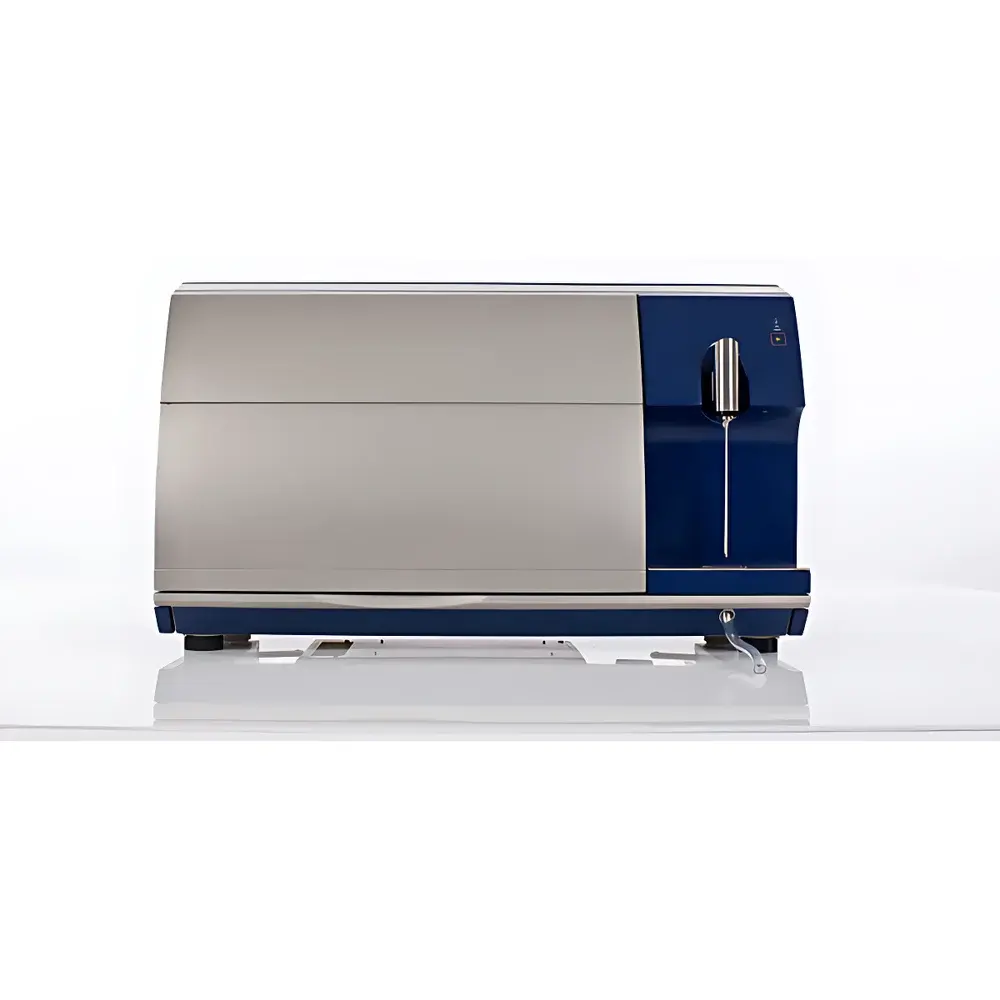
FOSS WineScan Multi-Parameter Wine Analyzer
| Brand | FOSS |
|---|---|
| Origin | Denmark |
| Model | WineScan |
| Application Modes | Laboratory & Online-ready |
| Analysis Time | 30 seconds per sample |
| Alcohol Content Range | 0.01–0.4 % vol |
| pH Range | 2.8–3.9 |
| Dimensions (L × W × H) | 62 × 33 × 59 cm |
| Instrument Weight | 89 kg |
| Measurement Principle | Fourier Transform Infrared (FTIR) Spectroscopy |
| Key Parameters | Density, pH, Total Acidity, Reducing Sugars, Dry Extract, Brix, Ethanol, Volatile Acidity, Malic Acid, Lactic Acid, Tartaric Acid, Free SO₂ (optional), Residual Sugar, Acetic Acid, Glucose, Fructose, Glycerol, Citric Acid, Sorbic Acid, Methanol (method-dependent) |
Overview
The FOSS WineScan Multi-Parameter Wine Analyzer is a laboratory-grade, FTIR-based spectrophotometric instrument engineered for rapid, reagent-free quantitative analysis of grape must, wine, and related enological matrices. Leveraging full-spectrum Fourier Transform Infrared spectroscopy across the mid-infrared region (typically 4000–600 cm⁻¹), the WineScan captures molecular vibrational fingerprints to simultaneously quantify up to 20 physicochemical parameters in a single 30-second measurement cycle—without sample dilution, derivatization, or chemical reagents. Its optical architecture incorporates a high-stability interferometer, temperature-controlled flow cell (for liquid stream analysis), and a robust Peltier-cooled DTGS detector, ensuring spectral reproducibility under routine laboratory conditions. Designed for compliance with ISO 22000, OIV Resolution OIV-OENO 427A-2010, and EU Regulation (EU) No 2019/934 on wine analysis methods, the WineScan serves as a primary or confirmatory tool in quality control laboratories of wineries, contract testing facilities, and regulatory agencies.
Key Features
- Single-shot FTIR acquisition delivering 20 validated parameters in ≤30 seconds per sample
- No consumables required: eliminates dependency on titrants, enzymes, or colorimetric reagents
- Integrated auto-sampler compatibility (optional) supporting unattended batch analysis of up to 48 samples
- Temperature-controlled flow cell (±0.1 °C stability) enabling precise density and refractive index correlation
- Pre-calibrated, matrix-specific chemometric models developed and validated against reference methods (e.g., AOAC 920.182 for ethanol, OIV-MA-AS313-01A for total acidity)
- Self-diagnostic optical path monitoring with real-time signal-to-noise ratio tracking and alignment verification
- IP54-rated enclosure suitable for controlled laboratory environments and near-production-line deployment
Sample Compatibility & Compliance
The WineScan accepts clarified, filtered, or centrifuged liquid samples—including grape must (with turbidity <5 NTU), white/red/rosé wines, fortified wines, and dealcoholized base wines—within defined viscosity (≤5 mPa·s) and particulate limits. It complies with international oenological standards: OIV Method OIV-MA-AS311-01 (pH), OIV-MA-AS312-01 (total acidity), OIV-MA-AS313-01A (ethanol), and ISO 2173 (Brix). All calibration models are traceable to NIST-traceable reference materials and undergo periodic verification per ISO/IEC 17025:2017 requirements. The system supports GLP-compliant audit trails, including user logins, method versioning, raw spectral archiving, and change history for all calibration updates.
Software & Data Management
WineScan operates via WinWine software (v6.5+), a Windows-based platform compliant with FDA 21 CFR Part 11 for electronic records and signatures. The software provides role-based access control, automated report generation (PDF/CSV/XLSX), trend charting over time, outlier detection using Mahalanobis distance, and seamless integration with LIMS via ASTM E1384 or HL7 protocols. Spectral libraries are managed through a centralized server; model updates require dual-authorization and generate immutable audit entries. Raw interferograms and processed spectra are stored with embedded metadata (sample ID, operator, timestamp, instrument status), enabling full data reprocessing without loss of fidelity.
Applications
- Harvest decision support: real-time assessment of sugar accumulation, acid degradation, and phenolic maturity indicators in must
- Fermentation monitoring: hourly tracking of ethanol rise, malic acid depletion, and glycerol formation during alcoholic and malolactic fermentation
- Blending optimization: quantitative prediction of sensory-relevant parameters (e.g., tartaric acid:pH ratio, residual sugar:acidity balance)
- Regulatory reporting: generation of OIV-mandated analytical summaries for DOC/G/IGP labeling submissions
- Shelf-life stability studies: longitudinal monitoring of volatile acidity drift, free SO₂ decline, and oxidation markers (e.g., acetaldehyde)
- Contract laboratory accreditation: ISO/IEC 17025 method validation packages available upon request
FAQ
Does the WineScan require daily recalibration?
No—calibration stability is verified weekly using certified reference standards; full recalibration is recommended every 6 months or after major hardware service.
Can it analyze cloudy or unfiltered must?
Only clarified samples (<5 NTU turbidity) are supported; inline filtration modules (e.g., 0.45 µm PTFE) are available as accessories.
Is method transfer possible between different WineScan units?
Yes—chemometric models are portable across instruments of the same generation when accompanied by spectral alignment validation per OIV-OENO 558A-2018.
What maintenance does the optical system require?
Annual interferometer alignment verification and DTGS detector performance check; no user-serviceable optics—FOSS-certified field service only.
How is data integrity ensured during power interruption?
The system includes an integrated UPS interface and automatic recovery mode that resumes interrupted analyses from the last stable spectral acquisition point.





