
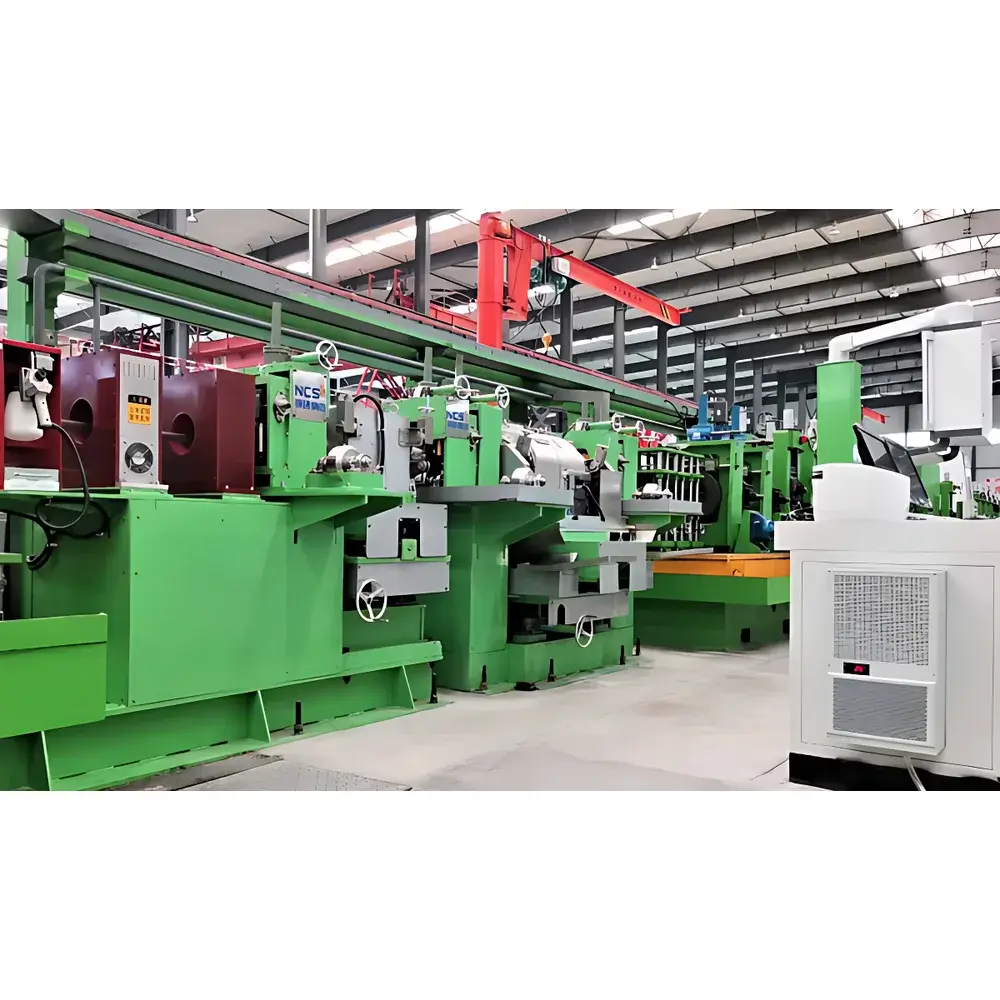
NC-GET Series Ultrasonic and Eddy Current Combined Inspection System for Welded Tubes
| Brand | NCS (China Iron and Steel Research Institute Group) |
|---|---|
| Model | NC-GET Series |
| Origin | Beijing, China |
| Manufacturer | NCS |
| Country of Origin | China |
| Pricing | Available Upon Request |
Overview
The NC-GET Series Ultrasonic and Eddy Current Combined Inspection System is an integrated non-destructive testing (NDT) platform engineered for high-throughput, high-reliability inspection of welded tubes and solid bars in industrial production environments. It combines pulse-echo ultrasonic testing (UT) with multi-frequency eddy current testing (ECT) in a single synchronized scanning configuration—enabling simultaneous detection of volumetric defects (e.g., lack of fusion, porosity, slag inclusions) via UT and surface/near-surface discontinuities (e.g., cracks, pits, grinding marks) via ECT. The system employs through-transmission and immersion or contact probe configurations for UT, while the ECT module utilizes differential and absolute probe arrays operating across 10 kHz–10 MHz frequency range to optimize lift-off compensation and defect phase discrimination. Designed for inline or offline deployment, it supports continuous rotational scanning at speeds up to 3 m/s, with real-time signal acquisition at ≥100 MS/s per channel and spatial resolution ≤0.5 mm along the axial direction.
Key Features
- Integrated dual-method architecture: Synchronized ultrasonic and eddy current data acquisition with time-aligned defect mapping and cross-validated reporting.
- Modular probe carriage system: Adaptable to tube diameters from Φ6 mm to Φ660 mm and wall thicknesses up to 80 mm; accommodates both round and square/rectangular sections.
- High-stability mechanical scanning: Precision servo-driven rotation and linear translation stages with repeatability ±0.02 mm and angular resolution ≤0.1°.
- Real-time signal processing: FPGA-based digital filtering, adaptive gain control, and noise suppression algorithms compliant with ISO 12718:2019 (NDT — Vocabulary — Ultrasonic testing).
- Rugged industrial enclosure: IP54-rated cabinet with temperature-controlled electronics compartment (15–35 °C operational range), EMI-shielded cabling, and redundant power supply.
- Comprehensive calibration support: Includes reference standards traceable to NIM (National Institute of Metrology, China) for UT (flat-bottom hole, side-drilled hole blocks) and ECT (notch, EDM slot, and lift-off calibration specimens).
Sample Compatibility & Compliance
The NC-GET system is validated for ferrous and non-ferrous conductive materials including carbon steel, stainless steel, aluminum alloys, copper, titanium, and nickel-based superalloys. It meets the technical requirements of multiple national and international standards governing welded tube inspection, including GB/T 7735 (identical to ISO 10893-2:2020, “Non-destructive testing of steel tubes — Part 2: Automated electromagnetic testing of seamless and welded steel tubes for verification of hydraulic leak tightness and detection of imperfections”), GB/T 11260 (identical to ISO 10893-3:2020, “Part 3: Automated full peripheral ultrasonic testing of seamless and welded steel tubes for detection of longitudinal and/or transverse imperfections”), GB/T 5248, GB/T 5126, YB/T 4083, GB/T 12969.2, and GB/T 29997. All inspection procedures are documented per ISO/IEC 17025:2017 requirements, and system validation reports include measurement uncertainty budgets per GUM (JCGM 100:2008).
Software & Data Management
The proprietary NCS-Insight™ software suite provides full lifecycle NDT data management—from setup and calibration to real-time monitoring, post-processing, and regulatory reporting. It features a role-based user interface with configurable access levels (Operator, Technician, QA Engineer, Administrator), audit trail logging compliant with FDA 21 CFR Part 11 (electronic signatures, change history, secure login), and GLP/GMP-ready report templates. Raw A-scan, C-scan, and impedance plane data are stored in HDF5 format with embedded metadata (time stamp, probe ID, gain settings, material grade). Export options include PDF inspection certificates, CSV defect logs, and XML files compatible with enterprise MES/QMS platforms (e.g., Siemens Opcenter, ETQ Reliance). Software updates follow IEC 62304 Class B medical device software development lifecycle principles.
Applications
This system serves critical quality assurance functions across regulated manufacturing sectors: incoming raw material verification of seamless and ERW/HFI welded tubes in steel service centers; final inspection prior to shipment in pipe mills producing OCTG, line pipe, and boiler/tube products; in-process monitoring during heat exchanger tube fabrication in power generation; and periodic integrity assessment of aging tubing in nuclear steam generator and aerospace hydraulic systems. Its dual-method capability reduces false call rates in high-conductivity alloys (e.g., Ti-6Al-4V) where conventional UT alone may miss tight fatigue cracks, and mitigates lift-off interference in aluminum extrusions where ECT-only systems suffer from variable conductivity effects.
FAQ
What types of defects can the NC-GET system detect simultaneously?
It detects volumetric flaws (e.g., lack of penetration, internal voids) via ultrasonics and surface-breaking or near-surface flaws (e.g., longitudinal cracks, pitting, seam defects) via eddy current—without requiring separate passes.
Is the system suitable for automated production line integration?
Yes—it supports PLC-level communication via Modbus TCP and EtherNet/IP, offers hardware-triggered start/stop signals, and delivers pass/fail outputs with configurable tolerance bands for downstream sorting logic.
Does the system provide traceable calibration documentation?
Yes—each unit ships with a factory calibration certificate referencing NIM-traceable standards, and includes on-site calibration verification protocols aligned with ISO 17025 Clause 6.6.
Can the software generate compliance reports for ISO or ASTM audits?
Yes—predefined report modules generate evidence packs for ISO 9001, API Q1, ASME BPVC Section V, and customer-specific quality agreements, including measurement uncertainty statements and operator qualification records.
What maintenance intervals are recommended for long-term stability?
Preventive maintenance is scheduled every 1,000 operational hours or annually (whichever occurs first), covering probe wear assessment, encoder calibration, water filtration system servicing, and FPGA firmware integrity checks.



