
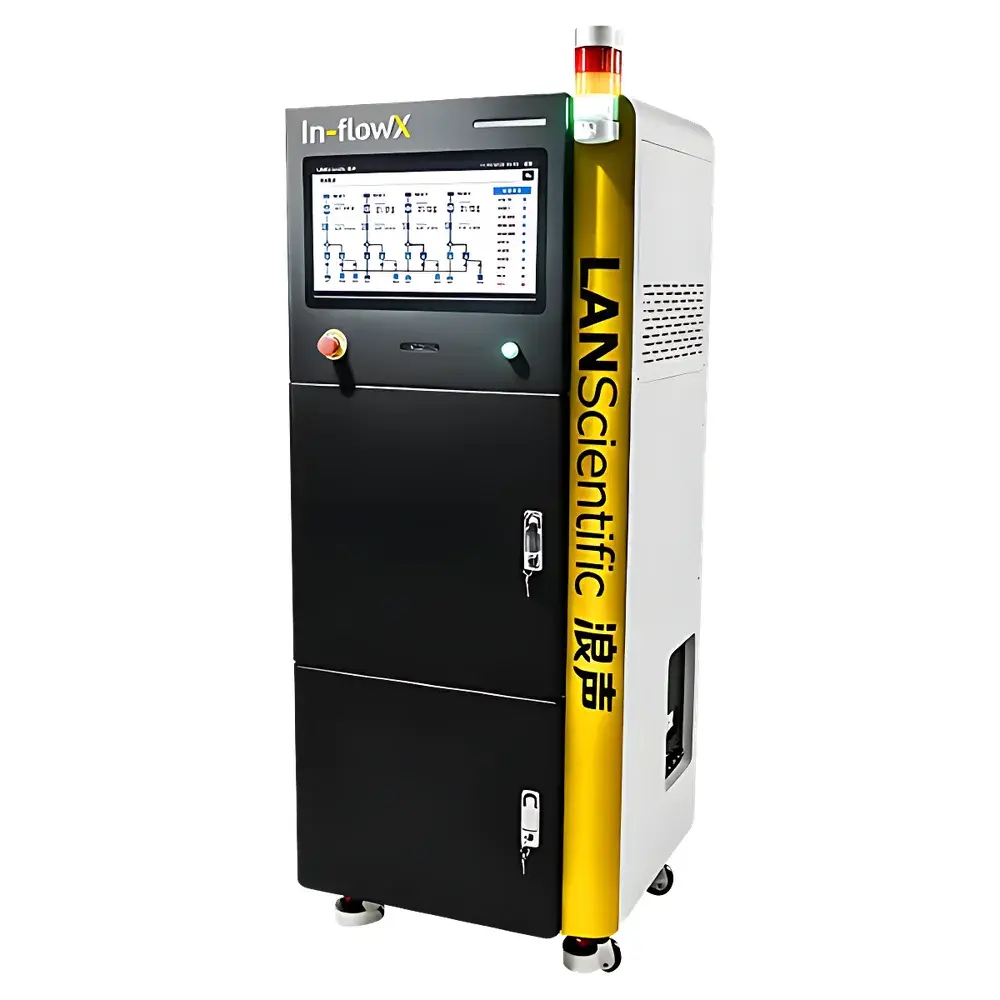
LANScientific In-flowX Multi-Channel Online Electroplating Bath Monitoring System
| Brand | LANScientific |
|---|---|
| Origin | Jiangsu, China |
| Manufacturer Type | Manufacturer |
| Origin Category | Domestic |
| Model | In-flowX |
| Form Factor | Benchtop/Floor-standing |
| Instrument Type | Conventional ED-XRF Spectrometer |
| Measurement Principle | Energy Dispersive X-Ray Fluorescence (ED-XRF) |
| Detection Range | ppm to wt% |
| Compliance Framework | Designed for GLP/GMP-aligned process monitoring environments |
| Communication Protocols | RS485, TCP/IP |
| Enclosure Rating | IP65 |
| Sample Interface | Flow-through liquid cell with automated sampling loop |
| Core Functionalities | Automated sampling, real-time spectral acquisition, multi-element quantification, auto-calibration, self-cleaning cycle, threshold-based alarm triggering |
Overview
The LANScientific In-flowX Multi-Channel Online Electroplating Bath Monitoring System is an industrial-grade energy dispersive X-ray fluorescence (ED-XRF) spectrometer engineered specifically for continuous, non-invasive elemental analysis of flowing electroplating electrolytes. Unlike conventional offline ICP-OES or titration-based methods, the In-flowX operates on a flow-through measurement principle: liquid samples are drawn directly from active plating tanks via dedicated peristaltic or diaphragm pump loops, delivered through chemically inert PFA or quartz-lined flow cells, and analyzed in real time using a high-stability X-ray tube and silicon drift detector (SDD). This configuration enables simultaneous quantification of major bath constituents (e.g., Cu²⁺, Ni²⁺, Zn²⁺, Co²⁺), critical impurities (Fe, Pb, Cr, Sn), and organic additive surrogates (via Cl, S, P markers) without reagent consumption, sample digestion, or operator intervention. The system’s fundamental architecture adheres to ASTM E1621–22 and ISO 20873:2020 guidelines for XRF-based liquid analysis, ensuring traceability and method robustness in regulated production environments.
Key Features
- Multi-channel architecture supporting up to 8 independent flow paths — each equipped with isolated fluidic manifolds, dedicated sample cells, and synchronized spectral acquisition to prevent cross-contamination and enable true parallel monitoring across multiple plating lines or tank zones.
- Automated operational sequence: integrated peristaltic pumps initiate scheduled sampling; programmable rinse cycles with deionized water or dilute acid flush the flow path between analyses; real-time background correction compensates for matrix-induced spectral drift.
- Self-calibrating reference mode: onboard calibration standards (certified liquid reference materials traceable to NIST SRM 2783) are automatically introduced at user-defined intervals (e.g., every 2–4 hours) to maintain long-term quantification accuracy ±2% RSD over 72-hour continuous operation.
- IP65-rated stainless-steel enclosure with corrosion-resistant internal wetted components (Hastelloy C-276 valves, sapphire windows, PFA tubing) ensures reliable deployment in high-humidity, acidic, or chloride-rich production floors.
- Zero-reagent, zero-waste operation: no chemical digestion, no acid waste generation, no consumable electrodes — reducing total cost of ownership while meeting ISO 14001 environmental management requirements.
Sample Compatibility & Compliance
The In-flowX is validated for aqueous electroplating baths including acid copper sulfate, Watts nickel, alkaline zinc, and cyanide-free gold strike formulations. It accommodates suspended solids ≤5 µm and viscosity ≤25 cP without clogging. All fluidic interfaces comply with FDA 21 CFR Part 11-ready data integrity protocols when paired with optional audit trail logging. The system supports IQ/OQ documentation packages aligned with ISO/IEC 17025 laboratory accreditation criteria and is routinely deployed in facilities operating under IATF 16949 and AS9100 quality management systems. Regulatory alignment includes support for USP elemental impurity testing principles where applicable to plating-derived contamination control.
Software & Data Management
The embedded Linux-based firmware runs LANScientific’s ProcessQuant™ v4.2 software suite, featuring a web-accessible HMI with role-based user permissions (operator, engineer, administrator). Quantitative results are exported in CSV/Excel format with timestamped metadata (sample ID, channel, acquisition time, detector live time, ambient temperature/humidity). Raw spectra (.spe) and processed reports are stored locally on encrypted SSD and mirrored to network shares via SMB or SFTP. OPC UA and Modbus TCP gateways enable bidirectional integration with MES (e.g., Siemens Opcenter, Rockwell FactoryTalk) and ERP platforms (SAP S/4HANA, Oracle Cloud), allowing real-time feed-forward control signals (e.g., auto-adjustment of replenishment pump duty cycles based on Cu²⁺ deviation).
Applications
- Electroplating Production Lines: Continuous monitoring of Cu²⁺, Ni²⁺, and Cl⁻ in PCB panel plating baths; detection of Fe³⁺ and organic breakdown products in acid copper strike solutions to preempt dendritic growth and micro-roughness defects.
- Copper Foil Manufacturing: In-line tracking of Cu²⁺, H₂SO₄, and Cl⁻ concentrations during surface treatment stages (roughening, black oxide, silane coupling) to maintain tensile strength and peel adhesion consistency across 12–25 µm foil gauges.
- Hydrometallurgical Operations: Real-time quantification of Cu, Co, Ni, and Mn in solvent extraction (SX) raffinate and electrolyte bleed streams to optimize extractant regeneration cycles and minimize metal loss.
- Custom Multi-Point Risk Mitigation: Configurable alarm logic supports cascaded thresholds (e.g., “Cu²⁺ 65 ppm” triggers Level-2 alert), enabling proactive intervention before defect formation thresholds are exceeded.
FAQ
What elements can the In-flowX detect in electroplating baths?
The system quantifies metals including Cu, Ni, Zn, Co, Sn, Pb, Fe, Cr, and Ag, plus non-metals such as Cl, S, and P — all simultaneously in a single 60–120 second acquisition cycle.
Does it require daily manual maintenance?
No. Scheduled self-cleaning cycles, automatic calibration verification, and predictive diagnostics reduce required operator interaction to less than 15 minutes per week.
Can it interface with our existing PLC infrastructure?
Yes. Native RS485 (Modbus RTU) and Ethernet (Modbus TCP, OPC UA) interfaces are standard; custom protocol adapters (e.g., Profibus DP, EtherNet/IP) are available upon request.
Is spectral data export compliant with 21 CFR Part 11?
When configured with optional electronic signature modules and audit trail logging, the system meets predicate rule requirements for electronic records and signatures in GxP environments.
What is the minimum detectable concentration for copper in sulfuric acid baths?
Under typical operating conditions (100 kV excitation, 1 mm path length, 120 s count time), the practical detection limit for Cu is 0.8 ppm with a relative standard deviation of ≤1.5% at 100 ppm concentration.





