
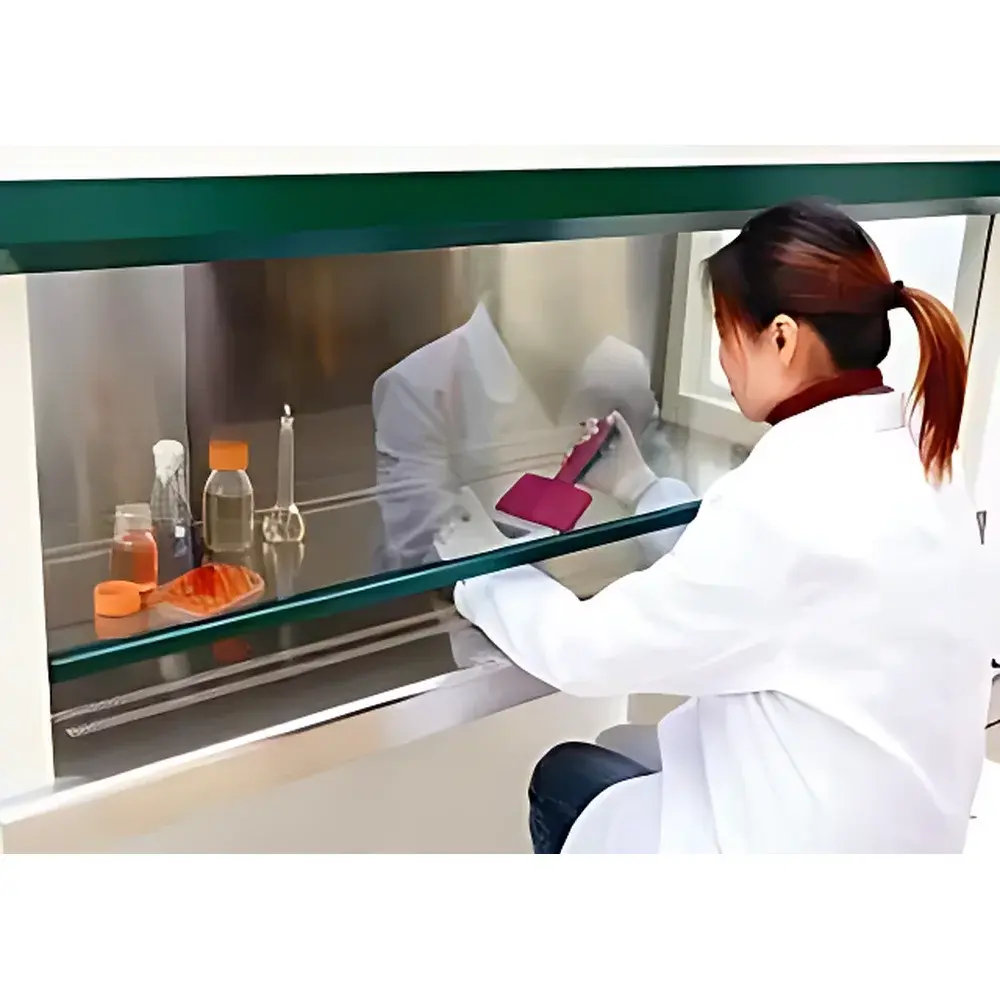
Zhicheng ZHJH-C1112B Vertical Laminar Flow Clean Bench
| Brand | Zhicheng |
|---|---|
| Origin | Shanghai, China |
| Manufacturer Type | Direct Manufacturer |
| Product Category | Domestic |
| Model | ZHJH-C1112B |
| Pricing | Upon Request |
| Airflow Direction | Vertical Laminar Flow |
| Work Surface | Single |
| Filtration Efficiency | ISO Class 5 (equivalent to Federal Standard 209E Class 100) @ ≥0.5 µm |
| Microbial Contamination | ≤0.5 CFU/plate (90 mm Petri dish) |
| Adjustable Air Velocity Range | 0.3–0.6 m/s (7-step LED digital control) |
| Noise Level | ≤62 dB(A) |
| Vibration Peak-to-Peak Amplitude | ≤4 µm |
| Illumination | ≥300 lx |
| Initial Filter Resistance | ≤120 Pa (at maximum airflow) |
| Working Area Dimensions (W×D×H) | 1200 × 625 × 645 mm |
| Overall Dimensions (W×D×H) | 1320 × 740 × 1700 mm |
| Net Weight | 215 kg |
| Power Consumption | 680 W |
| Input Voltage/Frequency | AC 220 V, 50/60 Hz |
Overview
The Zhicheng ZHJH-C1112B Vertical Laminar Flow Clean Bench is an ISO Class 5-certified (Federal Standard 209E Class 100) unidirectional airflow workstation engineered for precision-sensitive laboratory operations requiring particulate-free environments. It operates on the principle of vertical laminar flow: ambient air is drawn through a pre-filter to remove coarse particulates, then pressurized into a plenum chamber before passing through a certified HEPA filter (≥99.995% efficiency at 0.3 µm). The resulting downward, uniform airflow—maintained within a tightly controlled velocity range of 0.3–0.6 m/s—sweeps contaminants away from the work surface and out through the front grille, ensuring continuous protection of samples, reagents, and personnel during aseptic procedures. Designed for integration into GLP-compliant laboratories and GMP-aligned cleanroom-adjacent workflows, this bench meets structural and performance benchmarks defined in ISO 14644-1 for cleanroom classification and ASTM F2102 for laminar flow cabinet validation protocols.
Key Features
- Integrated dual-stage filtration system: high-efficiency pre-filter + certified HEPA filter (tested per EN 1822-3), with real-time filter resistance monitoring (≤120 Pa at rated airflow)
- Seven-step digitally controlled air velocity regulation via LED display, enabling precise adaptation to procedural requirements (e.g., cell culture vs. sterile instrument handling)
- Touch-locked control interface with independent UV lamp activation and interlocked safety cutoff when sash is raised above operational limit
- Self-balancing vertical sliding sash with friction-damped counterweight mechanism, allowing stable positioning at any height between 100–400 mm
- Double-sided transparent acrylic side windows (thickness ≥8 mm) providing wide-angle visibility and optimal natural/artificial light transmission
- Electropolished 304 stainless steel work surface (1200 × 625 × 645 mm internal dimensions), corrosion-resistant and compatible with common disinfectants including 70% ethanol and hydrogen peroxide vapor
- Integrated lighting system: 300 lx minimum illumination (measured at work surface), paired with germicidal UV-C lamps (254 nm, 30 W) featuring timer-based auto-shutoff and motion-sensor override
- Structural frame finished with electrostatic powder coating (RAL 7035), supporting full-load stability and minimizing electrostatic accumulation
- Four swivel casters (two with locking brakes), rated for 50 kg per wheel, enabling safe relocation without disassembly
Sample Compatibility & Compliance
The ZHJH-C1112B accommodates standard biosafety Level 1 and Level 2 applications involving microbial cultures, tissue explants, primary cell isolation, and non-hazardous pharmaceutical compounding. Its single-opening vertical-flow configuration ensures minimal turbulence and consistent downflow integrity across the entire 1.2 m work width—validated per ISO 14644-3 Annex B for airflow uniformity and particle count verification. The unit complies with IEC 61010-1 (Safety Requirements for Electrical Equipment for Measurement, Control, and Laboratory Use) and conforms to electromagnetic compatibility standards per EN 61326-1. Optional documentation packages support FDA 21 CFR Part 11-compliant audit trails when integrated with validated lab information management systems (LIMS).
Software & Data Management
While the ZHJH-C1112B operates as a standalone hardware platform, its LED controller logs operational parameters—including cumulative UV exposure time, total runtime, and last-set airflow velocity—for manual recordkeeping. For regulated environments, optional RS-485 serial output enables connection to external data acquisition modules compliant with ISO/IEC 17025 traceability requirements. All firmware updates are performed via secure USB interface with version-controlled checksum verification, ensuring integrity during GLP/GMP audits.
Applications
This clean bench serves critical roles in academic research laboratories conducting plant tissue culture and embryonic stem cell passaging; biopharmaceutical QC labs performing media fill simulations and environmental monitoring plate incubation; clinical microbiology units executing antibiotic susceptibility testing and colony isolation; and semiconductor R&D facilities handling photomask inspection and thin-film deposition pre-cleaning. Its robust mechanical design and calibrated airflow profile also support long-duration procedures such as PCR setup, ELISA plate coating, and microinjection under sustained sterility conditions.
FAQ
What ISO classification does the ZHJH-C1112B meet?
It achieves ISO Class 5 (equivalent to FS209E Class 100) at ≥0.5 µm particle size, verified by third-party airborne particle counting per ISO 14644-1.
Is UV sterilization validated for microbial reduction efficacy?
Yes—the installed UV-C lamps comply with ISO 15714 for ultraviolet germicidal irradiation dosimetry, delivering ≥40 mJ/cm² fluence over 30 minutes on the work surface.
Can the unit be integrated into a building’s HVAC monitoring system?
Via optional analog 4–20 mA output module (sold separately), airflow velocity and filter pressure drop can be relayed to centralized BMS platforms.
What maintenance intervals are recommended for HEPA filter replacement?
Under typical usage (8 hrs/day, ISO Class 8 ambient), replace every 18–24 months—or sooner if differential pressure exceeds 200 Pa or particle counts exceed ISO Class 5 limits during routine monitoring.
Does the bench include certification documentation for regulatory submissions?
Factory-issued test reports include airflow uniformity maps, particle count validation data, noise/vibration measurements, and electrical safety compliance summaries—available upon request with NIST-traceable calibration certificates.



