
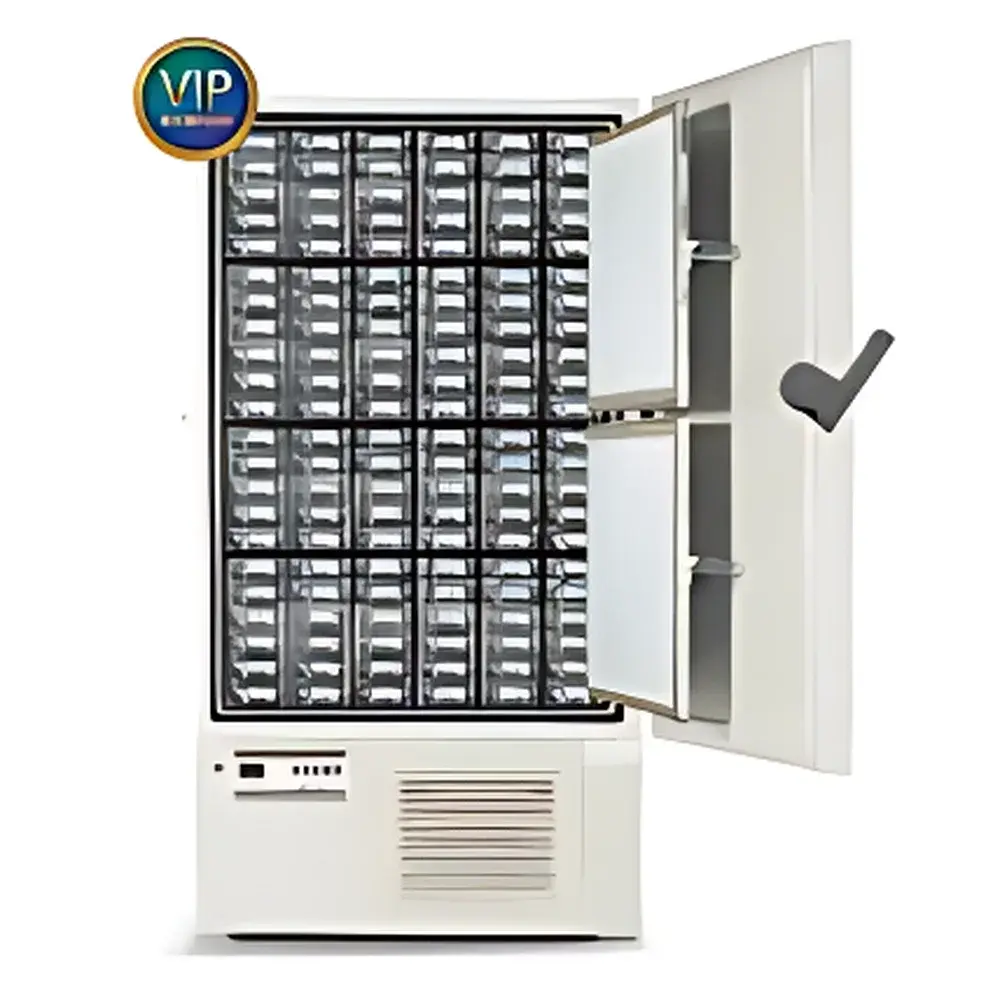
Panasonic MDF-U780V VIP Ultra-Low Temperature Freezer
| Brand | Panasonic |
|---|---|
| Model | MDF-U780V |
| Temperature Range | –50 °C to –86 °C (0.1 °C adjustable) |
| Effective Volume | 736 L |
| Interior Dimensions (W×D×H) | 890 × 600 × 1380 mm |
| Exterior Dimensions (W×D×H) | 1030 × 875 × 1990 mm |
| Power Supply | 220 V, 50 Hz |
| Rated Input Power | 1185 W |
| Compressor Type | Dual hermetic compressors (1100 W each) |
| Refrigerants | R404A / R508B (ozone-friendly) |
| Insulation | Polyurethane foam + Vacuum Insulation Panels (VIP) |
| External Casing | Powder-coated galvanized steel |
| Internal Chamber | Electrogalvanized steel with polyester resin coating |
| Door Configuration | 1 outer door + 2 inner doors |
| Safety Features | High/low temperature alarm, power failure alarm, remote alarm contact, sensor self-diagnosis, compressor protection circuit |
| Standard Accessories | 1 set of keys, 3 stainless-steel shelves, 1 defrost scraper |
| Cooling Method | Direct cooling |
| Temperature Control | Microprocessor-based digital controller with LED display |
| Monitoring Ports | 2 × 17 mm access ports (rear, lower-left) |
Overview
The Panasonic MDF-U780V VIP Ultra-Low Temperature Freezer is an engineered solution for long-term cryopreservation of biologically sensitive materials under strictly controlled thermal conditions. Designed and manufactured in China (Liaoning Province) under Panasonic’s global quality framework, this unit employs a dual-compressor cascade refrigeration system coupled with advanced Vacuum Insulation Panel (VIP) technology integrated into polyurethane foam walls. This hybrid insulation architecture achieves superior thermal resistance—significantly reducing heat ingress compared to conventional foamed units—while maintaining stable chamber temperatures between –50 °C and –86 °C, with 0.1 °C resolution and ±1.5 °C uniformity across the full volume (per IEC 61000-4-2 and ISO 15190:2020 Annex B test protocols). Its direct-cooling design ensures rapid pull-down performance and minimal temperature fluctuation (< ±2 °C at setpoint), critical for preserving nucleic acid integrity, primary cell viability, and protein conformation over extended storage periods.
Key Features
- Dual hermetic compressors (1100 W each) configured in cascade mode for reliable operation across ambient conditions from 10 °C to 30 °C, enabling consistent performance even during seasonal load variations.
- VIP-enhanced insulation system—combining high-density polyurethane foam with vacuum-sealed panels—reduces wall thickness without compromising thermal efficiency, optimizing internal usable volume relative to external footprint.
- Microprocessor-controlled digital temperature management with real-time LED display, programmable alarm thresholds, and automatic recovery after power interruption.
- Robust safety architecture including independent high/low temperature monitoring, power failure detection with battery-backed memory, remote alarm relay output (dry contact, 250 V AC/3 A), and self-diagnostic sensor validation.
- Electrogalvanized internal chamber with polyester resin coating resists corrosion from repeated decontamination cycles and condensate exposure; exterior housing features durable powder-coated steel construction.
- Two 17 mm rear-mounted access ports facilitate integration with external monitoring systems or sample retrieval tools while preserving thermal integrity.
Sample Compatibility & Compliance
The MDF-U780V is validated for storage of human tissues, whole blood, plasma, serum, isolated DNA/RNA, purified proteins, stem cells, and other thermolabile biospecimens requiring uninterrupted sub–80 °C conditions. Its temperature stability profile meets requirements outlined in ISO 20387:2018 (Biobanking), ASTM F2641-22 (Standard Specification for Ultra-Low Temperature Freezers), and supports compliance with Good Laboratory Practice (GLP) and Good Manufacturing Practice (GMP) environmental monitoring expectations. While not certified to FDA 21 CFR Part 11 out-of-the-box, the unit’s alarm logging capability and configurable relay outputs enable integration into Part 11–compliant data acquisition ecosystems when paired with validated third-party software and audit-trail-enabled controllers.
Software & Data Management
This freezer operates as a standalone hardware platform with embedded firmware for local control and status indication. It does not include onboard network connectivity or proprietary cloud software; however, its dry-contact alarm relay and analog temperature output (0–5 V or 4–20 mA optional via external interface module) support integration with laboratory-wide Building Management Systems (BMS), SCADA platforms, or electronic lab notebooks (ELNs). Users may configure continuous temperature logging using compatible external data loggers compliant with ISO/IEC 17025 traceability standards. Alarm events—including sensor faults, compressor anomalies, and door-open duration—are stored in non-volatile memory with time stamps for retrospective review during internal audits.
Applications
- Cryopreservation of primary human cells and induced pluripotent stem cells (iPSCs) where thermal hysteresis must be minimized to prevent ice recrystallization damage.
- Long-term archival storage of clinical trial biospecimens under ISO 20387-aligned biobank operating procedures.
- Stabilization of enzyme preparations and monoclonal antibodies prior to formulation development or stability testing per ICH Q5C guidelines.
- Secure cold chain holding for diagnostic reagents, reference standards, and proficiency testing materials distributed across multi-site research networks.
- Backup storage for liquid nitrogen-dependent repositories during scheduled maintenance or emergency LN₂ supply disruptions.
FAQ
What refrigerants are used, and are they compliant with current environmental regulations?
R404A and R508B are employed as low-GWP alternatives approved under the Kigali Amendment to the Montreal Protocol. Both are ozone-depleting-potential (ODP)-zero refrigerants and meet EU F-Gas Regulation (No. 517/2014) phase-down schedules for laboratory equipment installed before 2025.
Is the unit suitable for GxP-regulated environments?
Yes—when deployed with documented IQ/OQ protocols, calibrated external temperature mapping, and integrated into a validated alarm response workflow, it fulfills infrastructure requirements for GLP, GCP, and GMP Annex 1 cold storage zones.
Can temperature data be exported for regulatory submission?
Raw temperature readings are not natively exportable; however, analog outputs or relay-triggered external loggers—qualified per ALCOA+ principles—enable compliant data capture and electronic signature workflows.
What is the recommended preventive maintenance interval?
Panasonic recommends quarterly visual inspection of door gaskets and condenser coil cleaning, plus annual verification of compressor oil level, refrigerant pressure balance, and alarm functionality by authorized service technicians.
Does the freezer support remote monitoring via Ethernet or Wi-Fi?
No native network interface is included; integration requires third-party hardware gateways or industrial IoT adapters that comply with institutional cybersecurity policies.



