
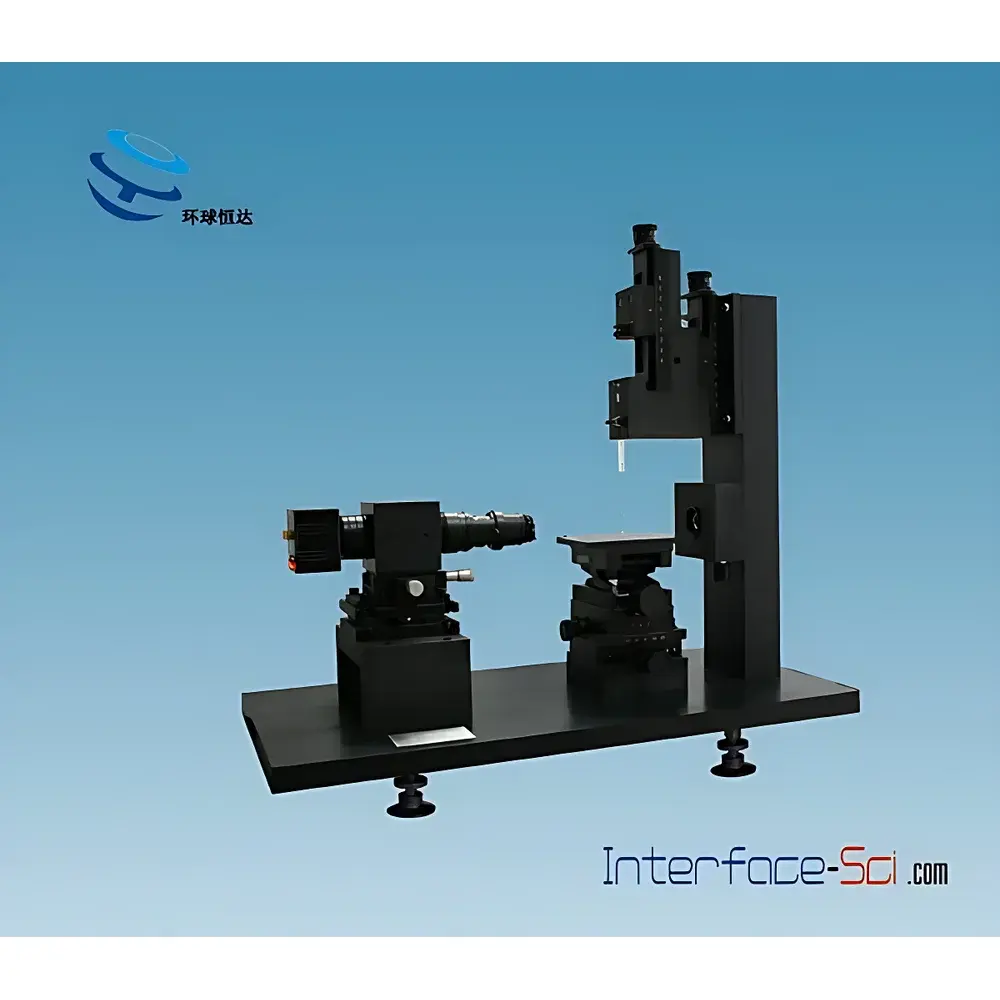
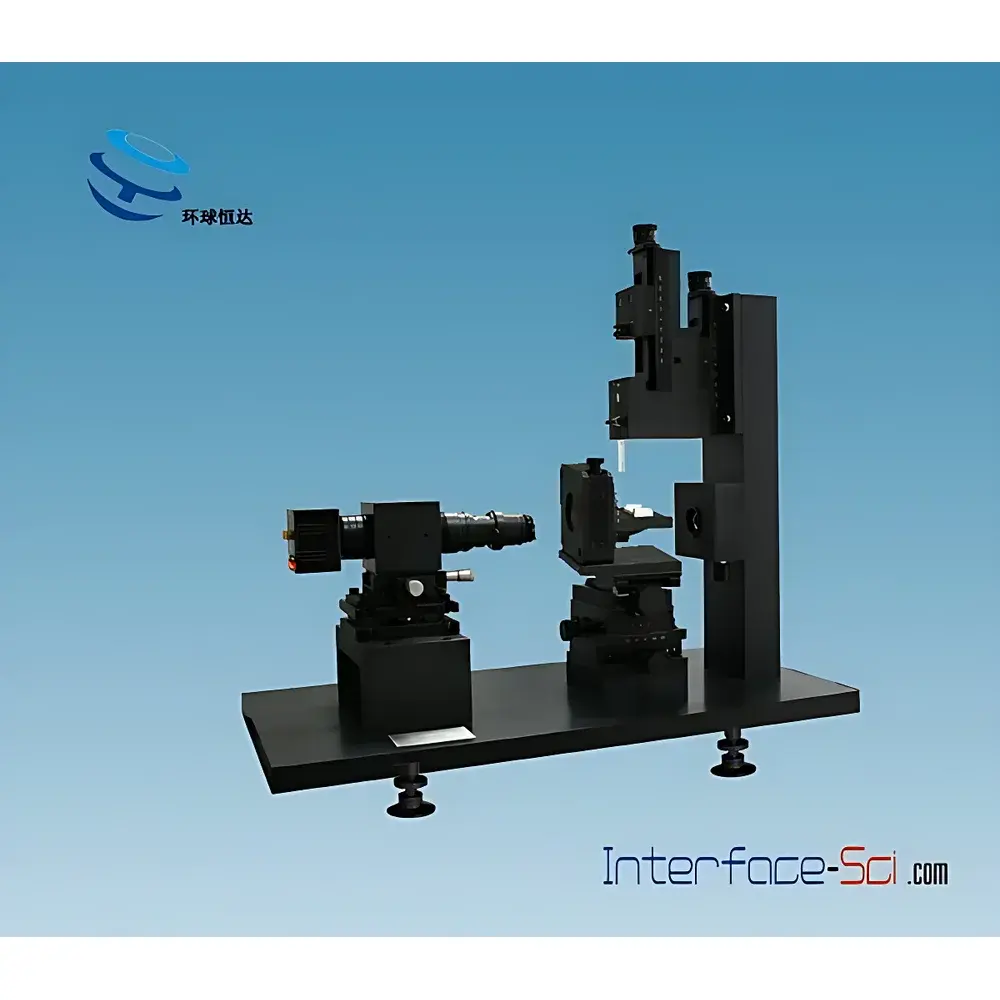
Interface SCI2000A Video-Based Optical Contact Angle Analyzer
| Brand | Interface |
|---|---|
| Origin | Beijing, China |
| Model | SCI2000A |
| Instrument Type | Benchtop Laboratory System |
| Contact Angle Range | 0–180° |
| Contact Angle Accuracy | ±0.1° |
| Contact Angle Resolution | 0.01° |
| Sample Stage Dimensions | 120 × 100 mm |
| Imaging Resolution (min) | 1280 × 1024 pixels |
| Surface/Interfacial Tension Range | 5.0–2000 mN/m |
| Surface Tension Resolution | 0.001 mN/m |
| Imaging Speed (standard) | 25 fps |
| Optical Magnification | 0.7–5.0× continuous zoom |
| Power Supply | AC 220 V, 50 Hz |
| Dimensions | 300 × 500 × 420 mm |
| Weight | 15 kg |
Overview
The Interface SCI2000A Video-Based Optical Contact Angle Analyzer is a precision benchtop instrument engineered for quantitative characterization of solid-liquid and liquid-liquid interfacial phenomena. It operates on the principle of optical silhouette imaging combined with advanced digital image analysis to determine contact angles—defined as the angle formed at the three-phase (solid-liquid-gas) boundary where a liquid droplet meets a solid surface. The system supports multiple measurement modes including sessile drop (2- and 3-state), pendant drop, captive bubble, and immersion (plate) methods—enabling comprehensive assessment of static, advancing, receding, tilt, and roll-off angles. Coupled with Young-Laplace equation-based interfacial tension analysis and multi-model surface free energy calculation, the SCI2000A serves as a foundational tool in interfacial science, particularly for nanomaterial surface modification, plasma treatment validation, thin-film coating evaluation, and biomaterial wettability screening.
Key Features
- High-precision mechanical architecture: Five-axis manual sample stage with cross-roller guidance, micrometer-driven vertical lift (60 mm travel, 0.1 mm resolution), and optional 360° rotational platform (0.01° angular resolution) for dynamic contact angle and roll-off angle measurements.
- Optimized optical subsystem: Industrial-grade 60× continuous zoom lens (0.7–5.0× magnification), low-distortion optics, and high-contrast cold LED backlighting with parallel-light collimation ensure sharp, repeatable droplet edge detection.
- Modular fluid delivery: Dual-path configuration—standard manual syringe drive (25 mm stroke, 0.1 mm resolution) plus optional programmable peristaltic pump or high-accuracy motorized syringe pump (bidirectional control, sub-microliter dispensing).
- Flexible imaging capability: USB 2.0 monochrome CCD camera (1280 × 1024 @ 25 fps standard); upgrade paths available to 60, 100, 200, 1000, or 2000 fps for transient wetting dynamics.
- Comprehensive analytical software: Six built-in contact angle algorithms (tangent, height, circle, ellipse, spline, and Young-Laplace fitting), real-time video capture (AVI export), automated baseline detection, curvature correction for convex/concave substrates, and roughness compensation.
Sample Compatibility & Compliance
The SCI2000A accommodates diverse sample geometries—including rigid plates (max. 180 × ∞ × 60 mm), fibers, membranes, plant leaves, and compressed powders—via customizable fixtures (e.g., fiber clamps, film holders, and leaf mounts). Its modular design supports ASTM D724 (paper wettability), ASTM D5946-2004 (corona-treated polymer films), and ISO 15989 (water contact angle of treated films). All measurement workflows comply with GLP documentation requirements; audit trails, user access logs, and timestamped image-data pairing are natively supported. While not FDA 21 CFR Part 11–certified out-of-the-box, the software architecture permits integration with validated electronic lab notebook (ELN) systems for regulated environments requiring full traceability.
Software & Data Management
The proprietary analysis suite implements dual-mode data acquisition: fully automated sequence-driven testing (multi-point, time-lapse, sequential dispensing) or manual operator-guided measurement. Surface free energy calculations leverage 11 established models—including Owens-Wendt-Rabel, Fowkes (extended and simple), van Oss-Chaudhury-Good (acid-base), Wu harmonic mean, Zisman critical surface tension, and Neumann Equation of State—paired with an integrated database of >300 liquids and >500 physicochemical parameters. All results—including fitted curves, contact angle values, interfacial tension outputs, and surface energy components—are stored in a relational SQLite database. Export options include Excel (.xlsx), CSV, annotated PNG/JPEG, and AVI video with embedded metadata. Batch processing, statistical summary reports, and cross-sample comparative analysis are fully scriptable via Python API hooks.
Applications
The SCI2000A delivers reproducible interfacial data across academic and industrial R&D domains. In materials science, it quantifies hydrophobicity/hydrophilicity transitions post-plasma, UV-ozone, or chemical grafting—critical for MEMS packaging, anti-fouling coatings, and self-cleaning surfaces. In life sciences, it assesses protein adsorption kinetics, lung surfactant behavior, and biocompatibility of implants (e.g., contact lenses, orthopedic polymers). In electronics manufacturing, it verifies cleaning efficacy on wafer surfaces and evaluates solder mask wettability. In formulation development, it guides surfactant selection for agrochemicals, inks, cosmetics, and enhanced oil recovery fluids. Additional use cases include coal/rock wettability in geoscience, electrowetting-on-dielectric (EWOD) device calibration, and humidity-dependent contact angle hysteresis studies.
FAQ
What measurement methods does the SCI2000A support?
It supports sessile drop (static, advancing, receding), pendant drop (surface/interfacial tension), captive bubble (hydrophobic surface characterization), and immersion (plate) methods.
Can the system measure dynamic contact angles automatically?
Yes—via optional motorized rotation stage and time-resolved image capture, enabling automated tilt-angle and roll-off angle determination with programmable ramp rates.
Is surface free energy calculation included in the base software?
Yes—the standard software includes 11 thermodynamic models and a curated liquid property database for both low- and high-energy solid surface analysis.
What is the minimum detectable surface tension value?
The system achieves 0.001 mN/m resolution using Young-Laplace curve fitting on high-contrast pendant drop images.
Are regulatory-compliant data integrity features available?
Audit trail logging, electronic signatures, and secure user role management are implemented; full 21 CFR Part 11 compliance requires site-specific validation protocols and third-party ELN integration.



