
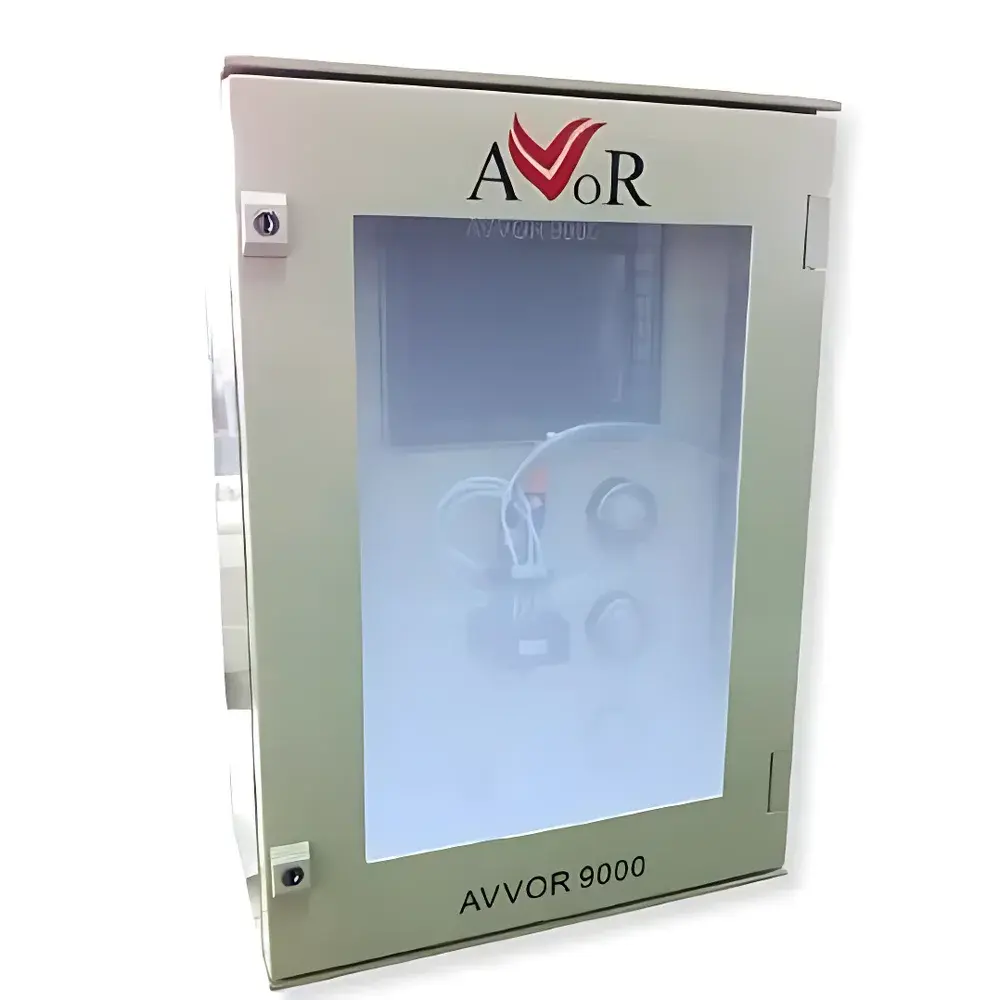
AVVOR 9000 Combined Calcium and Fluoride Ion Analyzer
| Brand | AVVOR |
|---|---|
| Model | 9000 |
| Type | Online Ion Analyzer |
| Detection Range (Ca²⁺) | 0.02–4010 ppm |
| Detection Range (F⁻) | 0.02–1900 ppm |
| Resolution | 0.01 ppm |
| Accuracy | ±5% of full scale |
| Detection Limit | 0.1 ppm |
| Response Time | 30 s |
| Measurement Precision | 0.1 ppm |
| Output Signal | Isolated DC 4–20 mA (max load 1 kΩ) |
| Operating Temperature | 0–55 °C |
| Enclosure Rating | IP65 |
| Dimensions (H×W×D) | 400 × 300 × 150 mm |
| Display | 7-inch color touchscreen |
| Data Storage | Internal memory + optional 8 GB microSD/USB drive |
Overview
The AVVOR 9000 Combined Calcium and Fluoride Ion Analyzer is an online, potentiometric ion-selective analyzer engineered for continuous, real-time monitoring of calcium (Ca²⁺) and fluoride (F⁻) ions in aqueous environmental and industrial water streams. It operates on the principle of ion-selective electrode (ISE) measurement—leveraging solid-state or crystalline membrane electrodes with high specificity for Ca²⁺ and F⁻. For fluoride analysis, the instrument employs a lanthanum fluoride (LaF₃)-based ion-selective electrode, which generates a Nernstian potential response proportional to the logarithm of free fluoride ion activity. To ensure accurate quantification, the system integrates a proprietary buffering reagent that sequesters interfering metal cations (e.g., Al³⁺, Fe³⁺) and stabilizes sample pH within the optimal operational range of 4.0–9.0—thereby liberating bound fluoride as free F⁻ prior to measurement. Calcium detection utilizes a PVC-membrane ISE doped with calcium ionophore X (ETH 1001), offering selectivity over common divalent cations such as Mg²⁺ and Sr²⁺ under controlled ionic strength conditions. The analyzer is designed for deployment in municipal drinking water treatment plants, groundwater remediation sites, semiconductor rinse water loops, and fluoride-addition control systems where regulatory compliance and process stability depend on sub-ppm-level ion concentration tracking.
Key Features
- Integrated dual-channel ISE platform supporting simultaneous, independent measurement of Ca²⁺ and F⁻ without cross-sensitivity interference
- 7-inch high-resolution capacitive touchscreen interface with multi-language support (English, Spanish, French, German, Chinese)
- Onboard linear calibration capability with ≥5-point user-defined standardization for both ions, including slope verification and offset correction
- Configurable automatic cleaning cycle—compatible with optional external ultrasonic or chemical purge modules to mitigate electrode fouling in turbid or scaling-prone samples
- Internal non-volatile memory for secure storage of time-stamped measurement logs, calibration records, and alarm events
- Rugged IP65-rated enclosure suitable for indoor and semi-outdoor installation in utility rooms, pump stations, or control cabinets
- Isolated 4–20 mA analog outputs per channel with configurable scaling, enabling direct integration into SCADA, DCS, or PLC-based supervisory systems
Sample Compatibility & Compliance
The AVVOR 9000 is validated for use with potable water, surface water, groundwater, treated wastewater effluent, and low-conductivity process water (conductivity < 2 mS/cm). Sample pH must be maintained between 4.0 and 9.0 for reliable F⁻ measurement; built-in pH compensation algorithms adjust for minor drift when used with optional integrated pH sensor input. The analyzer complies with ISO 10523 (water quality — determination of pH), ASTM D511 (calcium in water), and ASTM D3869 (fluoride in water) methodology principles. Its data integrity architecture supports audit-ready operation under GLP and GMP frameworks, with timestamped calibration logs, user-access-controlled configuration changes, and tamper-evident event history. While not certified to FDA 21 CFR Part 11 out-of-the-box, the system’s logging structure and password-protected administrative mode facilitate validation for regulated environments upon site-specific qualification.
Software & Data Management
Data acquisition and visualization are managed via embedded firmware with configurable sampling intervals (10 s to 24 h). Historical trends—including real-time concentration curves, calibration status flags, and alarm thresholds—are rendered directly on the touchscreen display. Raw measurement data, calibration reports, and system diagnostics can be exported via USB 2.0 port to standard FAT32-formatted flash drives or microSD cards (up to 8 GB, optional). No proprietary software is required for data retrieval; exported CSV files are compatible with Excel, LabVIEW, PI System, and most LIMS platforms. Remote access is supported through Modbus RTU (RS-485) or optional Ethernet/Wi-Fi gateway modules—enabling integration into centralized water quality dashboards and predictive maintenance workflows.
Applications
- Real-time monitoring of fluoride dosing in municipal drinking water distribution systems to meet WHO and EPA regulatory limits (≤1.5 mg/L)
- Calcium hardness tracking in cooling tower make-up water to prevent scale formation and optimize antiscalant dosing
- Groundwater plume characterization at sites contaminated with fluorinated compounds or calcium-rich leachates
- Process control in lithium extraction brines where Ca²⁺ interference affects downstream recovery efficiency
- Compliance verification for industrial discharge permits requiring reporting of total recoverable fluoride and dissolved calcium
- Research-grade ion speciation studies in hydrogeochemical modeling where paired Ca²⁺/F⁻ ratios inform mineral saturation index calculations
FAQ
Does the AVVOR 9000 require daily manual calibration?
No—calibration frequency depends on application severity and regulatory requirements; typical field deployments operate on weekly or biweekly calibration schedules supported by automated drift checks.
Can the analyzer distinguish between free fluoride and fluoride complexed with aluminum?
Yes—the integrated buffer chemistry selectively dissociates Al-F complexes and suppresses hydrolysis artifacts, ensuring measurement reflects thermodynamically active F⁻ only.
Is temperature compensation automatic?
Yes—built-in Pt1000 RTD sensor provides real-time temperature feedback for Nernst equation correction across the full 0–55 °C operating range.
What maintenance is required beyond electrode replacement?
Annual verification of flow cell integrity, cleaning module functionality (if installed), and analog output linearity using certified reference standards is recommended.
Can historical data be retrieved remotely via network connection?
Yes—when equipped with optional communication modules, the unit supports Modbus TCP and HTTP-based API endpoints for secure, read-only data polling from enterprise infrastructure.
Related Products







