
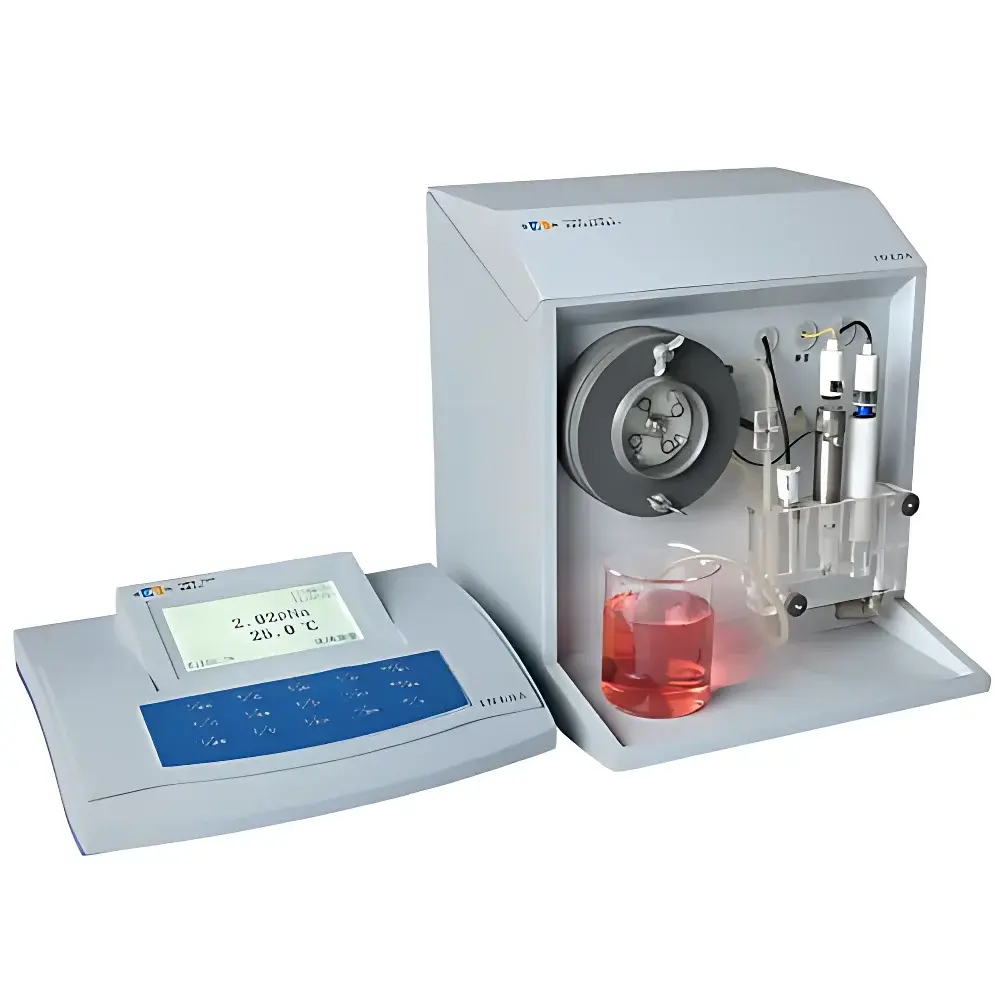
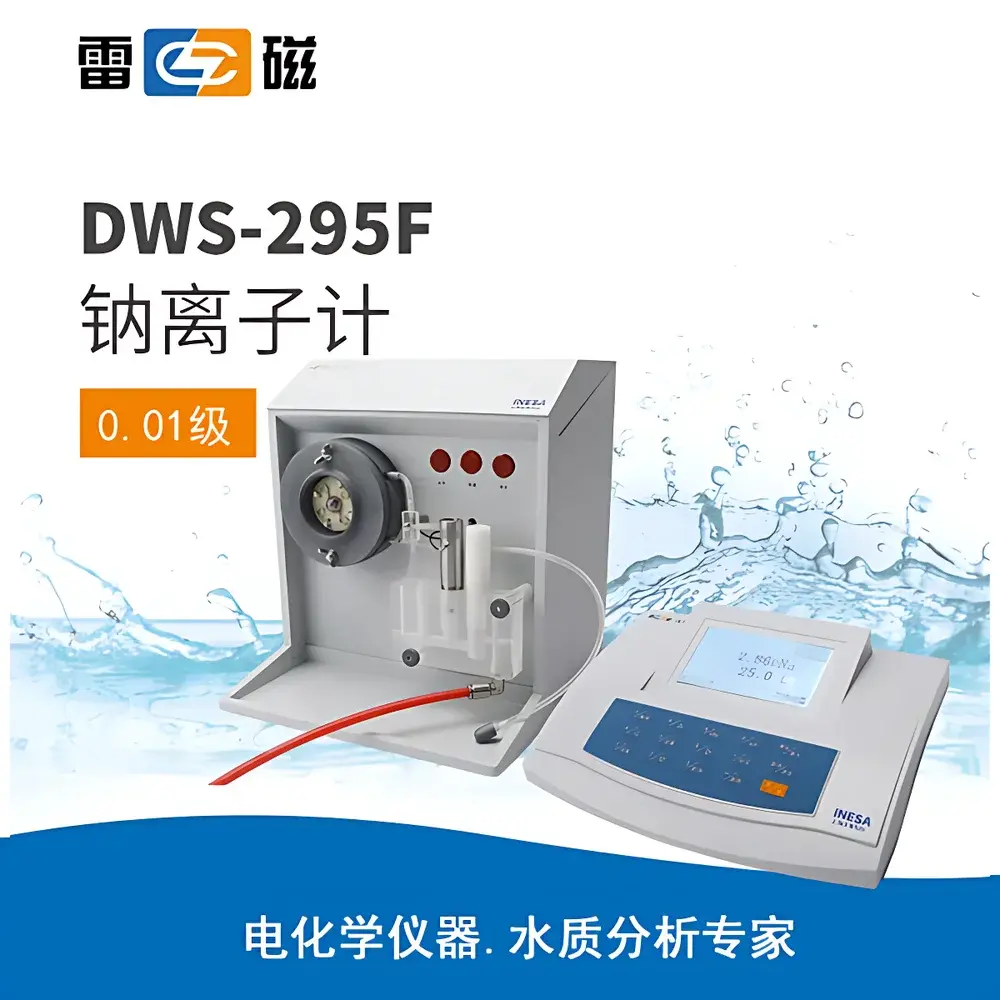
Leici DWS-295F Sodium Ion Analyzer
| Brand | Leici |
|---|---|
| Origin | Shanghai, China |
| Manufacturer Type | Direct Manufacturer |
| Regional Origin | Domestic (China) |
| Model | DWS-295F |
| Price Range | USD 700–1,400 |
| Instrument Category | Sodium Ion Analyzer |
| Form Factor | Benchtop |
| Measurement Accuracy | ±0.01 pNa |
| Temperature Range | −5.0 to 110.0 °C |
| pNa Range | 0.00–9.00 pNa |
| mV Range | −1999 to +1999 mV |
| [Na⁺] Concentration Range | 2.3×10⁻² to 2.3×10⁷ µg/L |
| Temperature Accuracy | ±0.2 °C |
| Data Storage Capacity | 50 datasets (pNa/mV/[Na⁺]/temperature) |
| Interface | USB |
| Power Supply | DC 9 V, 800 mA (center-positive) |
| Dimensions | 280 × 215 × 92 mm |
| Weight | 1.0 kg |
Overview
The Leici DWS-295F Sodium Ion Analyzer is a benchtop potentiometric instrument engineered for precise quantification of sodium ion activity in aqueous samples via selective ion electrode (SIE) measurement. It operates on the Nernst principle, where the sodium-selective electrode generates a potential proportional to the logarithm of the sodium ion activity (pNa = −log₁₀[aNa⁺]), referenced against a stable Ag/AgCl double-junction reference electrode. Designed for high-reliability operation in regulated water quality laboratories, the DWS-295F supports critical applications in steam cycle chemistry monitoring—including boiler feedwater, condensate, and ultra-pure water systems—where sub-ppb-level sodium detection is essential for corrosion prevention and turbine protection. Its integrated temperature sensor enables real-time thermal compensation per ISO 17025-compliant measurement workflows, ensuring traceable accuracy across dynamic thermal environments.
Key Features
- Triple-electrode architecture: Simultaneous display of pNa value and temperature, or mV and temperature, or [Na⁺] concentration and temperature—enabling cross-verification and method validation.
- Automated calibration routines: Supports one-point or two-point calibration with standardized Na⁺ solutions; auto-calculation of electrode theoretical slope (%Nernstian response) with diagnostic feedback.
- Intelligent temperature compensation: Built-in Pt1000 thermistor provides continuous thermal correction using the standard Nernst equation coefficient (−59.16 mV/pNa at 25 °C), adjustable for non-standard temperatures per ASTM D1129.
- Persistent memory retention: Non-volatile flash storage preserves up to 50 complete measurement records—including pNa, mV, calculated [Na⁺], temperature, date/time stamp, and electrode status—even after power interruption.
- Dual print modes: Direct thermal printing (via optional accessory printer) or USB-exported CSV files compatible with LIMS and ELN platforms; supports GLP-compliant audit trails with user-defined ID fields.
- Robust electrical design: Isolated analog front-end minimizes ground-loop interference; DC 9 V input eliminates AC line noise common in industrial lab environments.
Sample Compatibility & Compliance
The DWS-295F is validated for use with low-conductivity water matrices (e.g., <1 µS/cm deionized water, steam condensate, nuclear-grade primary coolant) and moderate-ionic-strength samples (up to 100 mS/cm), provided appropriate ionic strength adjusters (ISA) are used to maintain activity coefficient stability. It complies with key international standards governing ion analysis: ISO 10523 (water quality — determination of pH), ASTM D4582 (standard practice for measuring sodium in high-purity water), and IEC 61000-4-3 (EMC immunity). For regulated environments, its data integrity features—including timestamped records, parameter lockout, and USB export audit logs—support alignment with FDA 21 CFR Part 11 requirements when deployed with controlled access protocols and electronic signature validation.
Software & Data Management
Data exchange is facilitated exclusively through its native USB 2.0 interface (CDC class), enabling direct connection to Windows/Linux workstations without proprietary drivers. Exported datasets include raw mV, compensated pNa, derived [Na⁺] (µg/L), temperature (°C), calibration history, and electrode slope diagnostics—all in UTF-8 encoded CSV format. No cloud dependency or vendor-hosted software is required. Laboratories implementing computerized system validation (CSV) may integrate exported files into validated LIMS (e.g., LabWare, Thermo Fisher SampleManager) or statistical process control (SPC) tools. Firmware updates are delivered as signed HEX binaries via Leici’s publicly accessible technical support portal—no internet-connected instrumentation required during field deployment.
Applications
- Power generation: Continuous monitoring of sodium breakthrough in mixed-bed demineralizers and condensate polishing units per EPRI TR-102329 guidelines.
- Semiconductor manufacturing: Verification of sodium contamination in ultrapure water (UPW) distribution loops meeting SEMI F63 specifications (<0.1 ppq detection limit achievable with optimized flow-cell configuration).
- Pharmaceutical water systems: Support for USP purified water and Water for Injection (WFI) sodium trending under GMP Annex 1 environmental controls.
- Academic research: Teaching potentiometric principles, ion-selective electrode characterization, and activity vs. concentration modeling in physical chemistry labs.
- Industrial wastewater compliance: Quantitative assessment of sodium discharge limits under local regulatory frameworks (e.g., EU Industrial Emissions Directive, US EPA NPDES).
FAQ
What is the minimum detectable sodium concentration using the DWS-295F?
The practical lower limit depends on electrode conditioning and sample matrix, but under optimized conditions (low-ISA, clean electrode surface, temperature-controlled measurement), the instrument reliably resolves [Na⁺] down to 23 ng/L (0.023 µg/L), corresponding to pNa ≈ 8.5.
Does the instrument support automatic electrode diagnosis?
Yes—it calculates and displays the measured electrode slope (%) relative to the theoretical Nernst slope (59.16 mV/pNa at 25 °C) after each calibration, flagging deviations >±5% as potential fouling or aging indicators.
Can the DWS-295F be used with flow-through cells?
It is designed for static beaker measurements; however, third-party 10-mL flow cells with compatible BNC + mini-DIN connectors may be interfaced—calibration and temperature compensation must be verified per application note AN-DWS-03.
Is firmware upgrade capability available in the field?
Yes—firmware updates are distributed as digitally signed binary packages; installation requires a USB-connected PC and Leici’s open-source update utility (freely downloadable from their global technical resources portal).







