
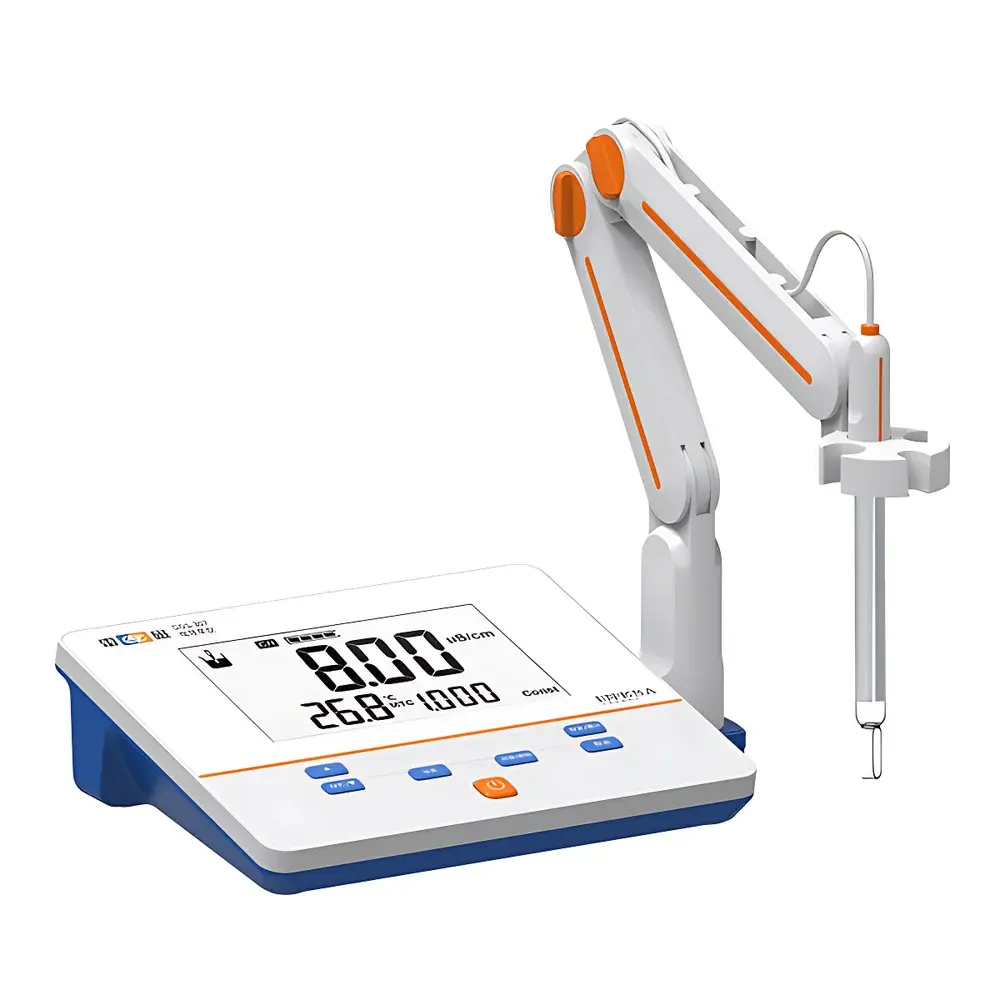
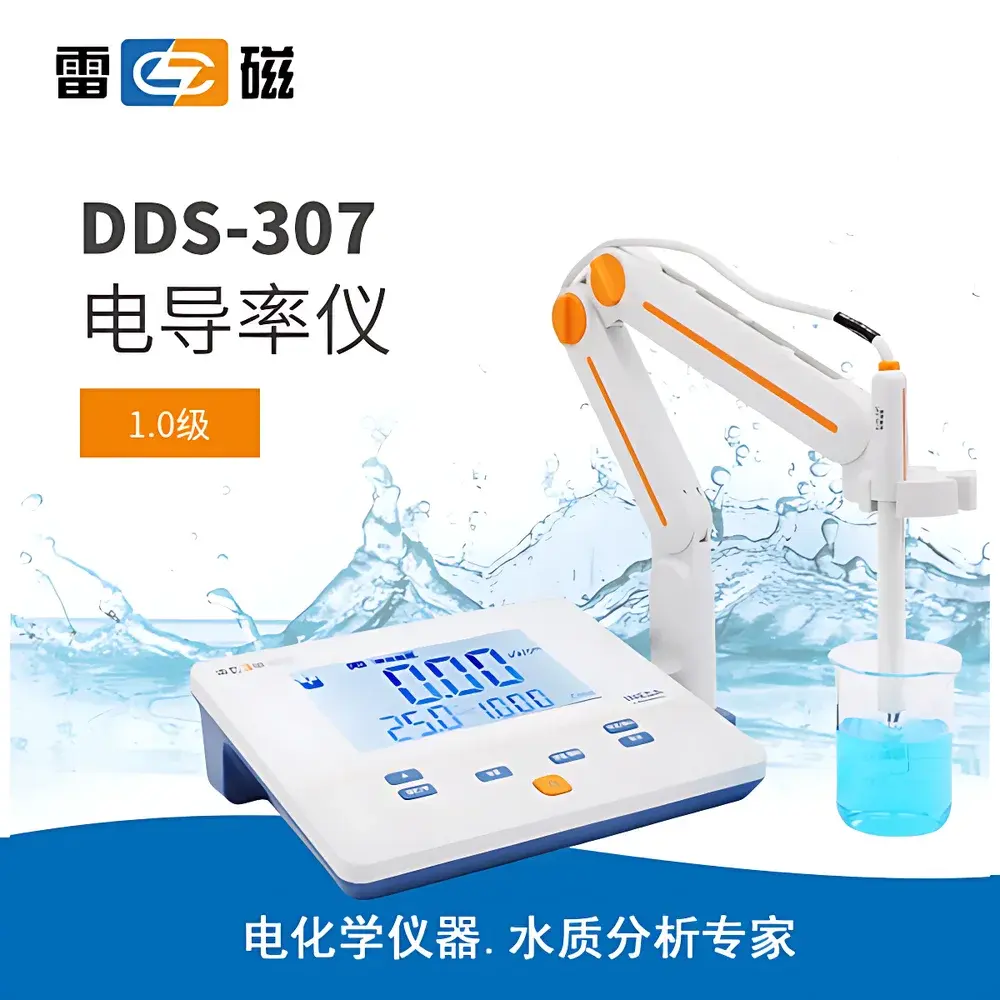
Leici DDS-307 Benchtop Conductivity Meter
| Brand | Leici |
|---|---|
| Origin | Shanghai, China |
| Manufacturer Type | Direct Manufacturer |
| Regional Origin | Domestic (China) |
| Model | DDS-307 |
| Price Range | USD 140–280 (FOB) |
| Measured Parameter | Conductivity Only |
| Form Factor | Benchtop |
| Intended Use | Laboratory |
| Conductivity Range | 0.00 µS/cm to 200 mS/cm |
| Accuracy | ±1.0% of Full Scale (FS) |
| Minimum Resolution | 0.01 µS/cm (auto-ranging) |
| Conductivity Class | Class 1.0 per GB/T 11018–2022 |
| Temperature Compensation | Manual |
| Calibration | Single-point with auto-recognition of 4 standard GB solutions (e.g., KCl 0.01 mol/L, 0.1 mol/L, 1.0 mol/L, and 0.001 mol/L) |
| Electrode Constant Support | Auto-frequency switching optimized for 1.0 cm⁻¹ cell |
| IP Rating | IP54 |
| Data Storage | 50 measurement records with timestamp, recall, and deletion |
| Display | High-contrast LCD with backlight |
| Power Supply | AC/DC adapter (Input: 100–240 VAC, Output: 20 VDC / 1500 mA) |
| Dimensions (W×D×H) | 242 × 195 × 68 mm |
| Weight | 0.9 kg |
Overview
The Leici DDS-307 is a benchtop conductivity meter engineered for routine laboratory applications requiring reliable, traceable, and compliant electrical conductivity measurements in aqueous solutions. Based on the principle of two-electrode AC conductometric measurement—applying a low-frequency alternating current across a pair of platinum electrodes and measuring the resulting conductance—the instrument determines solution conductivity by calculating the reciprocal of resistance, corrected for electrode geometry via cell constant calibration. Designed to meet national metrological standards (GB/T 11018–2022), it delivers Class 1.0 accuracy per Chinese regulatory classification, corresponding to an overall uncertainty budget suitable for quality control, environmental monitoring, and educational laboratories where ISO/IEC 17025-aligned practices are implemented but full GLP validation is not mandated.
Key Features
- Benchtop form factor with compact footprint (242 × 195 × 68 mm) and lightweight aluminum-chassis construction (0.9 kg), optimized for space-constrained lab benches.
- High-contrast monochrome LCD with backlight ensures legibility under varied ambient lighting conditions; intuitive membrane keypad supports tactile operation with minimal training.
- Auto-ranging circuitry dynamically selects optimal measurement frequency and gain to maintain resolution down to 0.01 µS/cm across the full 0.00 µS/cm–200 mS/cm span—enabling seamless transition from ultrapure water (e.g., ASTM D1193 Type I) to concentrated brines or industrial process streams.
- Manual temperature compensation (MTC) allows user-defined coefficient input (α = 0.0–3.0 %/°C), compatible with common electrolytes including NaCl, KCl, and CaCO₃-based systems.
- IP54-rated enclosure provides protection against dust ingress and water splashes during routine handling—suitable for shared instrumentation labs with moderate environmental variability.
- Integrated electrode detection logic verifies presence and basic integrity of the supplied 1.0 cm⁻¹ platinized-cell before measurement initiation, reducing operator-induced error.
Sample Compatibility & Compliance
The DDS-307 is validated for use with aqueous electrolyte solutions exhibiting conductivity up to 200 mS/cm—covering applications from deionized water QC (≤ 1 µS/cm) to wastewater effluent screening (≥ 10 mS/cm). It complies with GB/T 11018–2022 for laboratory conductivity meters and supports traceability through single-point calibration using four certified GB reference solutions (0.001, 0.01, 0.1, and 1.0 mol/L KCl). While not preconfigured for 21 CFR Part 11 compliance, its data storage architecture (50 timestamped entries with immutable record ID) permits manual audit trail reconstruction for internal QA review. The instrument does not support multi-parameter expansion or analog output; it is strictly a dedicated conductivity endpoint device.
Software & Data Management
Data handling is performed locally via non-volatile memory: each stored record includes conductivity value, temperature reading, date/time stamp, and calibration status flag. Users may browse, select, and delete individual entries directly from the front panel—no PC interface or proprietary software is provided. All stored data remain retained during power cycling due to built-in EEPROM backup. For laboratories requiring electronic record archiving, manual transcription into LIMS or Excel is supported. Firmware updates are not field-upgradable; version control is maintained at point of manufacture.
Applications
- Quality assurance of purified water systems (PW, WFI pre-checks) per pharmacopeial guidelines (USP , EP 2.2.38).
- Monitoring boiler feedwater and condensate purity in industrial maintenance programs.
- Environmental testing of surface water, groundwater, and leachates per EPA Method 120.1 and HJ/T 342–2007.
- Electrolyte concentration verification in battery electrolyte formulation and electroplating bath control.
- Academic instruction in analytical chemistry, physical chemistry, and environmental science laboratories.
FAQ
Does the DDS-307 support automatic temperature compensation (ATC)?
No—it provides manual temperature compensation only, requiring the user to input a fixed temperature coefficient (α) appropriate for the sample matrix.
Can third-party conductivity cells be used with this instrument?
Yes, provided they feature a standardized BNC connector and are calibrated with a known cell constant (e.g., 0.1, 1.0, or 10 cm⁻¹); however, auto-recognition and frequency optimization are guaranteed only with Leici-branded 1.0 cm⁻¹ electrodes.
Is calibration verification traceable to NIM or other national standards?
Calibration uses GB-certified KCl solutions, which are traceable to the National Institute of Metrology (NIM), China; certificate of analysis is supplied with each standard kit.
What power source options are available?
Only the included AC/DC adapter (20 VDC / 1500 mA) is supported; internal battery operation is not implemented.
Does the instrument meet ISO/IEC 17025 requirements for accredited testing?
It satisfies metrological performance criteria for Class 1.0 instruments per GB/T 11018–2022 and may be incorporated into a 17025 scope when paired with documented procedures, uncertainty budgets, and staff competency records—but no built-in audit trail or electronic signature functionality is present.
Related Products





