
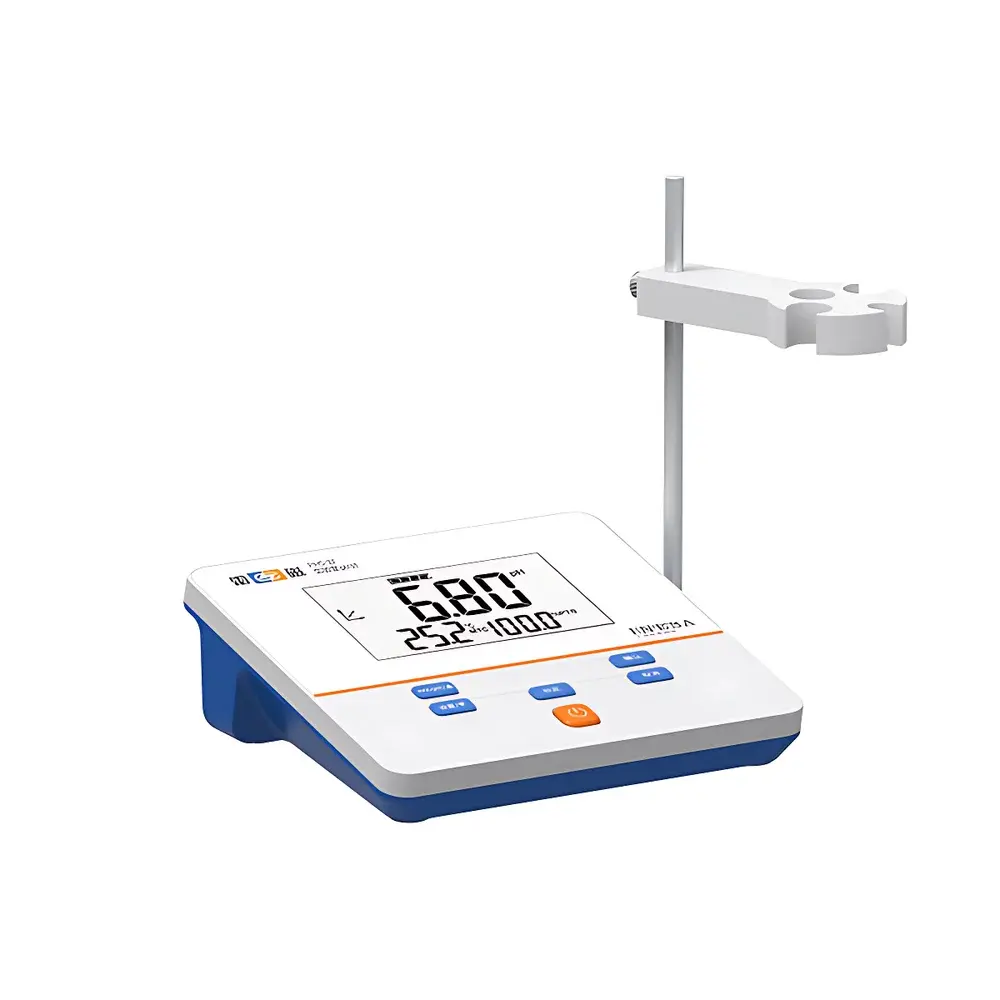
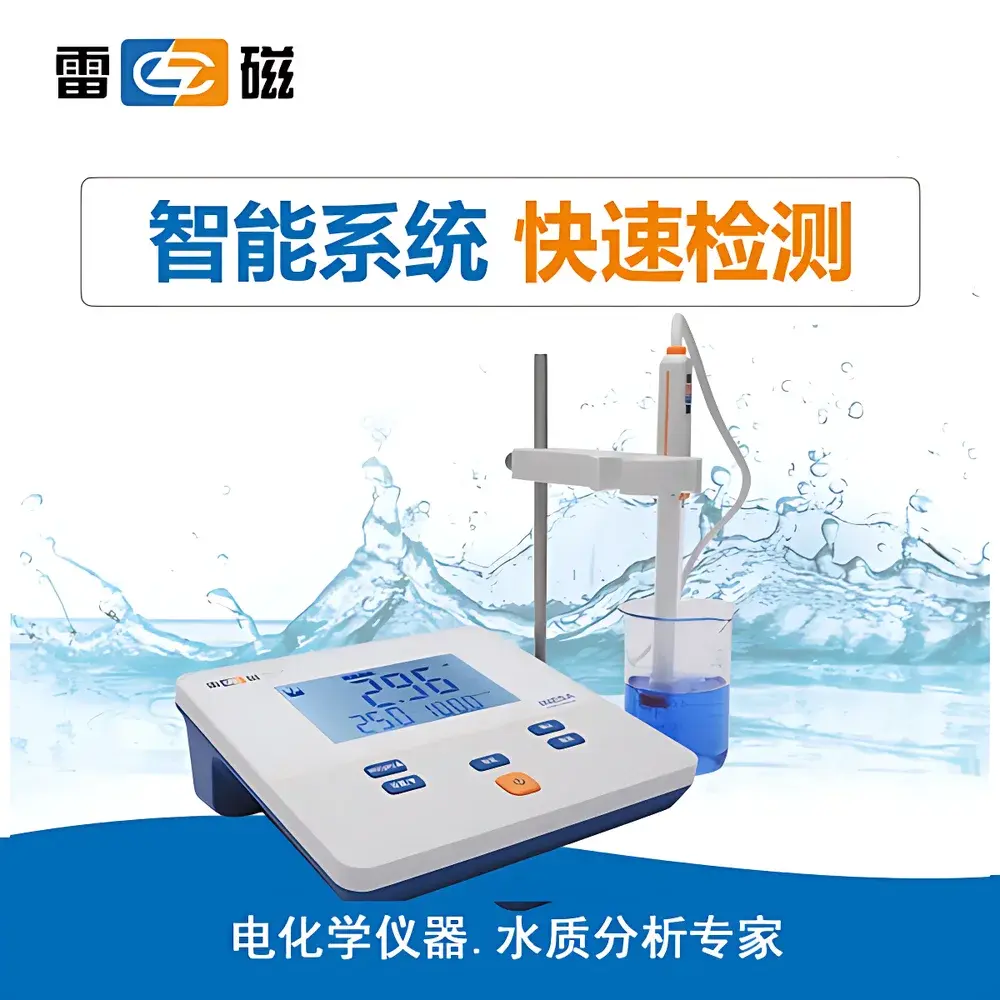
Leici PHS-2F Benchtop pH Meter
| Brand | Leici |
|---|---|
| Origin | Shanghai, China |
| Manufacturer Type | OEM Manufacturer |
| Regional Classification | Domestic (China) |
| Model | PHS-2F |
| Price Range | USD 140–280 |
| Instrument Type | Benchtop |
| Parameter Types | Dual (pH + mV) |
| pH Accuracy | ±0.01 pH |
| pH Range | 0.00–14.00 pH |
| pH Resolution | 0.01 pH |
| mV Range | −1800 to +1800 mV |
| mV Resolution | 1 mV |
| mV Accuracy | ±0.1% FS |
| Temperature Compensation | Manual |
| Calibration Standards | GB Standard Buffers (pH 4.00, 6.86, 9.18) |
| Calibration Points | 1–2 point |
| Display | High-contrast LCD with stability indicator |
| Enclosure Rating | IP54 |
| Power Supply | AC/DC adapter (Input: 100–240 VAC, Output: 20 VDC / 1500 mA) |
| Dimensions (L×W×H) | 200 × 160 × 63 mm |
| Weight | 0.6 kg |
Overview
The Leici PHS-2F Benchtop pH Meter is a precision electrochemical instrument engineered for routine pH and millivolt (mV) measurements in academic laboratories, quality control environments, and industrial process support settings. It operates on the fundamental principle of potentiometric measurement: the potential difference between a pH-sensitive glass electrode and a stable reference electrode is converted into a digital pH reading via Nernst equation-based signal processing. Designed to meet the performance requirements of ISO 8655-5 (volumetric instruments) and aligned with general laboratory compliance expectations for GLP documentation, the PHS-2F delivers reliable, repeatable results across aqueous and mildly buffered samples. Its dual-parameter capability—simultaneous pH and mV readout—enables both direct acidity assessment and redox potential evaluation without requiring instrument reconfiguration.
Key Features
- High-contrast monochrome LCD display with real-time stability indicator—visual confirmation of measurement equilibrium before data capture
- Intuitive membrane keypad interface with tactile feedback; supports one-handed operation during routine calibration or sample testing
- Auto-power-off function (configurable timeout) and power-loss memory retention—preserves last calibration status and user settings after unexpected shutdown
- IP54-rated enclosure—provides protection against dust ingress and water splashes from any direction, suitable for shared lab benches with moderate environmental exposure
- Smart buffer recognition system—automatically detects and validates GB-standard pH 4.00, 6.86, and 9.18 buffer solutions during calibration; also accepts user-defined buffer values for non-standard applications
- Manual temperature compensation (MTC) via numeric keypad entry—enables correction for solution temperature deviations from 25 °C using built-in Nernst slope adjustment
- Built-in factory reset and configuration restore functions—facilitates rapid recovery after misconfiguration or multi-user deployment
Sample Compatibility & Compliance
The PHS-2F is optimized for aqueous solutions with low to moderate ionic strength and minimal suspended solids. It accommodates standard combination pH electrodes (BNC connector) compatible with common laboratory buffers, tap water, wastewater effluents, food extracts, and pharmaceutical preparations. While not certified for hazardous area use or continuous online monitoring, it complies with IEC 61010-1:2010 safety standards for electrical equipment used in laboratory environments. Its 0.02-class accuracy rating aligns with national metrological verification regulations in China (JJG 119–2018), and its calibration traceability supports internal audit requirements under ISO/IEC 17025. The instrument does not incorporate electronic audit trail or 21 CFR Part 11-compliant user authentication, and therefore is intended for non-GMP environments where formal electronic record integrity is not mandated.
Software & Data Management
The PHS-2F operates as a standalone electrochemical analyzer with no embedded data logging or PC connectivity. All measurements are displayed in real time and must be manually recorded. No proprietary software, drivers, or USB/RS-232 interfaces are provided. This design prioritizes operational simplicity, electromagnetic interference resilience, and long-term reliability over digital integration—making it particularly suitable for teaching labs, field-deployed satellite labs, or facilities with strict IT security policies restricting peripheral device attachment. Calibration history is retained in volatile memory and persists across power cycles only when the internal backup capacitor remains charged; users are advised to document calibration dates and buffer assignments externally for traceability.
Applications
- Academic instruction in general chemistry and analytical laboratory courses—ideal for introducing students to electrode theory, calibration methodology, and error sources in potentiometry
- QC testing of raw materials and finished products in food & beverage, cosmetics, and water treatment sectors—e.g., verifying pH consistency of rinse waters, cleaning agents, or emulsion formulations
- Environmental monitoring of surface water, groundwater, and treated effluent per EPA Method 150.1 and ISO 10523 guidelines
- Supporting titration endpoint detection where mV mode provides redox potential tracking alongside pH trends
- Validation of buffer preparation accuracy and shelf-life assessment of calibration standards
FAQ
Does the PHS-2F support automatic temperature compensation (ATC)?
No—it requires manual temperature entry prior to measurement. An external Pt100 or thermistor probe cannot be connected.
Can third-party pH electrodes be used with this meter?
Yes, provided they feature a standard BNC connector and operate within the input impedance tolerance of ≥1 × 10¹² Ω.
Is the instrument supplied with calibration certificates?
No—factory calibration is performed per internal QA protocols, but NIST-traceable certificate of calibration is not included. Users must arrange third-party certification if required.
What is the expected service life of the included composite pH electrode?
Under normal usage (≤4 hours/day, proper storage in KCl solution), the electrode typically maintains specification for 12–18 months before drift exceeds ±0.02 pH.
Does the PHS-2F comply with FDA 21 CFR Part 11?
No—it lacks electronic signature capability, audit trail generation, and secure user access controls required for regulated pharmaceutical or biotech workflows.
Related Products





