
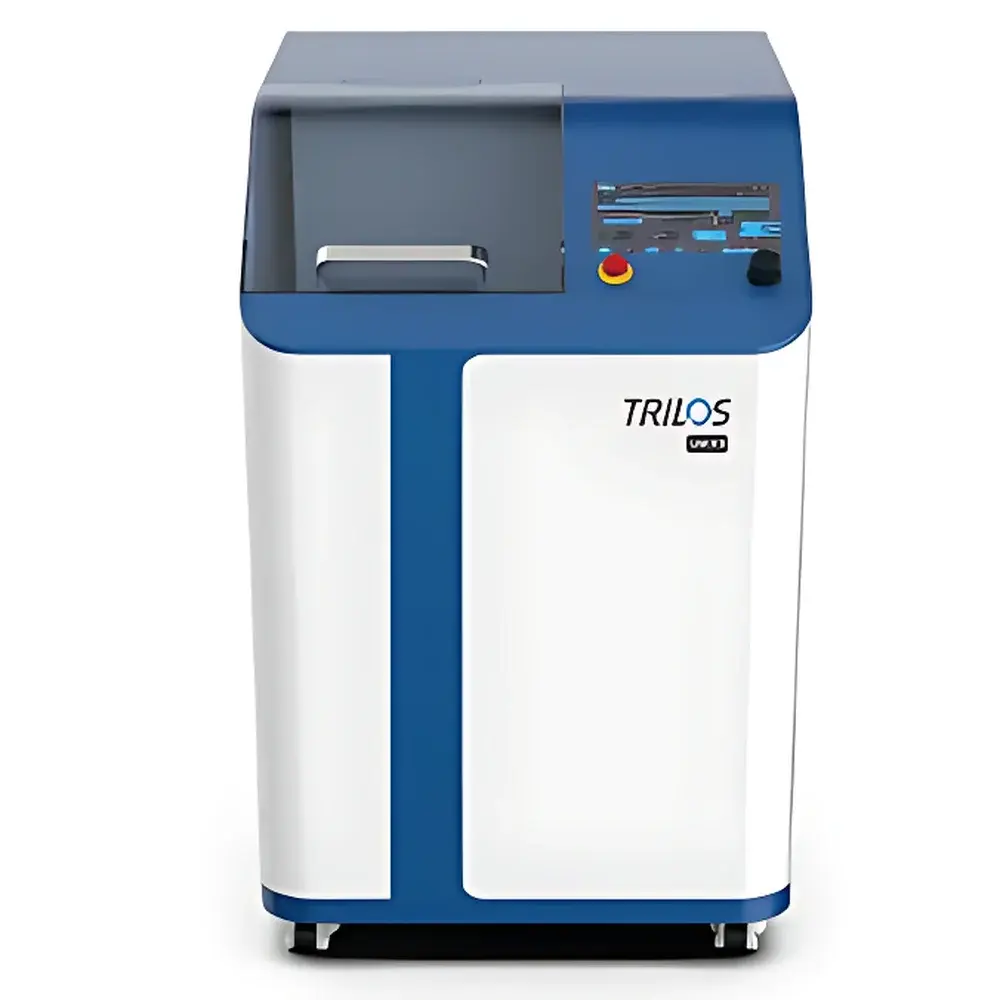
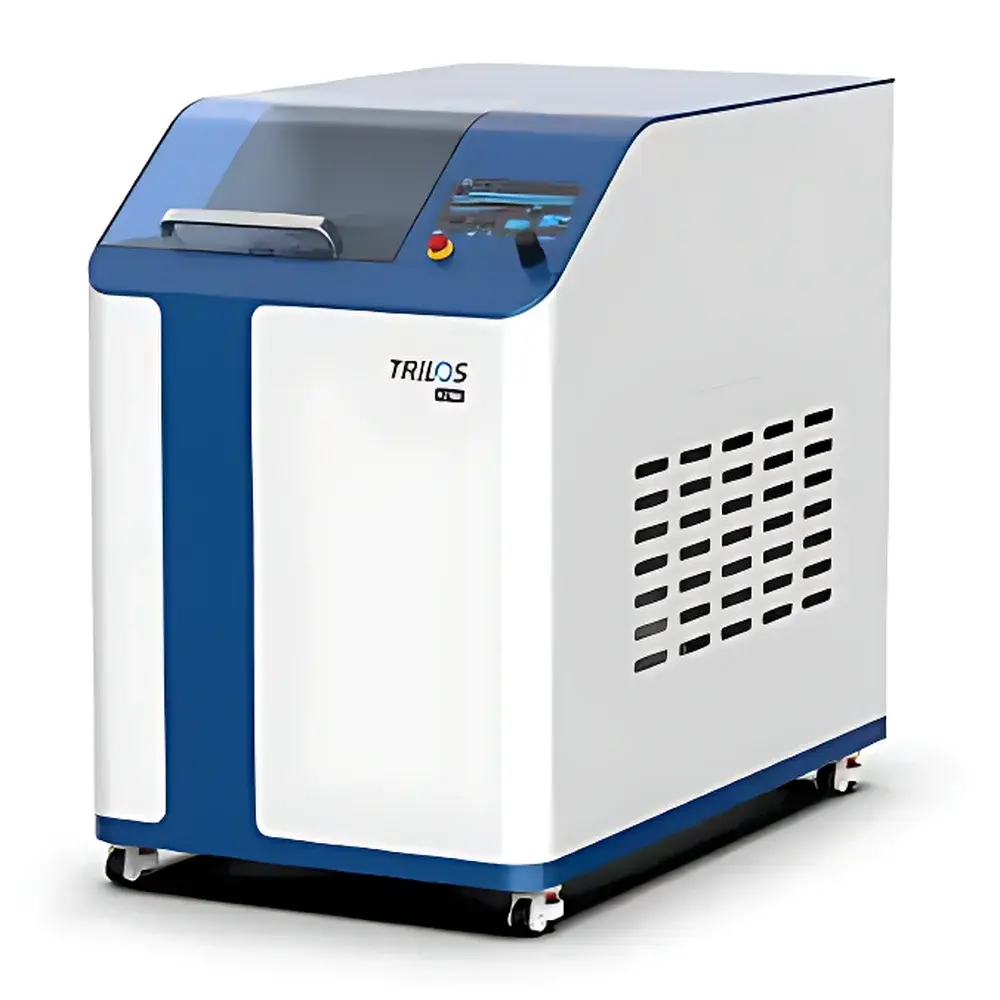
TRILOS ND1000 Ultra-High-Pressure Microfluidic Nanohomogenizer
| Brand | TRILOS |
|---|---|
| Origin | USA |
| Model | ND1000 |
| Instrument Type | High-Pressure Homogenizer |
| Dimensions (W×D×H) | 920 × 680 × 1150 mm |
| Maximum Batch Volume | < 5000 mL |
| Throughput | 60 L/h |
| Operating Pressure | 2000 bar (200 MPa) |
| Inlet Particle Size | < 500 µm |
| Max. Feed Viscosity | < 10,000 cP |
| Feed Temperature Range | < 90 °C |
| Online Temperature Control Range | 10–90 °C |
| Minimum Single-Batch Volume | 5000 mL |
| Homogenization Stage | Single-stage |
| Ambient Operating Conditions | 3–40 °C, ≤90% RH |
| CIP Cycle | 30 min @ ≤90 °C, 60 L/h water consumption |
Overview
The TRILOS ND1000 is an ultra-high-pressure microfluidic nanohomogenizer engineered for precision nanoscale particle size reduction and uniform dispersion in laboratory and pilot-scale applications. It operates on the principle of microfluidization—where fluid is forced under controlled high pressure through precisely engineered interaction chambers (Z-type or Y-type), generating intense shear, cavitation, turbulent flow, and collision-based mechanical energy transfer. Unlike traditional valve-based homogenizers, the ND1000 employs a fixed-geometry microchannel disperser that ensures consistent hydraulic residence time, repeatable energy input per pass, and minimal thermal load variation across batches. This architecture delivers exceptional reproducibility in particle size distribution (PSD), critical for formulation development in regulated environments such as pharmaceuticals and biologics. Designed to bridge the gap between benchtop feasibility studies and early-stage process validation, the ND1000 supports scalable process mapping from R&D to GMP-aligned pilot production.
Key Features
- Stainless-steel sanitary construction compliant with 3-A and ASME BPE standards; all wetted surfaces electropolished to Ra ≤ 0.4 µm
- Fixed-geometry Z/Y-type microfluidic interaction chamber enabling deterministic energy delivery and batch-to-batch consistency
- Real-time PLC-controlled pressure regulation (up to 2000 bar) with digital diaphragm pressure monitoring and overpressure safety relief
- Integrated temperature-controlled recirculation loop with ±0.5 °C stability across 10–90 °C operating range
- Dual hygienic tri-clamp connections (inlet/outlet) compatible with ISO 2852 and DIN 11851 standards
- Self-contained CIP system supporting automated cleaning cycles at up to 90 °C using ≤60 L/h water flow
- 11 kW high-efficiency motor (IE3 class, IP55 enclosure, Class F insulation) optimized for continuous-duty operation
- CE-certified mechanical safety architecture including emergency stop circuitry, interlocked access panels, and pressure-hold verification logic
Sample Compatibility & Compliance
The ND1000 accommodates a broad spectrum of complex fluids—including liposomal suspensions, protein-based therapeutics, ceramic nanoparticle slurries (e.g., SiO₂, ZrO₂, Al₂O₃), conductive pastes, and high-viscosity emulsions (<10,000 cP). Feed solids content may reach up to 40 wt%, provided inlet particles remain below 500 µm. The system meets key regulatory expectations for equipment used in GLP and early-phase GMP workflows: full audit trail capability via timestamped event logging, user-access-level control (admin/operator), and electronic signature support aligned with FDA 21 CFR Part 11 principles. All mechanical design documentation conforms to EN ISO 12100 (risk assessment) and EN 60204-1 (electrical safety). Material certifications (EN 10204 3.1) are available for all primary contact components.
Software & Data Management
Equipped with an industrial-grade HMI touchscreen interface running embedded Linux OS, the ND1000 logs all operational parameters—including pressure profile, temperature history, total processing time, number of passes, and motor load—in CSV-compatible format. Optional Ethernet/IP or Modbus TCP connectivity enables integration into centralized MES or SCADA platforms. Raw data files include cryptographic hash signatures for integrity verification. Historical run records are retained for ≥12 months onboard and can be exported via USB or network share. Firmware updates follow IEC 62443-2-4 secure update protocols, with version rollback capability and signed firmware image validation.
Applications
- Pharmaceutical nanomedicine: Preparation of lipid nanoparticles (LNPs), nanoemulsions, liposomes, polymeric micelles, and sterile suspensions meeting USP and Ph. Eur. 2.9.35 requirements
- Bioprocessing: Controlled lysis of bacterial, yeast, and mammalian cells without denaturation; recovery of intracellular proteins and nucleic acids
- Advanced materials: Deagglomeration and surface functionalization of carbon nanotubes, graphene oxide, metal oxides, and quantum dots
- Food & beverage: Cold homogenization of dairy alternatives, plant-based proteins, and probiotic suspensions to enhance shelf-life and mouthfeel
- Cosmetics & personal care: Stabilization of oil-in-water and water-in-oil nanoemulsions for active ingredient delivery
- Electronics manufacturing: Production of homogeneous conductive inks and dielectric pastes for printed electronics
FAQ
What is the maximum allowable feed viscosity for stable operation?
The ND1000 maintains reliable performance with feed viscosities up to 10,000 cP at 25 °C, provided inlet particle size remains below 500 µm and temperature is maintained within the specified range.
Can the system operate in closed-loop recirculation mode?
Yes—the ND1000 supports fully automated recirculation with programmable pass counting, real-time pressure feedback, and dynamic flow rate modulation to maintain constant energy input per pass.
Is the interaction chamber replaceable, and what is its service life?
The Z/Y-type microfluidic chamber is a wear-part with documented lifetime exceeding 500 operational hours under standard conditions; replacement is performed via calibrated torque tooling and requires post-installation pressure calibration.
Does the system comply with FDA 21 CFR Part 11 for electronic records?
While the base configuration provides audit-trail logging and user authentication, full Part 11 compliance (including electronic signatures and system validation support) is enabled through optional software licensing and IQ/OQ documentation packages.
What maintenance intervals are recommended for routine operation?
Daily visual inspection of seals and clamps; weekly lubrication of non-submerged mechanical linkages; quarterly verification of pressure transducer accuracy and safety valve setpoint; annual full calibration and chamber wear assessment per TR-MAINT-ND1000 protocol.



