
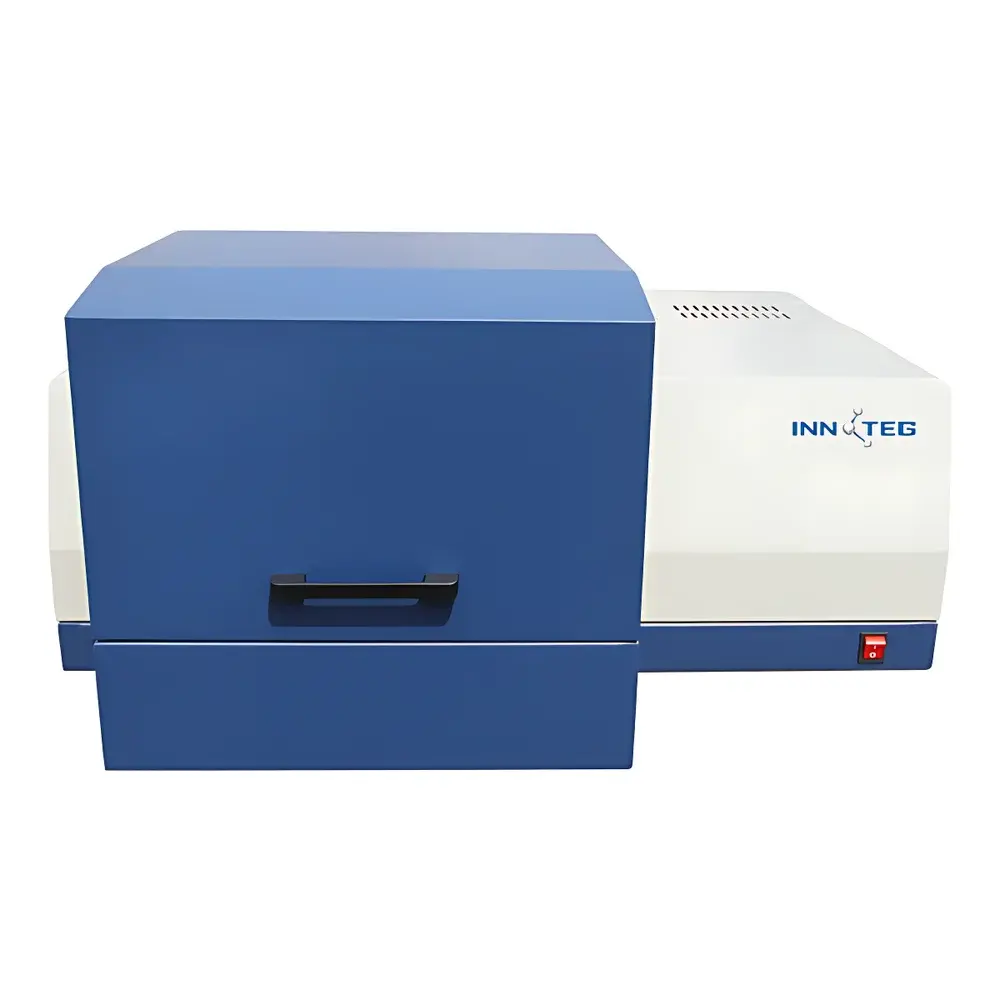
INNOTEG IUS-200-15 UV-Vis-NIR Spectrophotometer
| Brand | INNOTEG |
|---|---|
| Origin | Guangdong, China |
| Manufacturer Type | Authorized Distributor |
| Product Origin | Domestic (China) |
| Model | IUS-200-15 |
| Spectral Range | 280–2500 nm |
| Slit Bandwidth | UV-VIS: 0.2, 0.5, 1, 2, 3, 5 nm |
| NIR | 0.8, 2, 4, 8, 12, 20 nm |
| Wavelength Accuracy | ±0.5 nm (UV/VIS), ±2.0 nm (NIR) |
| Wavelength Repeatability | ≤0.3 nm (UV/VIS), ≤1.0 nm (NIR) |
| Integrating Sphere Diameter | 150 mm |
| Optical Design | Dual-beam, dual-grating, dual-detector architecture |
| Detector Configuration | Separate optimized detectors for UV/VIS and NIR ranges |
| Software Compatibility | Windows 7/10 |
| Data Export Formats | TXT, CSV, XLSX |
| Compliance Standards | GB/T 2680-2021, JGJ/T 151-2008, ISO 9050:2003, GB/T 22476-2008, GB/T 36261-2018, GB/T 25261-2010, JG/T 235-2014, JGJ/T 287-2014, GJB 798-90, GJB 2502.2-2006 |
Overview
The INNOTEG IUS-200-15 UV-Vis-NIR Spectrophotometer is a high-performance, dual-beam optical instrument engineered for precise spectral characterization across the ultraviolet (280 nm), visible (380–780 nm), and near-infrared (780–2500 nm) regions. It employs a rigorously calibrated dual-grating monochromator system coupled with spectrally optimized dual-detector architecture—separate silicon photodiode for UV-VIS and extended-range InGaAs detector for NIR—to ensure consistent signal-to-noise ratio and minimal baseline drift across the full operational range. The integrated 150 mm integrating sphere enables direct measurement of transmittance, specular reflectance, and diffuse reflectance without mechanical reconfiguration, supporting standardized optical property evaluation of planar and semi-diffusing materials. Its optical design minimizes stray light and polarization sensitivity, delivering high reproducibility in compliance with international photometric and radiometric testing protocols.
Key Features
- Dual-beam, dual-grating optical path architecture with real-time reference beam correction to suppress source intensity fluctuation and thermal drift.
- Configurable slit bandwidth selection: six discrete settings in UV-VIS (0.2–5 nm) and six in NIR (0.8–20 nm), enabling resolution-flexible method development per application requirements.
- Integrated 150 mm PTFE-coated integrating sphere with baffle-controlled port geometry, certified for bidirectional reflectance distribution function (BRDF)-compatible measurements per ASTM E275 and ISO/CIE standards.
- Automated wavelength calibration using internal holmium oxide and didymium reference filters; self-diagnostic startup sequence validates grating positioning, detector linearity, and lamp stability prior to measurement.
- Thermally stabilized sample compartment accommodating specimens up to 250 × 250 × 20 mm—optimized for architectural glass, coated substrates, textiles, and liquid cuvettes (10 mm pathlength standard).
- Modular firmware architecture supporting future protocol updates for emerging industry-specific test methods (e.g., solar heat gain coefficient derivation per ISO 15099).
Sample Compatibility & Compliance
The IUS-200-15 supports quantitative optical analysis of rigid, semi-rigid, and liquid samples conforming to national and international regulatory frameworks. Its measurement engine satisfies metrological traceability requirements outlined in GB/T 2680-2021 (optical properties of building glass), JGJ/T 151-2008 (energy performance calculation), and ISO 9050:2003 (determination of luminous and solar photometric properties). For coated optics and functional films, it delivers data compliant with GJB 798-90 (military specification for optical coatings) and GJB 2502.2-2006 (infrared transmittance testing). All spectral acquisitions adhere to GLP-aligned audit trails: timestamped raw scans, user-defined metadata tagging, and immutable parameter logging—including slit width, integration time, detector gain, and ambient temperature—ensuring full 21 CFR Part 11 readiness when deployed in regulated QC environments.
Software & Data Management
The dedicated INNOTEG SpectraSuite software provides a validated, Windows-based interface for instrument control, spectral acquisition, and post-processing. It implements automated baseline correction algorithms (including multipoint linear and polynomial interpolation), Kubelka-Munk transformation for diffuse reflectance quantification, and built-in calculators for solar transmittance (Tsol), luminous transmittance (Tlum), and shading coefficient (SC) per ISO 15099 Annex D. Data export conforms to ASTM E131-compliant spectral file formats (.txt, .csv, .xlsx) with embedded header metadata (wavelength units, detector type, calibration date). The software supports batch processing of multi-sample sequences, comparative overlay visualization, and customizable report generation—including annotated spectra, tabulated peak tables, and pass/fail flagging against user-defined specification limits. Audit logs record all operator actions, method changes, and calibration events with digital signature capability.
Applications
- Architectural glazing: Determination of solar optical properties (Tsol, Rsol, Asol) for energy modeling and compliance with ASHRAE 90.1 and EN 410.
- Automotive glass: Quantitative assessment of UV blocking efficiency (>99% at 320 nm), haze, and colorimetric coordinates (CIE L*a*b*) under D65 illumination.
- Functional coatings: Thickness-independent evaluation of anti-reflective, low-emissivity (low-E), and selective absorber layers via interference fringe analysis.
- Textile and polymer films: Measurement of NIR reflectance profiles for moisture content estimation and pigment dispersion homogeneity.
- Solution-phase spectroscopy: Quantitative analysis of carbohydrate solutions (glucose, fructose, sucrose) using second-derivative absorbance peaks in the 1900–2200 nm region.
- Materials R&D: Characterization of quantum dot dispersions, perovskite thin films, and thermochromic polymers across extended spectral domains.
FAQ
What spectral resolution options are available in UV-VIS and NIR ranges?
The instrument offers six programmable slit bandwidths: 0.2, 0.5, 1, 2, 3, and 5 nm in UV-VIS; and 0.8, 2, 4, 8, 12, and 20 nm in NIR—each selectable via software without hardware modification.
Is the integrating sphere removable or fixed?
The 150 mm integrating sphere is permanently integrated into the optical housing to maintain alignment stability and minimize recalibration frequency; no field removal is supported.
Does the system support 21 CFR Part 11 compliance?
Yes—when configured with password-protected user roles, electronic signatures, and enabled audit trail logging, the software meets core technical requirements for Part 11 validation in pharmaceutical and medical device QA laboratories.
Can the instrument measure absolute reflectance without external standards?
No—absolute reflectance requires calibration against NIST-traceable reference standards (e.g., Spectralon® SRM 990) prior to sample measurement; the software includes dedicated routines for standard-based normalization.
What is the maximum sample thickness accommodated in transmission mode?
The sample stage accepts specimens up to 20 mm thick; for thicker solids, optional extended-path accessories (e.g., 50 mm cuvette holders) are available through INNOTEG’s OEM integration program.






