
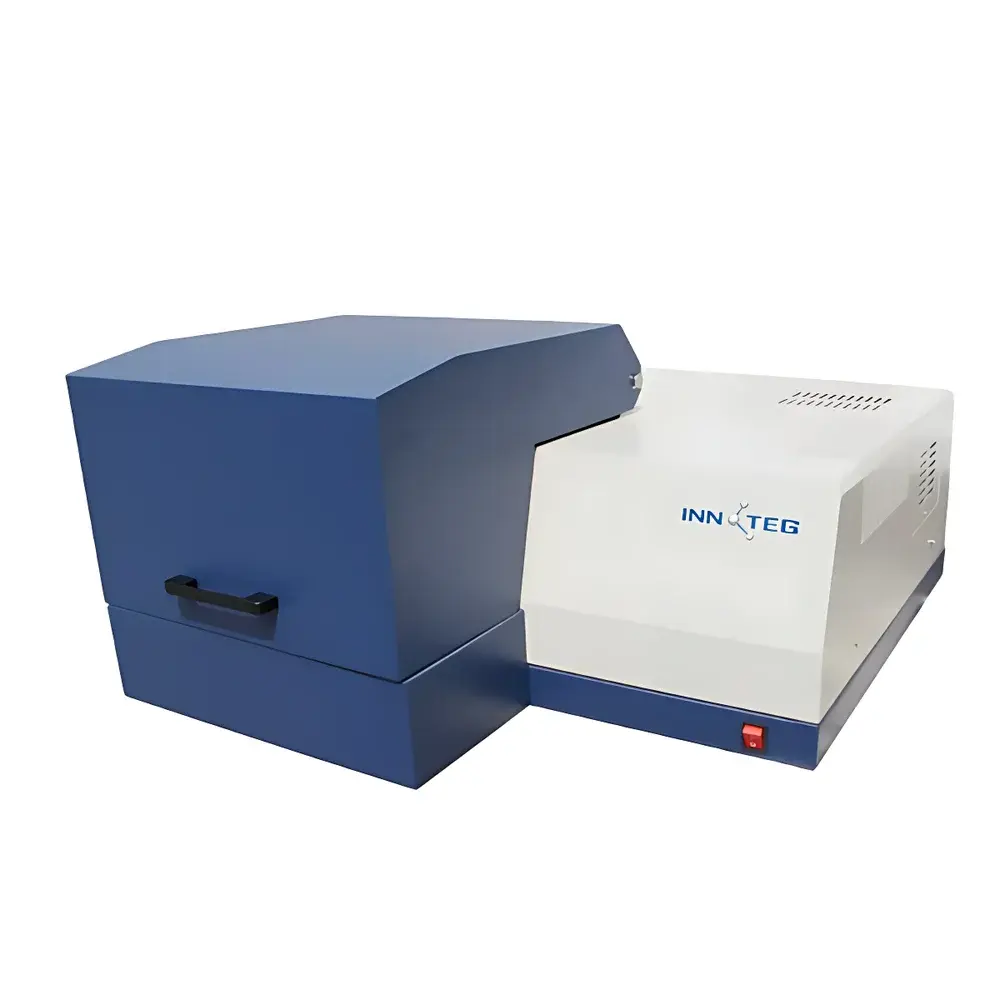
INNOTEG IUS-200-10 UV-Vis-NIR Spectrophotometer
| Brand | INNOTEG |
|---|---|
| Origin | Guangdong, China |
| Manufacturer Type | Authorized Distributor |
| Product Origin | Domestic (China) |
| Model | IUS-200-10 |
| Spectral Range | 280–2500 nm |
| Slit Bandwidth | UV-VIS: 0.2, 0.5, 1, 2, 3, 5 nm |
| NIR | 0.8, 2, 4, 8, 12, 20 nm |
| Wavelength Accuracy | ±0.5 nm (UV/VIS), ±2.0 nm (NIR) |
| Wavelength Repeatability | ≤0.3 nm (UV/VIS), ≤1.0 nm (NIR) |
Overview
The INNOTEG IUS-200-10 UV-Vis-NIR Spectrophotometer is a dual-beam, double-grating, dual-detector optical instrument engineered for high-fidelity spectral characterization across the ultraviolet, visible, and near-infrared regions (280–2500 nm). Its integrated integrating sphere module—featuring a 100 mm diameter sphere with broadband baffle design—enables simultaneous measurement of transmittance, specular reflectance, and diffuse reflectance without mechanical reconfiguration. The optical architecture minimizes stray light and baseline drift through balanced beam path compensation and thermally stabilized grating mounts. This system is purpose-built for materials requiring compliance with building envelope performance standards, including solar heat gain coefficient (SHGC), visible light transmittance (VLT), and near-infrared rejection—critical parameters in architectural glazing, coated substrates, and functional thin films.
Key Features
- Dual-beam optical design with real-time reference channel correction, ensuring long-term photometric stability under variable ambient conditions.
- Double-grating monochromator: UV/VIS and NIR gratings are independently optimized for resolution and throughput, enabling selectable slit bandwidths (0.2–5 nm in UV/VIS; 0.8–20 nm in NIR) via motorized aperture control.
- Co-located dual-detector system: Silicon photodiode (280–1000 nm) and extended InGaAs detector (900–2500 nm) with automatic switchover at 900 nm, eliminating spectral gaps and reducing signal-to-noise degradation in weak-intensity regions.
- Integrated 100 mm PTFE-coated integrating sphere with bi-directional port configuration—supports both transmission and bidirectional reflectance measurements on solid, semi-transparent, or textured samples up to 300 × 300 × 20 mm.
- Automated wavelength calibration using internal holmium oxide and didymium reference filters; full-system validation traceable to NIST-traceable standards.
- Thermally managed optics enclosure with active air circulation, maintaining optical alignment stability over 8-hour continuous operation.
Sample Compatibility & Compliance
The IUS-200-10 accommodates rigid flat panels (e.g., architectural glass, PV encapsulants), flexible textiles, liquid cuvettes (10 mm pathlength standard), and powder pellets. Its large sample compartment supports direct mounting of automotive windshields and laminated safety glass without disassembly. The instrument meets metrological requirements of multiple international and national standards, including ISO 9050:2003 (optical properties of glazing), GB/T 2680–2021 (determination of optical properties of building glass), JGJ/T 151–2008 (energy performance testing of curtain walls), and GJB 2502.2–2006 (military specification for infrared transmittance of optical materials). Data acquisition workflows support GLP-compliant audit trails, with timestamped calibration logs and user-accessible metadata embedding per spectrum.
Software & Data Management
Control and analysis are executed via INNOTEG SpectraSuite v4.2—a Windows 7/10 native application compliant with FDA 21 CFR Part 11 for electronic records and signatures. The software provides real-time spectral preview, multi-curve overlay, derivative spectroscopy, and built-in calculation modules for SHGC, U-value, and solar transmittance per ISO 15099. All raw spectra are stored in vendor-neutral .spc format with embedded instrument configuration, date/time stamps, and operator ID. Export options include CSV, TXT, and Excel-compatible XLSX files—with column headers conforming to ASTM E275 nomenclature. Reporting templates are customizable for lab accreditation (e.g., CNAS, A2LA) and include pass/fail thresholds aligned with GB/T 36261–2018 and JG/T 235–2014.
Applications
- Architectural glazing evaluation: Quantification of solar spectral transmittance, reflectance, and absorptance for energy modeling and daylighting simulation inputs.
- Automotive glass certification: Measurement of photopic transmittance (Tv) and NIR blocking efficiency (800–2500 nm) per SAE J576 and ECE R43.
- Coating and pigment R&D: Analysis of absorption edge shifts, bandgap estimation, and Kubelka-Munk transformation for scattering media.
- Functional textile assessment: NIR reflectance profiling of IR-reflective fabrics used in thermal management apparel and camouflage systems.
- Sugar solution quantification: Calibration-free concentration determination of glucose, fructose, and sucrose via characteristic C–O and O–H overtone bands in the 1600–2200 nm region.
- Research-grade material screening: Optical constant derivation (n, k) from Kramers-Kronig transformed reflectance data on dielectric and semiconductor thin films.
FAQ
Does the IUS-200-10 support automated mapping of spatially heterogeneous samples?
No—this model is designed for single-point macro-area measurement. Spatial mapping requires optional XY stage integration, available as an aftermarket accessory kit (IUS-MAP-200).
Is the integrating sphere certified for absolute reflectance measurements?
Yes—the sphere’s PTFE coating is calibrated against NIST SRM 990c (diffuse reflectance standard) and includes factory-provided reflectance correction curves for each detector segment.
Can the system be validated for ISO/IEC 17025 accredited laboratories?
Yes—full validation documentation (IQ/OQ/PQ protocols), uncertainty budgets per GUM guidelines, and traceable calibration certificates are provided with each unit.
What maintenance intervals are recommended for optical alignment verification?
Wavelength accuracy and photometric linearity should be verified quarterly using supplied holmium oxide and neutral density filters; annual recalibration by INNOTEG-certified service engineers is advised.
Is remote operation supported over LAN or Ethernet?
Yes—SpectraSuite supports TCP/IP-based command-line control (SCPI protocol) for integration into automated test benches and LIMS environments.






