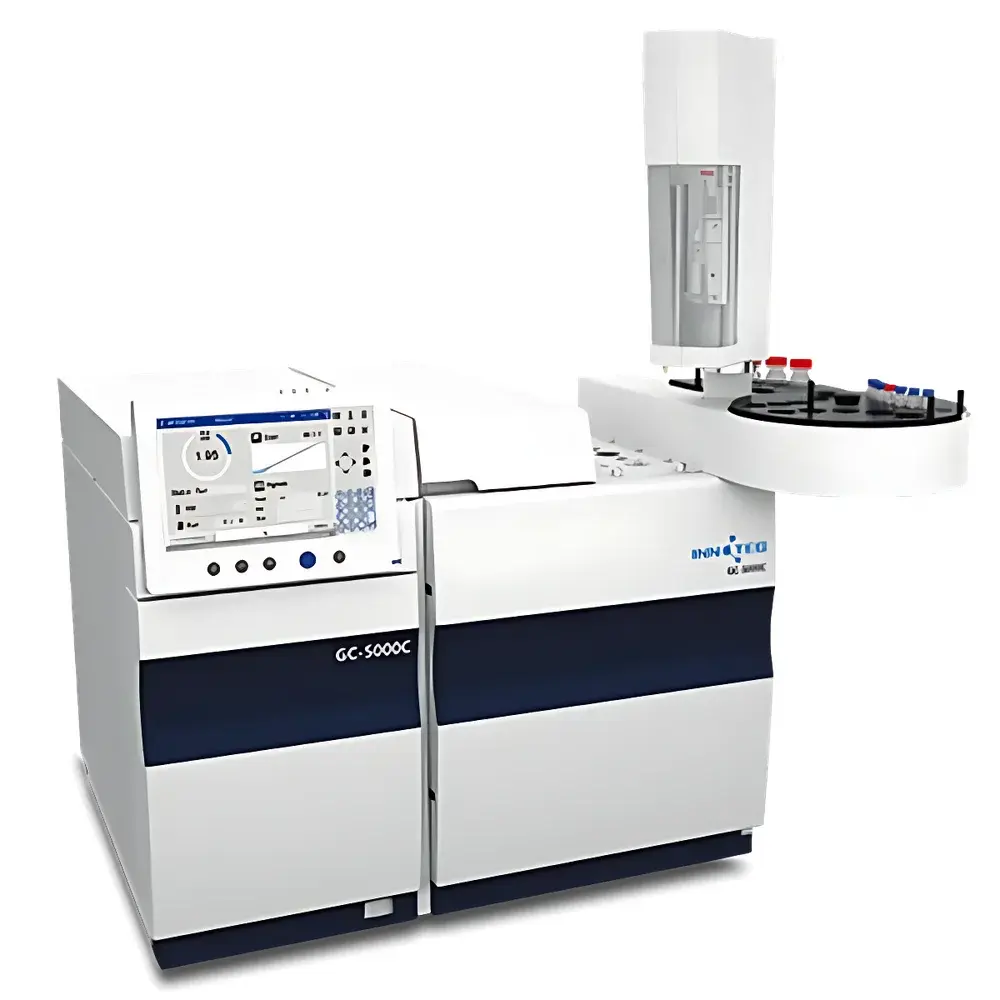
INNOTEG GC-5000C Used Gas Chromatograph
| Brand | INNOTEG |
|---|---|
| Model | GC-5000C |
| Origin | Guangdong, China |
| Manufacturer Type | Authorized Distributor |
| Country of Manufacture | China |
| Price Range | USD 14,000 – 28,000 (FOB) |
| Column Oven Temperature Range | Ambient + 5°C to 450°C |
| Max Ramp Rate | 150°C/min |
| Temperature Control Zones | 5 Standard + 4 Optional |
| Display | 9-inch Full-Color Touchscreen |
| Injector Configurations | Up to 3 Inlet Ports (simultaneous dual-injection capable) |
| Carrier Gas Control | Electronic Flow Control (EFC) |
| Compliance | Designed to meet ISO/IEC 17025 laboratory requirements for chromatographic analysis |
Overview
The INNOTEG GC-5000C is a robust, benchtop gas chromatograph engineered for precision separation and quantitative analysis of volatile and semi-volatile organic compounds. Based on classical capillary gas chromatography principles—employing carrier gas-driven partitioning across a thermally stable stationary phase—the GC-5000C delivers high reproducibility in retention time and peak area under controlled temperature programming. Its architecture integrates modular inlet systems, a precisely regulated column oven with rapid thermal response, and EFC-based carrier gas delivery to ensure consistent linear velocity and optimal resolution across diverse analyte classes. Designed and assembled in Guangdong, China, the instrument adheres to internationally recognized mechanical and electrical safety standards (IEC 61010-1), and its firmware supports audit-ready operation in regulated environments where traceability and method integrity are critical.
Key Features
- Modular inlet configuration supporting up to three independent ports—including split/splitless, PTV, and cool-on-column options—with capability for simultaneous dual-injection to increase throughput without compromising method fidelity.
- Column oven with five standard temperature-controlled zones (oven, injector, detector, transfer line, and auxiliary) plus four optional zones for advanced multi-detector or multi-column setups.
- Ultra-fast heating and cooling performance: maximum ramp rate of 150°C/min across full voltage range; oven temperature stability ±0.01°C at setpoint, with uniformity ≤0.5°C across 25 cm axial length.
- 9-inch capacitive touchscreen interface with intuitive icon-driven navigation, real-time chromatogram preview, and embedded method editor supporting gradient programming, event-triggered valve switching, and detector parameter scheduling.
- Electronic Flow Control (EFC) system calibrated for nitrogen, helium, and hydrogen carriers—providing flow accuracy ±0.5% of reading and repeatability <0.2% RSD over 24 hours.
- Front-access service design with tool-free column installation, quick-detach detector modules, and self-diagnostic routines accessible via service menu.
Sample Compatibility & Compliance
The GC-5000C accommodates a broad spectrum of sample matrices—including environmental water extracts, petrochemical distillates, food flavor volatiles, pharmaceutical residual solvents, and polymer additives—when paired with appropriate column chemistries (e.g., 5% phenyl methylpolysiloxane, polyethylene glycol, or cyanopropylphenyl columns). It complies with key analytical standards including ASTM D3606 (benzene/toluene in gasoline), ISO 11843-2 (detection limit validation), and USP (residual solvents). While not pre-certified for 21 CFR Part 11, the system supports user-configurable electronic signatures, audit trail logging (retained for ≥180 days), and password-protected method locking—enabling alignment with GLP and GMP documentation practices when deployed with validated SOPs.
Software & Data Management
Instrument control and data acquisition are managed through INNOTEG ChromaSuite v3.x—a Windows-based application supporting both local PC operation and remote web-enabled monitoring via Ethernet. The software provides real-time signal visualization, automated peak integration using iterative baseline correction algorithms, customizable report templates (PDF/CSV/XLSX export), and raw data archiving compliant with FAIR principles (Findable, Accessible, Interoperable, Reusable). All method files include embedded metadata (operator ID, timestamp, instrument serial, calibration status), and raw .chd files are stored in open-binary format for third-party reprocessing (e.g., in OpenChrom or Chromeleon). Data backup can be scheduled to network drives or NAS devices with SHA-256 checksum verification.
Applications
- Environmental testing: VOC screening in air canisters (EPA TO-17), pesticide residue analysis in soil/water (EPA 8081B), and BTEX quantification in groundwater.
- Pharmaceutical QC: Residual solvent profiling per ICH Q3C guidelines using headspace-GC/FID or GC/MS coupling.
- Food & beverage: Flavor compound fingerprinting (esters, aldehydes, terpenes), ethanol content determination, and adulteration detection in essential oils.
- Petrochemical QA: Hydrocarbon group-type analysis (PIONA), octane number prediction, and sulfur speciation (e.g., mercaptans, sulfides) via sulfur-selective detectors.
- Academic research: Method development for chiral separations, reaction monitoring, and pyrolysis-GC applications requiring precise thermal programming.
FAQ
Is the GC-5000C compatible with mass spectrometry detectors?
Yes—the instrument features standardized GC/MS interface dimensions (7/16″-27 UNF), vacuum-compatible transfer line heating (up to 350°C), and analog/digital trigger outputs for synchronization with most benchtop quadrupole and single-quadrupole MS systems.
What maintenance intervals are recommended for routine operation?
Injector septa should be replaced every 100 injections; liner cleaning or replacement every 250–500 injections depending on sample cleanliness; column trimming every 1–2 months for high-throughput labs; and EFC sensor recalibration annually or after major gas system servicing.
Can original factory calibration certificates be provided for used units?
Each refurbished GC-5000C undergoes full functional verification per INNOTEG’s Pre-Delivery Inspection protocol, including temperature accuracy verification (NIST-traceable RTD probe), flow calibration (primary bubble meter), and detector linearity assessment—documentation issued as a Certificate of Conformance, not NIST calibration.
Does the system support unattended overnight operation?
Yes—equipped with power-fail recovery mode, scheduled shutdown/startup, and automatic sequence pause/resume upon detector saturation or pressure fault, enabling reliable 24/7 batch processing with minimal operator intervention.
Related Products