
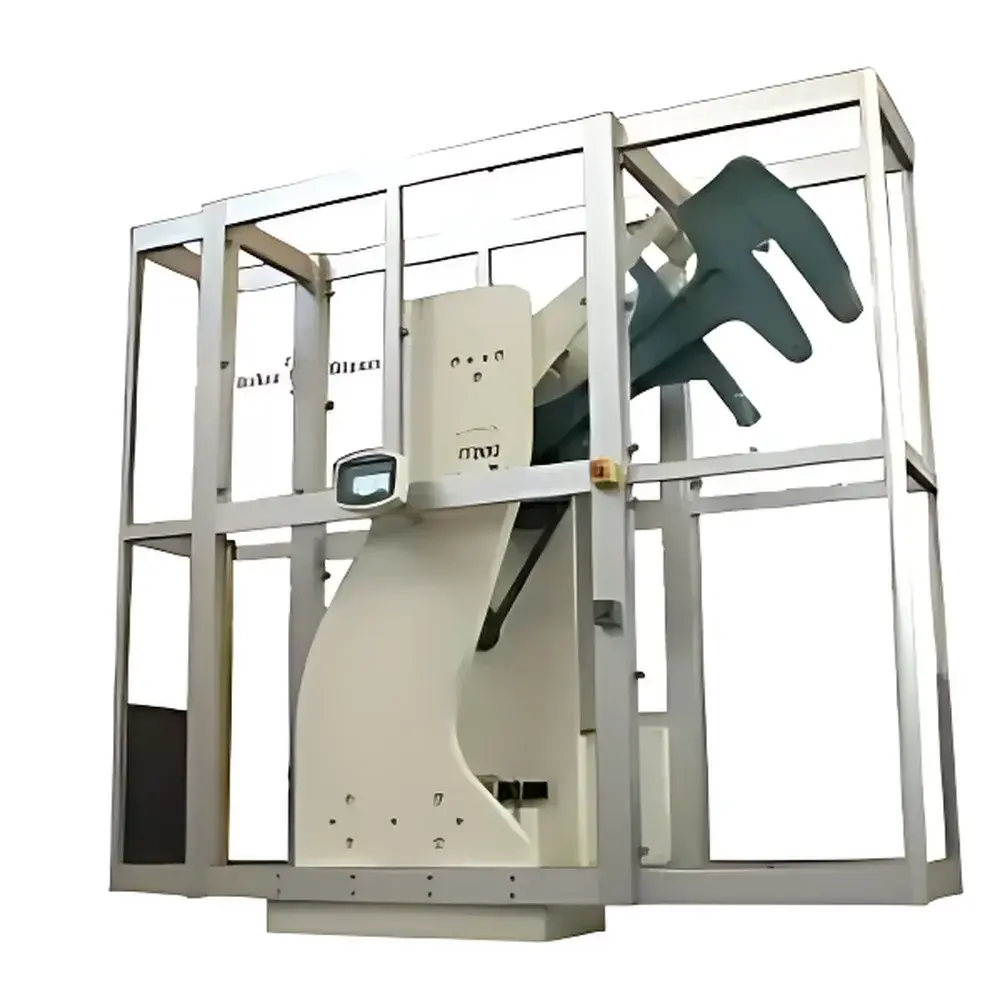
Tinius Olsen IT406 & IT542 Pendulum Impact Testing Machines
| Brand | Tinius Olsen |
|---|---|
| Model | IT406 / IT542 |
| Origin | USA |
| Impact Energy | 406 J / 542 J |
| Impact Velocity | 5.5 m/s |
| Maximum Lifting Height | 1.5 m |
| Compliance | ASTM E23, ISO 148-1, EN 10045-2 |
| Instrument Type | Pendulum Impact Tester |
| Sample Support Options | Charpy (simply supported beam), Izod (cantilever beam), Tensile Impact |
| Safety Features | Interlocked guarding, mechanical safety latch, optional electronic brake and auto-return system |
| Display Options | Analog scale (ft·lbf, J, kg·m) + optional digital readout |
Overview
The Tinius Olsen IT406 and IT542 Pendulum Impact Testing Machines are precision-engineered instruments designed for standardized Charpy and Izod impact testing of metallic, polymeric, and composite materials. Operating on the fundamental principle of gravitational potential energy conversion—where a calibrated pendulum is raised to a defined height and released to strike a notched specimen—the system delivers highly reproducible impact energy values traceable to international standards. These machines comply fully with ASTM E23 (Standard Test Methods for Notched Bar Impact Testing of Metallic Materials), ISO 148-1 (Metallic materials — Charpy pendulum impact test — Part 1: Test method), and EN 10045-2 (Metallic materials — Charpy impact test — Part 2: Verification of the testing machine). The IT406 delivers up to 406 J (300 ft·lbf) of nominal impact energy at a nominal striking velocity of 5.5 m/s; the IT542 extends this capability to 542 J (400 ft·lbf) while retaining identical mechanical architecture, kinematic geometry, and calibration methodology. Both models feature rigid cast-iron frames, precision-machined pivot bearings, and optimized aerodynamic pendulum design to minimize energy loss from friction and air resistance—verified to remain below 0.5% of full-scale energy when properly leveled and maintained.
Key Features
- Interchangeable hammer heads enabling rapid transition between Charpy (simply supported beam) and Izod (vertical cantilever) configurations without recalibration
- Integrated mounting boss on the pendulum rear for auxiliary fixtures—including tensile impact adapters per ASTM D1822
- Mechanical safety latch system that positively retains the pendulum at maximum lift height (1.5 m), eliminating vibration or premature release during setup
- High-stability analog scale with dual-unit graduation (J, ft·lbf, kg·m) and optional high-resolution digital display for real-time energy readout and statistical output
- Optional electronic braking and motorized auto-return system: completes full cycle (release → impact → arrest → return → re-latch) in ≤10 seconds, supporting >400 tests per shift
- Full interlocked safety enclosure with door switches and optional light curtain integration—machine operation disabled unless all protective barriers are fully engaged
Sample Compatibility & Compliance
The IT406/IT542 accommodates standard and non-standard specimens per ASTM E23, ISO 148, ISO 179 (plastics), and ISO 180 (Izod plastics). Specimen dimensions range from 10 × 10 × 55 mm (Charpy) to 63.5 × 12.7 × 3.2 mm (Izod), with optional low-velocity impact kits enabling controlled energy delivery across 55 discrete levels—from 0.13 m/s (0.4 ft/s) to 5.47 m/s (17.9 ft/s). All configurations maintain strict adherence to metrological requirements for pendulum verification outlined in ISO 148-2 and ASTM E23 Annex A3. Calibration certificates are NIST-traceable, and systems support GLP-compliant audit trails when paired with Tinius Olsen’s compliant data acquisition software.
Software & Data Management
While the base configuration operates via analog indication, the optional digital interface integrates with Tinius Olsen’s Horizon™ software platform. This Windows-based application supports automated test sequencing, real-time force-energy curve visualization, statistical analysis (mean, SD, CV%), pass/fail thresholding, and export to CSV, PDF, or XML formats. Horizon™ complies with FDA 21 CFR Part 11 requirements—including electronic signatures, user access control, and immutable audit logs—making it suitable for regulated QC environments under ISO/IEC 17025, GMP, or automotive IATF 16949 frameworks. Data integrity is preserved through timestamped metadata, instrument ID tagging, and automatic calibration event logging.
Applications
- Quality control of structural steels, aluminum alloys, and titanium grades in aerospace, energy, and heavy machinery manufacturing
- Notch sensitivity evaluation of thermoplastics (e.g., ABS, PC, PEEK) and fiber-reinforced composites per ISO 179 and ISO 180
- Material qualification for cryogenic service (–196 °C) using liquid nitrogen-cooled environmental chambers (compatible via external mounting)
- Failure analysis laboratories requiring traceable, repeatable impact energy quantification for root cause investigation
- R&D validation of heat-treated microstructures, weld zones, or additive-manufactured components where ductile-to-brittle transition behavior is critical
FAQ
What standards does the IT406/IT542 officially verify against?
ASTM E23, ISO 148-1/-2, EN 10045-2, ISO 179-1, ISO 180-1, and GB/T 229—all verified via third-party certification reports included with shipment.
Is the pendulum energy calibration traceable to national standards?
Yes. Each machine ships with a NIST-traceable calibration certificate covering pendulum moment of inertia, center-of-gravity position, and effective striking point verification.
Can the system be integrated into a laboratory information management system (LIMS)?
Horizon™ software supports ODBC and REST API connectivity for bidirectional data exchange with major LIMS platforms including LabWare, Thermo Fisher SampleManager, and Siemens Opcenter.
What maintenance intervals are recommended for long-term accuracy?
Annual verification of pivot bearing wear, knife-edge sharpness, and scale linearity is advised. Tinius Olsen provides certified field service engineers for ISO/IEC 17025-compliant recalibration.
Is tensile impact testing possible without custom tooling?
Yes. The rear mounting boss accepts Tinius Olsen’s ASTM D1822-compliant tensile impact fixture as a factory-installed option—no machining or alignment adjustments required.



