
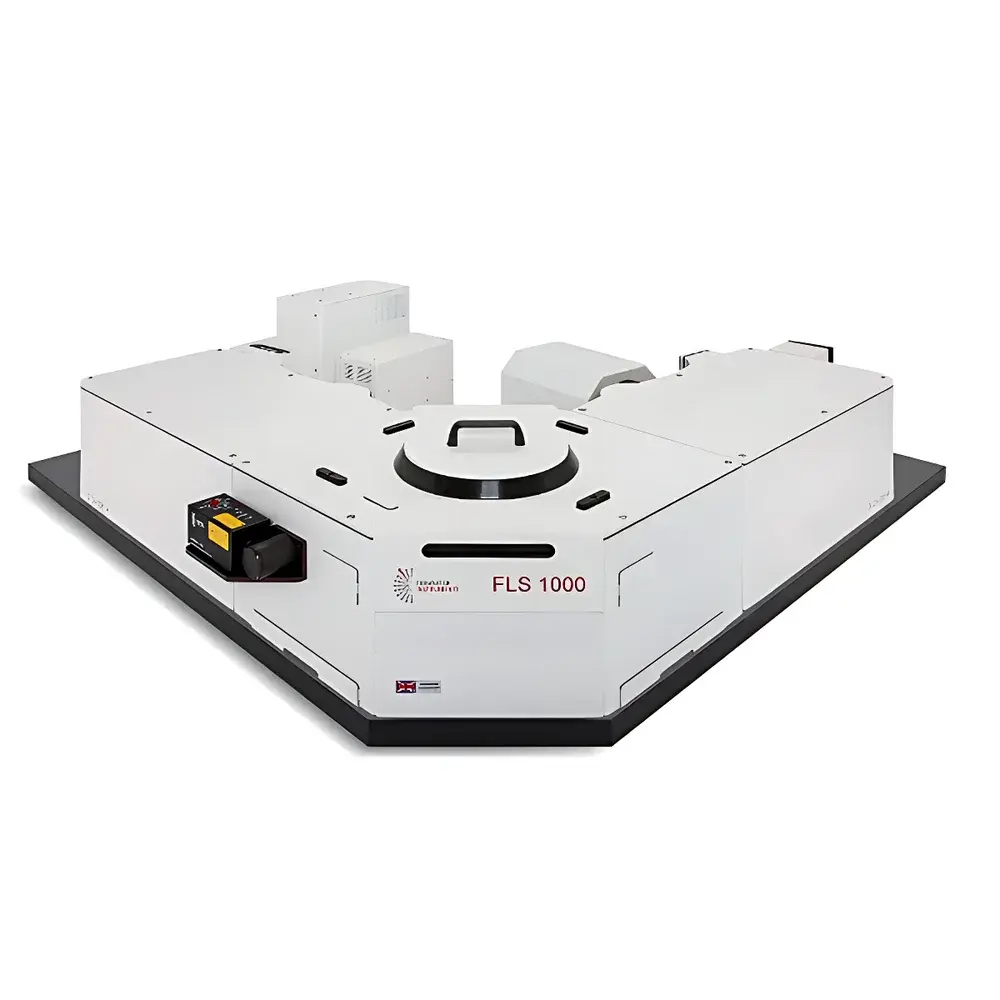
Edinburgh Instruments FLS1000 Modular Steady-State and Time-Resolved Fluorescence Spectrometer
| Brand | Edinburgh Instruments |
|---|---|
| Origin | United Kingdom |
| Model | FLS1000 |
| Spectral Range | 185 nm – 5500 nm |
| Lifetime Range | 10 ps – 10 s |
| Sensitivity (RMS) | >35,000:1 |
| Monochromator Focal Length | 325 mm |
| Grating Configuration | Interchangeable triple-grating turret (single- or dual-monochromator options) |
| Software | FluOracle® v4.x (supports ASTM E275, ISO 11698, USP <1031>, GLP-compliant audit trail & 21 CFR Part 11 optional modules) |
Overview
The Edinburgh Instruments FLS1000 is a high-performance, fully modular fluorescence spectrometer engineered for rigorous steady-state and time-resolved photoluminescence characterization. Based on the principle of photon detection following pulsed or continuous-wave excitation, the system employs time-correlated single-photon counting (TCSPC), phase-modulation fluorometry, and analog integration to quantify emission intensity, quantum yield, anisotropy, and excited-state decay kinetics across 12 orders of magnitude—from 10 picoseconds to 10 seconds. Its optical architecture supports both front-face and right-angle sample geometries, enabling quantitative analysis of highly absorbing, scattering, or low-concentration samples without signal distortion. Designed for research-grade reproducibility and long-term stability, the FLS1000 integrates thermally stabilized optics, vacuum-purged monochromators (optional), and active wavelength calibration via internal Hg/Ne reference lamps—ensuring traceable spectral accuracy compliant with ISO/IEC 17025 laboratory requirements.
Key Features
- Modular optical platform supporting independent configuration of excitation and emission pathways—including optional double monochromators for ultra-low stray light (< 1 × 10⁻⁶) and enhanced spectral purity
- Triple-grating turret with motorized selection (UV-VIS-NIR), each grating optimized for resolution, throughput, or dispersion; all gratings are pre-aligned and auto-recognized by FluOracle® software
- Integrated filter wheel with up to 12 positions, enabling automatic rejection of scattered laser light, Raman lines, and higher-order diffraction artifacts
- Expandable excitation source suite: pulsed diode lasers (250–1600 nm), xenon flashlamps, continuous-wave LEDs and lasers (including tunable OPO systems), all synchronized with sub-nanosecond jitter
- Multi-detector compatibility: PMTs (side-on and head-on, cooled to −30 °C), NIR-enhanced InGaAs detectors (up to 1700 nm), liquid-nitrogen-cooled Ge detectors (up to 5500 nm), and time-gated ICCD cameras for spatially resolved luminescence imaging
- Optical bench with kinematic mounts, temperature-controlled enclosure (±0.1 °C), and vibration-damped optical table integration capability
Sample Compatibility & Compliance
The FLS1000 accommodates solid, liquid, powder, thin-film, and fiber-based samples via interchangeable sample holders—including cryostat interfaces (4 K–300 K), integrating sphere attachments for absolute quantum yield measurement (per ASTM E275 and ISO 11698), and cuvette changers for high-throughput screening. All hardware and software modules comply with ISO 9001 manufacturing standards. Optional 21 CFR Part 11 compliance packages include electronic signatures, role-based access control, immutable audit trails, and data integrity validation protocols aligned with FDA and EMA expectations for regulated environments. System documentation supports GLP/GMP audit readiness, including IQ/OQ/PQ templates and full traceability of calibration records.
Software & Data Management
FluOracle® v4.x provides unified control of acquisition, real-time visualization, and advanced modeling—all within a single intuitive interface. The software implements industry-standard data formats (JCAMP-DX, ASCII, HDF5) and supports batch processing of lifetime decays using iterative reconvolution, multi-exponential fitting (with χ² minimization and F-test validation), and global analysis across multiple wavelengths or temperatures. Built-in modules enable Förster resonance energy transfer (FRET) efficiency calculation, anisotropy decay deconvolution, and phosphorescence discrimination via delayed gating. Data export is compatible with MATLAB, Python (via PyFluor), OriginLab, and commercial chemometrics platforms. All processing steps are logged with timestamps, user IDs, and parameter versions—enabling full experimental reproducibility.
Applications
The FLS1000 delivers critical photophysical insights across disciplines requiring quantitative luminescence characterization. In materials science, it characterizes charge-transfer states in perovskite solar cells, triplet harvesting in TADF emitters, and defect-related emission in wide-bandgap semiconductors. In life sciences, it resolves conformational dynamics of labeled proteins via time-resolved anisotropy and quantifies NAD(P)H/FAD redox ratios in live-cell metabolic imaging. Environmental scientists apply it to track photochemical degradation pathways of micropollutants and assess humic substance fluorescence indices (e.g., HIX, BIX). Forensic labs use its high-sensitivity UV-Vis-NIR mapping to differentiate ink formulations and document aging. Geological applications include rare-earth element fingerprinting in zircons and hydrocarbon identification in fluid inclusions.
FAQ
What is the minimum detectable lifetime with the FLS1000?
Instrument response function (IRF) width depends on detector and excitation source choice; typical IRF values range from 25 ps (with microchannel plate PMT + 405 nm pulsed diode) to 150 ps (with standard PMT + flashlamp), enabling reliable mono- and bi-exponential decay analysis down to ~1.5× the IRF width.
Can the FLS1000 measure absolute quantum yields?
Yes—when equipped with an integrating sphere accessory and calibrated reference standards (e.g., quinine sulfate in 0.1 M H2SO4), the system calculates absolute photoluminescence quantum yield per ISO 11698 and ASTM E275 protocols.
Is remote operation supported?
FluOracle® includes secure client-server architecture with TLS-encrypted communication, enabling validated remote access for instrument monitoring and scheduled acquisitions—fully auditable under 21 CFR Part 11 when configured with electronic signature modules.
How is wavelength calibration maintained over time?
The system performs automated wavelength calibration at startup and during scheduled maintenance using internal Hg/Ne spectral lines; drift correction algorithms adjust grating positioning in real time to maintain ±0.02 nm accuracy across the full 185–5500 nm range.
What service and support options are available globally?
Edinburgh Instruments provides factory-certified field service engineers in North America, Europe, and Asia-Pacific; extended warranty, preventive maintenance contracts, and application-specific training programs are available through authorized distributors.




