
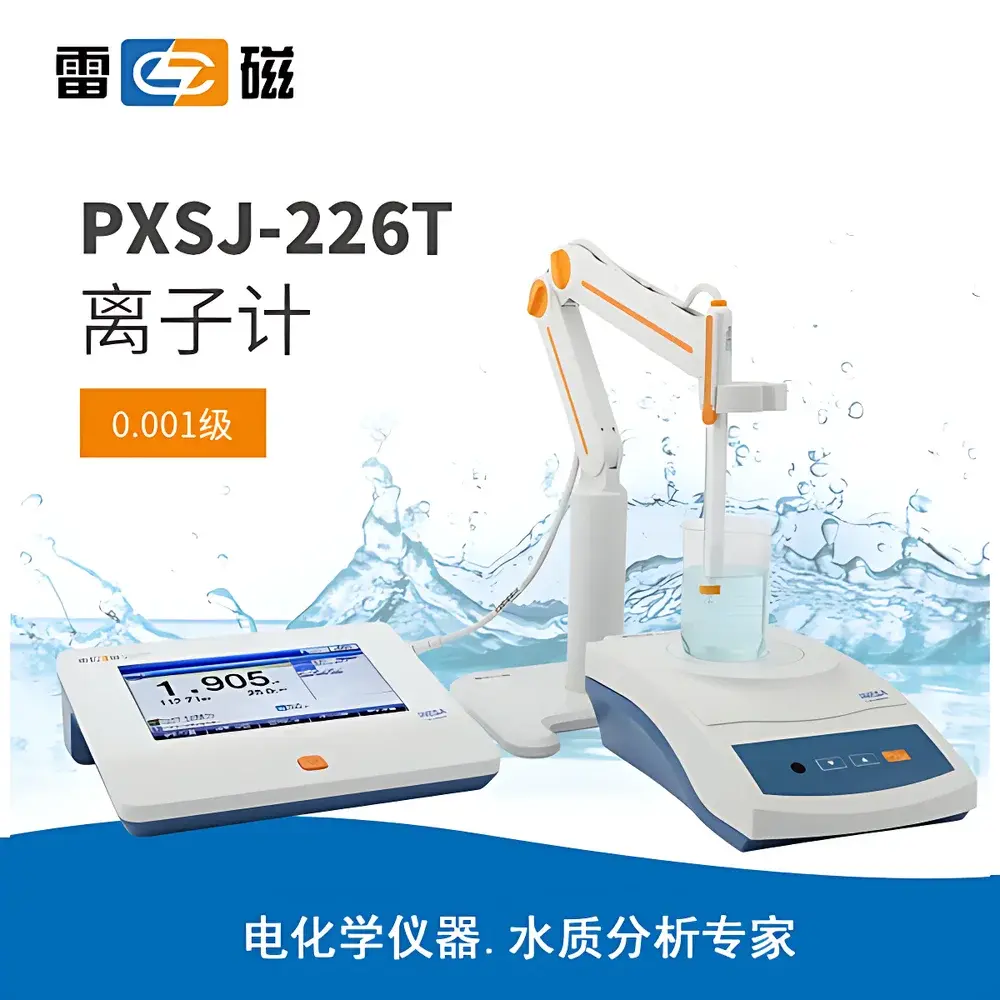
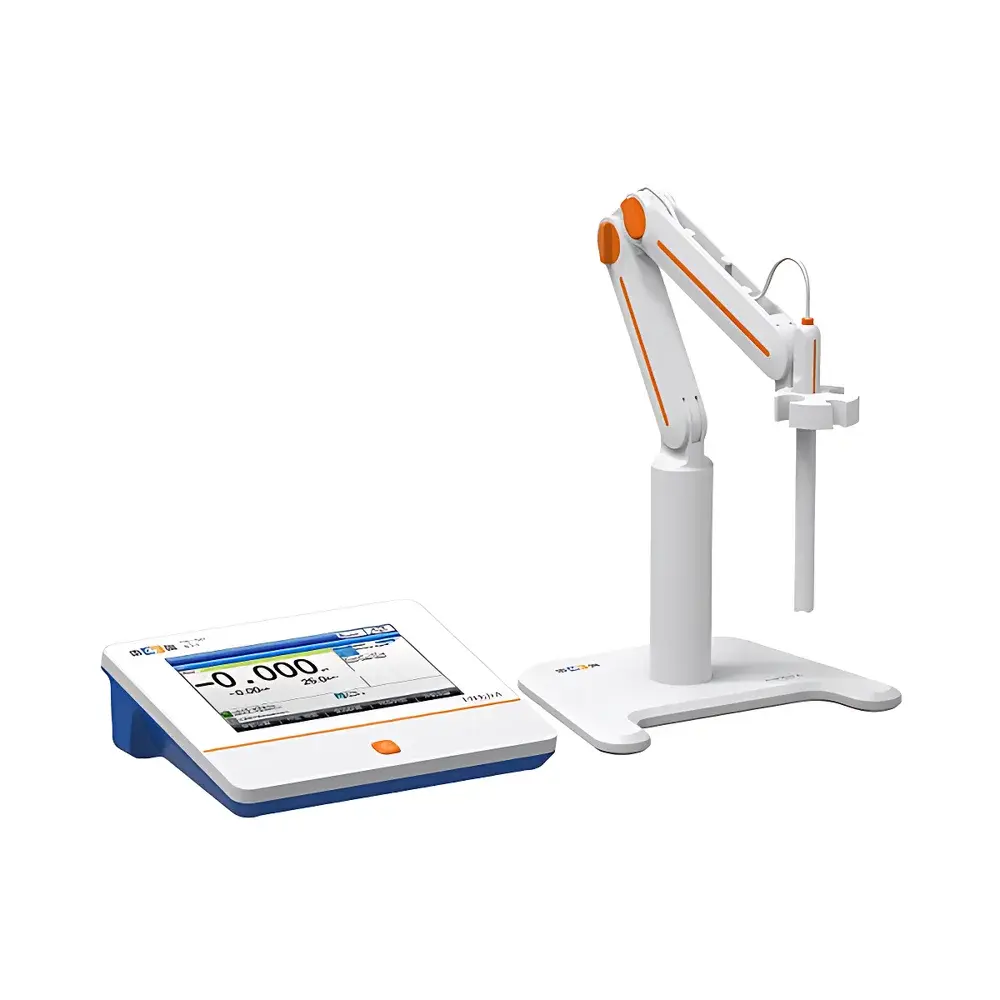
Leici PXSJ-226T Benchtop Ion Meter
| Brand | Leici |
|---|---|
| Origin | Shanghai, China |
| Model | PXSJ-226T |
| Instrument Type | Benchtop |
| Ion Measurement Range | 1.00×10⁻⁹ to 9.99×10⁹ (selectable units: mol/L, mmol/L, g/L, mg/L, μg/L, ppm) |
| Detection Limit | 1.00×10⁻⁹ to 9.99×10⁹ (same unit options) |
| Response Time | ≤5 s |
| Accuracy Class | 0.001 |
| Temperature Range | −10.0 to 135.0 °C (14.0 to 275.0 °F) |
| mV Range | −2000.00 to +2000.00 mV |
| pH/pX Range | −2.000 to 20.000 |
| pH/pX Resolution | 0.001 |
| mV Resolution | 0.01 mV |
| Temperature Resolution | 0.1 °C/°F |
| Dimensions | 220 × 195 × 68 mm |
| Weight | 0.95 kg |
Overview
The Leici PXSJ-226T Benchtop Ion Meter is a high-precision potentiometric analyzer engineered for quantitative determination of specific ion activities in aqueous solutions using ion-selective electrodes (ISEs). It operates on the Nernst equation principle, converting electrode potential differences into calibrated ion concentration values across six decades of dynamic range. Designed for routine and regulatory-compliant water quality analysis, the instrument supports direct measurement of fluoride (F⁻), chloride (Cl⁻), sodium (Na⁺), potassium (K⁺), ammonium (NH₄⁺), and other monovalent ions—enabling trace-level detection down to 1.00×10⁻⁹ mol/L. Its architecture integrates a low-drift analog front-end, temperature-compensated signal conditioning, and digital filtering to ensure high reproducibility in environmental, municipal, and industrial laboratory settings.
Key Features
- High-resolution 7-inch color TFT touchscreen with intuitive icon-driven interface supporting both English and Chinese language modes
- Selectable resolution modes: pX and pH at 0.001 / 0.01 / 0.1; mV at 0.01 / 0.1 / 1 mV
- Multi-point calibration capability: up to 6-point ISE or pH electrode calibration with automatic slope and offset validation
- Intelligent endpoint detection: supports auto-read, timed-read, interval-read, and manual-read acquisition protocols
- Comprehensive electrode diagnostics: real-time assessment of electrode response time, asymmetry potential, and membrane integrity
- IP54-rated enclosure for dust resistance and limited splash protection during benchtop operation
- Integrated temperature compensation using either built-in sensor or external Pt1000 probe (−10.0 to 135.0 °C)
- Firmware-upgradable platform enabling future method expansion and protocol customization via USB or PC link
Sample Compatibility & Compliance
The PXSJ-226T is validated for use with standard liquid-phase samples including drinking water, wastewater effluent, surface water, groundwater, and process streams. It accommodates common ISE configurations—including solid-state, crystalline membrane, and polymer-based electrodes—and interfaces seamlessly with tri-combination pH/ISE electrodes. The system conforms to Good Laboratory Practice (GLP) and Good Manufacturing Practice (GMP) data integrity requirements: all measurements are timestamped, user-logged, and stored with full audit trail metadata (operator ID, calibration history, electrode serial number, ambient temperature, and method version). Data storage supports up to 1000 complete measurement records with exportable CSV and PDF reports. While not certified for FDA 21 CFR Part 11 compliance out-of-the-box, its password-protected user hierarchy (admin/operator/technician), mandatory calibration reminders, and electronic signature-ready logbook provide foundational infrastructure for regulated environments aligned with ISO/IEC 17025 and ASTM D1129 standards.
Software & Data Management
- Onboard method management: preloaded templates for F⁻, Cl⁻, Na⁺, K⁺, NH₄⁺, and customizable user-defined ion methods
- Standard solution library: built-in support for GB, DIN, NIST, USA, MERK, and JIS buffer sets; allows creation of custom calibration groups
- Measurement modes: direct concentration, standard addition, sample addition, and Gran plot analysis for improved accuracy in complex matrices
- Data export: RS-232 interface for direct printing (selectable report formats); USB port for PC communication via Leici专用 software; U-disk read/write for offline data transfer
- Security framework: three-tier user access control with encrypted password policy, session timeout, and GMP-compliant operation logs traceable to individual users
Applications
The PXSJ-226T serves critical roles across environmental monitoring, municipal water treatment, food safety testing, pharmaceutical excipient analysis, and academic research. Typical use cases include fluoride monitoring in drinking water per WHO guidelines (≤1.5 mg/L), chloride quantification in cooling tower water to assess corrosion risk, ammonium tracking in wastewater nitrification processes, and sodium profiling in bottled mineral water quality control. Its wide linear dynamic range and configurable units (mol/L, mg/L, ppm, pX) eliminate unit conversion errors in multi-lab collaborations. When paired with an optional autosampler, the system enables unattended batch analysis of up to 48 samples—ideal for daily compliance reporting under national water quality standards such as China’s GB 5749-2022 or the U.S. EPA Method 300.0 for anions.
FAQ
Does the PXSJ-226T support GLP-compliant data archiving?
Yes—it stores full measurement metadata including operator ID, calibration parameters, electrode model/serial number, ambient temperature, and timestamped raw readings. Exported files retain this context for audit readiness.
Can it perform Gran plot analysis for weakly dissociated ions?
Yes—the instrument includes dedicated Gran method functionality for precise determination of total ion concentration in samples with interfering background electrolytes.
What electrode types are compatible with the PXSJ-226T?
It supports all standard BNC-connected ion-selective electrodes, combination pH/ISE electrodes, ORP electrodes, and temperature sensors meeting IEC 60746-1 specifications.
Is firmware update possible without sending the unit to service?
Yes—updates are delivered via USB flash drive or PC connection using Leici’s official configuration utility, preserving all user-defined methods and calibration data.
How does the system handle temperature compensation during ion measurement?
It applies automatic temperature correction based on either the integrated thermistor or an external Pt1000 probe, using the Nernstian temperature coefficient (dE/dT) appropriate for each ion type selected in the method.







