
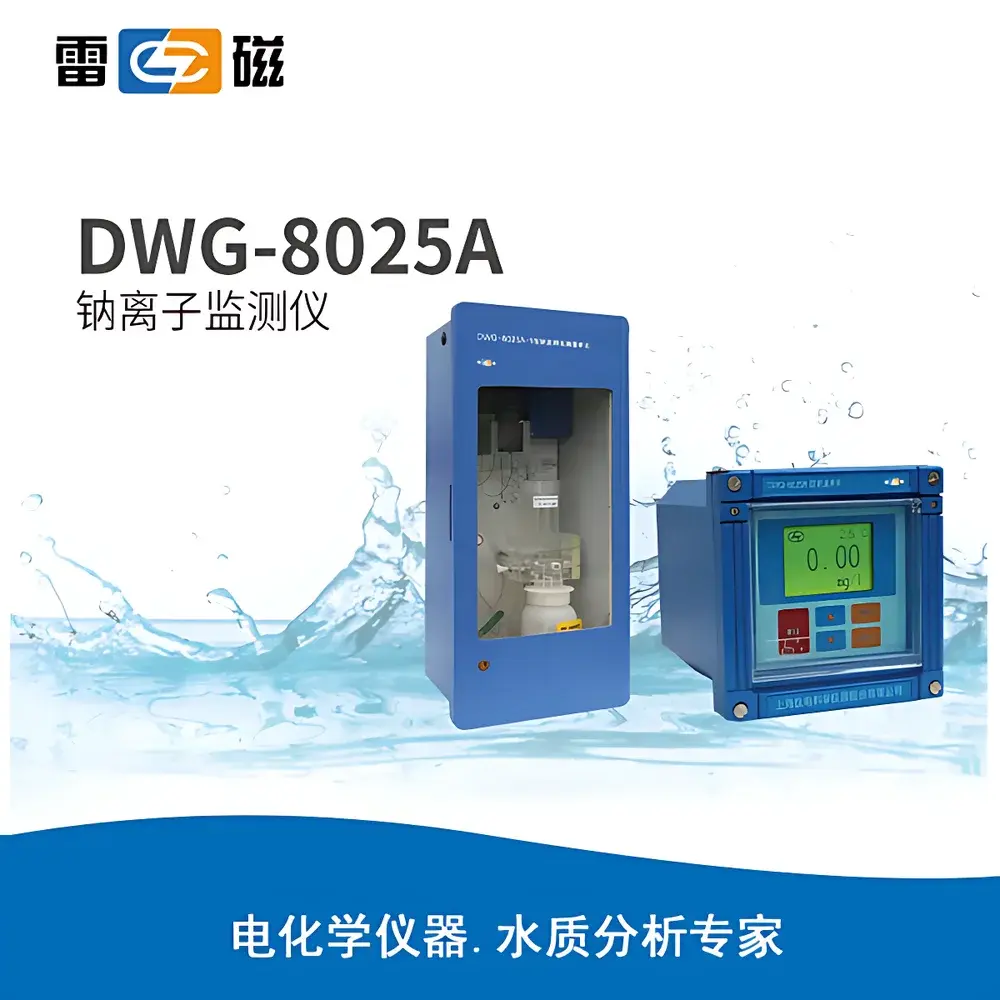
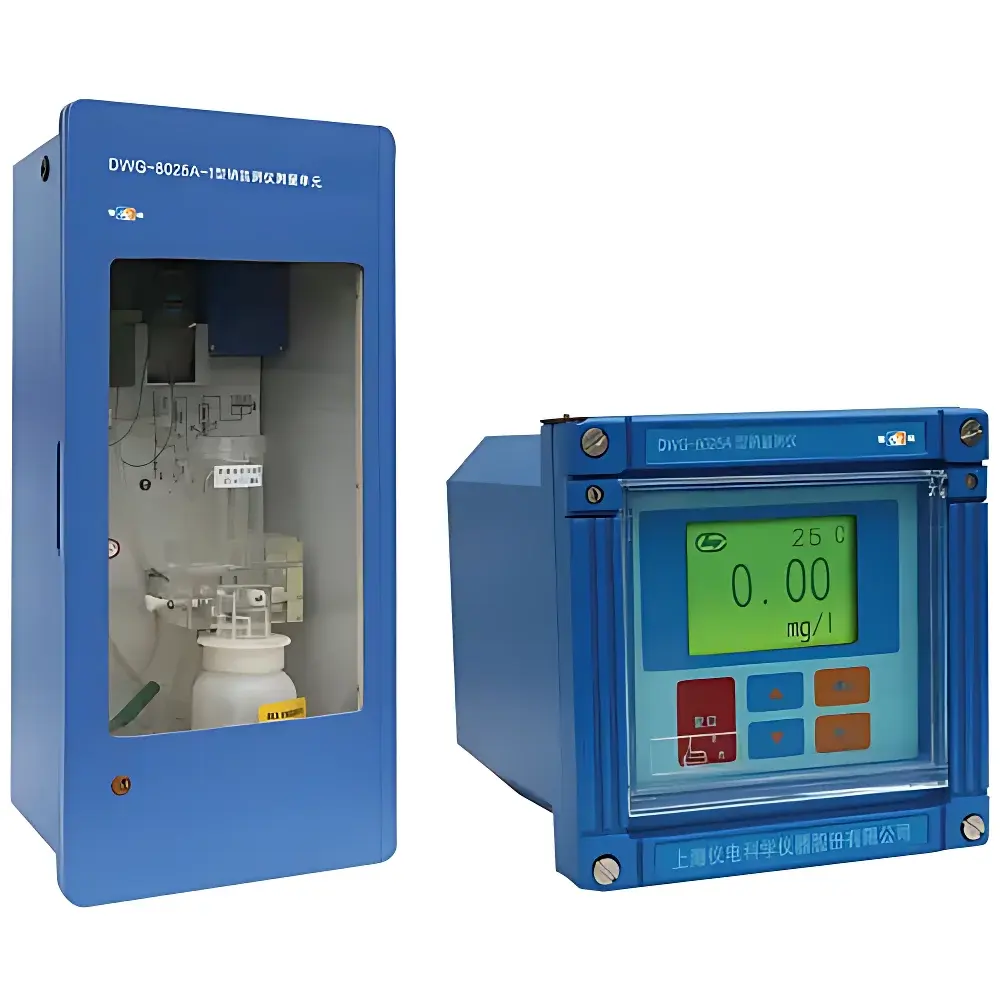
Leichi DWG-8025A Online Sodium Ion Analyzer
| Key | Brand: Leichi |
|---|---|
| Origin | Shanghai, China |
| Model | DWG-8025A |
| Measurement Range | 0.1–1000 µg/L Na⁺ |
| Resolution | 0.1 µg/L (≤10 µg/L), 1 µg/L (>10 µg/L) |
| Temperature Range | −10.0–120.0 °C |
| Temp. Resolution | 0.1 °C |
| Accuracy | ±10% of reading ±0.1 µg/L (Na⁺), ±0.5 °C (0.0–60.0 °C), ±1.0 °C (elsewhere) |
| Repeatability | ≤5% of reading |
| Drift | ±10% of reading/24 h |
| Enclosure Rating | IP65 |
| Output | 4–20 mA DC (isolated, user-configurable span), RS-232 or RS-485 (selectable) |
| Power | AC 220 V ±10%, 50 Hz ±1% |
| Dimensions (W×H×D) | Electronics Unit 144×144×150 mm, Measuring Cell 224×288×628 mm |
| Weight | 2 kg (electronics), 10 kg (measuring unit) |
Overview
The Leichi DWG-8025A Online Sodium Ion Analyzer is a dedicated, high-stability potentiometric instrument engineered for continuous, real-time monitoring of trace sodium ion concentrations in ultrapure water systems. It operates on the principle of selective ion measurement using a solid-state sodium-selective electrode coupled with a reference electrode and a guard (counter) electrode—forming a robust three-electrode configuration that minimizes junction potential drift and enhances long-term signal stability. Designed specifically for power generation applications, the DWG-8025A delivers reliable quantification of Na⁺ in critical water streams—including condensate, feedwater, and demineralized water—where sub-ppb-level detection is essential to prevent turbine corrosion, steam cycle contamination, and boiler tube scaling. Its operational architecture conforms to the functional requirements of IEC 61511 for safety-related instrumentation in process industries and supports integration into plant-wide DCS/SCADA environments via standardized analog and serial communication protocols.
Key Features
- Three-electrode potentiometric sensing system: Combines sodium-selective, reference, and guard electrodes to suppress liquid junction errors and ensure measurement reproducibility under variable flow and conductivity conditions.
- Integrated flow-regulated measurement cell: Equipped with a precision constant-pressure delivery module that maintains consistent sample velocity across the electrode surface—reducing boundary layer effects and improving response time and repeatability.
- Dual-parameter real-time display: Simultaneously presents sodium concentration (µg/L) and sample temperature (°C) on a backlit LCD interface with configurable units and decimal resolution.
- Auto-temperature compensation (ATC): Applies Nernstian correction based on real-time thermal input from a Pt1000 sensor embedded in the flow cell, ensuring accuracy across the full −10.0 to 120.0 °C operating range.
- Two-point calibration with standard addition mode: Supports both conventional bracketing calibration and incremental standard addition—a critical capability for validating low-concentration measurements (<10 µg/L) where matrix effects dominate.
- Configurable alarm and fault handling: Programmable high/low limit alarms with relay dry-contact outputs; automatic power-fail data retention and resume-on-reboot functionality.
- Industrial-grade communications: Isolated 4–20 mA analog output with fully adjustable zero/span; optional RS-232 or RS-485 interface (Modbus RTU protocol) for bidirectional configuration and data logging.
- IP65-rated enclosure: Dust-tight and protected against low-pressure water jets—suitable for mounting in turbine halls, chemical dosing rooms, or outdoor auxiliary buildings without additional housing.
Sample Compatibility & Compliance
The DWG-8025A is validated for use with deionized, reverse-osmosis, and mixed-bed polished water having conductivity <0.2 µS/cm and pH 6.5–9.5. For optimal selectivity and electrode longevity, optional integrated pH adjustment (via reagent dosing pump and inline pH sensor) is available to maintain sample alkalinity within the 8.5–9.2 range—mitigating hydrogen ion interference per ISO 10523 and ASTM D4582 guidelines. The analyzer complies with GB/T 6682–2008 (Chinese national standard for ultrapure water specifications) and aligns with technical expectations outlined in EP 2.2.38 (Electrochemical Methods) and USP (pH and Ion-Selective Electrodes). While not certified to IEC 61508 SIL levels out-of-the-box, its architecture supports third-party functional safety assessment for Safety Integrity Level 1 (SIL1) applications when deployed with redundant sensors and logic solvers.
Software & Data Management
Local configuration and diagnostics are performed via front-panel keypad navigation or through ASCII-command-based serial communication. The device stores up to 30 days of hourly averaged Na⁺ and temperature values internally (non-volatile memory), accessible via RS-485 polling. When integrated into centralized monitoring platforms (e.g., Siemens Desigo, Honeywell Experion, or custom SCADA), the 4–20 mA output provides traceable, audit-ready analog data streams compatible with FDA 21 CFR Part 11–compliant historians—provided the host system implements electronic signatures, change control, and audit trail functionality. Firmware updates are delivered via secure USB-to-serial adapter and require authenticated access credentials to prevent unauthorized modification.
Applications
- Thermal power plants: Continuous surveillance of sodium breakthrough in condensate polishing trains and after mixed-bed exchangers—enabling predictive maintenance and early leak detection in steam generators.
- Nuclear power facilities: Monitoring primary coolant purity per IEEE 381 and ASME OM-2 requirements, particularly during startup chemistry campaigns and post-maintenance flush validation.
- Semiconductor fabs: Control of rinse water sodium content in wafer cleaning lines, where Na⁺ > 0.5 µg/L may induce gate oxide defects in sub-28 nm node processes.
- Pharmaceutical water systems: Support of purified water (PW) and water for injection (WFI) quality assurance per EU GMP Annex 1 and WHO TRS 970, especially in multi-effect distillation loop integrity checks.
- Automotive electrocoat (E-coat) baths: Verification of final rinse water sodium residuals to prevent film adhesion failure and cathodic delamination on painted chassis components.
FAQ
What is the minimum detectable sodium concentration, and how is it verified?
The lower detection limit is 0.1 µg/L, validated per ISO 11929 using blank water (ASTM D1193 Type I) and repeated 10-fold dilutions of certified Na⁺ standards. Detection is confirmed by signal-to-noise ratio ≥3 and recovery within ±15% of theoretical value.
Does the DWG-8025A require daily calibration in continuous operation?
No. Under stable ultrapure water conditions, calibration intervals may extend to 72 hours. However, daily verification using a 2.0 µg/L check standard is recommended per ANSI/ISA-84.00.01 to confirm system bias and drift performance.
Can the analyzer operate at elevated temperatures without cooling?
Yes. The flow cell and electrode assembly are rated for continuous exposure up to 120.0 °C. Thermal management relies on passive conduction through stainless-steel wetted parts; no external chiller is required for typical turbine drain or extraction steam condensate applications.
Is the RS-485 interface compatible with Modbus TCP gateways?
The native protocol is Modbus RTU over RS-485. Interfacing with Modbus TCP networks requires an industrial protocol converter (e.g., Moxa EDS-G205A) configured for transparent bridging—no firmware modification of the DWG-8025A is needed.
How does the instrument handle air bubbles or particulate fouling in the sample stream?
The flow cell incorporates a downward-facing electrode orientation and laminar-flow geometry to minimize bubble entrapment. Optional 5-µm inline filtration is recommended upstream; if particulate accumulation is suspected, the cell can be flushed in-situ using deionized water at 2 bar pressure without disassembly.
Related Products







