
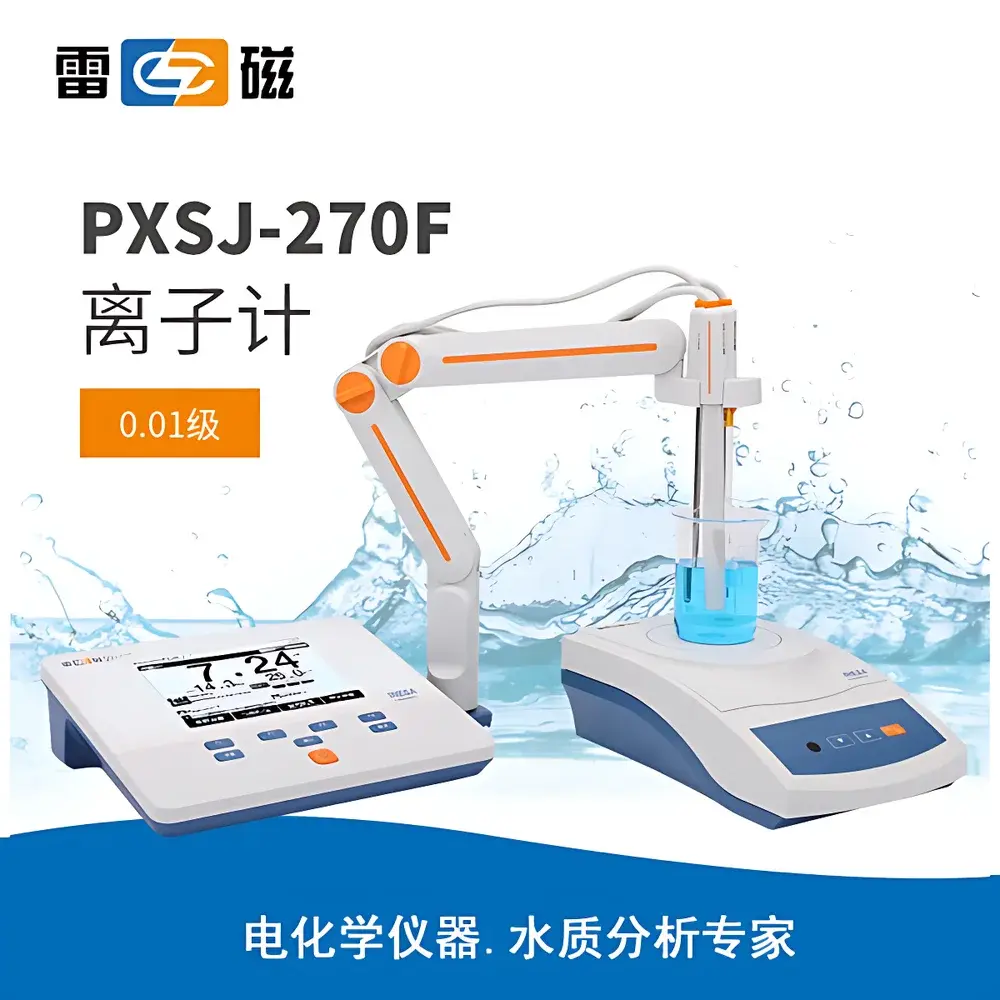
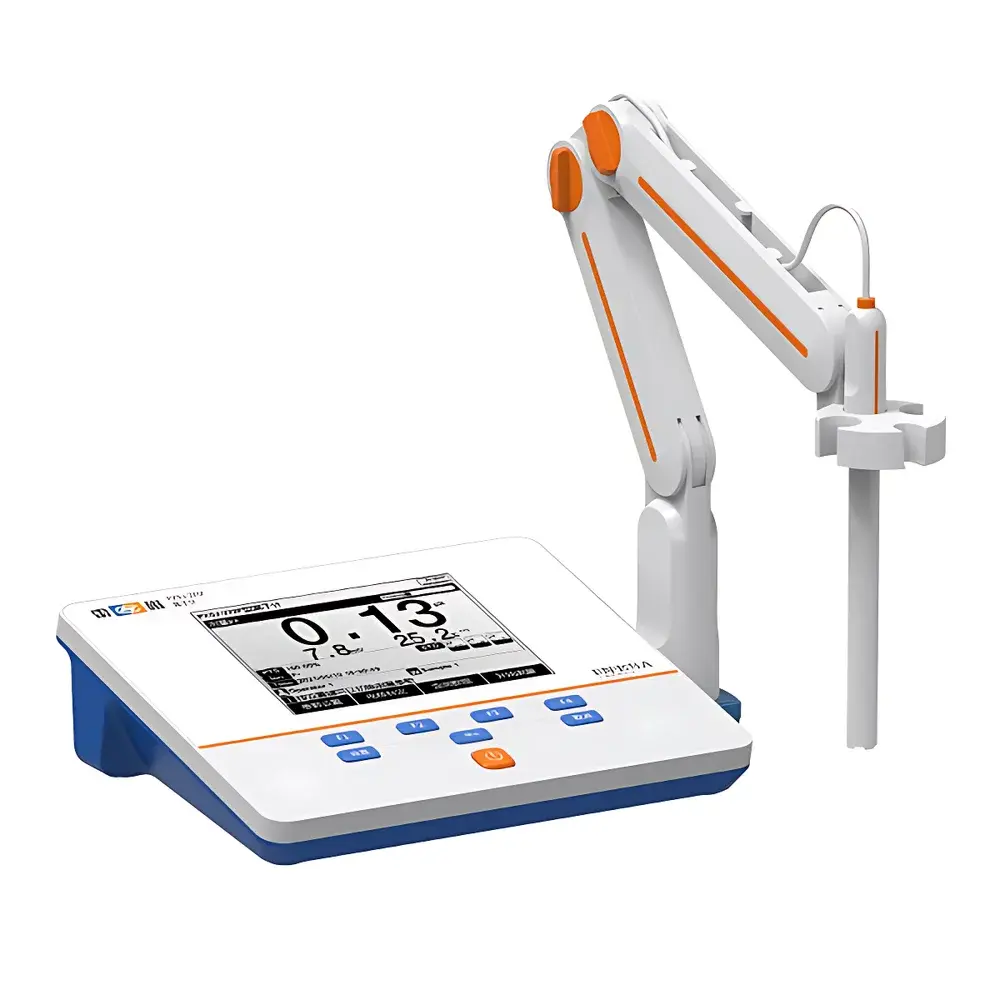
Leici PXSJ-270F Benchtop Ion Analyzer
| Brand | Leici |
|---|---|
| Origin | Shanghai, China |
| Model | PXSJ-270F |
| Instrument Type | Benchtop |
| Ion Measurement Range | (−2.00 to 20.00) pX |
| Measurement Accuracy | ±0.01 pX |
| Temperature Range | (−5.0 to 110.0) °C / (23.0 to 230.0) °F |
| mV Range | (−2000.0 to 2000.0) mV |
| pH Range | (−2.00 to 20.00) pH |
| Ion Concentration Units | mol/L, mmol/L, g/L, mg/L, μg/L |
| Data Storage Capacity | 500 datasets |
| Resolution | 0.01 pX / 0.01 pH / 0.1 mV / 0.1 °C |
| Temperature Compensation | Automatic & Manual |
| Calibration Points | 1–5-point pH calibration |
| Buffer Recognition | GB, DIN, NIST standard sets + user-defined buffers |
| Compliance | GLP-compliant data logging with audit trail support |
| Connectivity | RS-232 (printer), USB (PC software) |
Overview
The Leici PXSJ-270F Benchtop Ion Analyzer is a high-precision potentiometric measurement system engineered for quantitative determination of monovalent and multivalent ions in aqueous solutions. Based on the Nernst equation principle, it measures the electromotive force (EMF) generated across an ion-selective electrode (ISE) membrane relative to a stable reference electrode, enabling direct conversion of measured potential into ion activity or concentration. Designed for routine water quality laboratories, environmental monitoring stations, and industrial process control applications, the PXSJ-270F delivers trace-level ion quantification with certified accuracy at the 0.01 pX level—meeting the performance requirements of ISO 10523 (water quality — determination of pH), ASTM D1293 (electrical conductivity and pH of water), and USP (pH measurement). Its robust architecture supports long-term stability under variable ambient conditions, including temperature fluctuations from −5 °C to 110 °C, making it suitable for both cold-water source evaluation and high-temperature effluent analysis.
Key Features
- High-resolution 4.3-inch LCD display with adjustable contrast for clear visibility under laboratory lighting or ambient glare
- Dual-resolution selection: 0.01 pX / 0.1 pX and 0.1 mV / 1 mV modes for flexible precision matching across sample matrices
- Full-featured temperature compensation engine supporting both automatic (via integrated Pt1000 sensor) and manual input; units switchable between °C and °F
- Intelligent endpoint detection algorithm for stable, reproducible readings—supports auto-read, timed-read, interval-read, and manual capture protocols
- Comprehensive electrode management: automatic recognition of pH and ISE calibration standards per GB, DIN, and NIST specifications; up to five-point pH calibration with slope and offset diagnostics
- Preloaded ion modes for Na⁺, K⁺, NH₄⁺, Cl⁻, F⁻, and customizable user-defined ion profiles with configurable selectivity coefficients
- IP54-rated enclosure ensures protection against dust ingress and incidental water splashes during daily benchtop operation
- Integrated power management with brownout recovery, auto-shutdown after 30 minutes of inactivity, and non-volatile memory retention during power loss
Sample Compatibility & Compliance
The PXSJ-270F is validated for use with standard aqueous samples across drinking water, wastewater, surface water, groundwater, and industrial effluents. It accommodates common ISEs—including solid-state fluoride electrodes, liquid-membrane chloride sensors, and combination pH/ISE probes—when paired with compatible reference electrodes and temperature sensors. All measurement functions adhere to Good Laboratory Practice (GLP) principles: each stored dataset includes timestamp, operator ID (user-definable), electrode serial number, calibration history, temperature value, and measurement mode. Audit trails are preserved in non-volatile memory and exportable via USB for regulatory review. While not FDA 21 CFR Part 11–certified out-of-the-box, the instrument’s immutable logging structure and user-accessible calibration logs support validation workflows required under ISO/IEC 17025 and EPA Method 300.1 (determination of anions by ion chromatography—complementary verification).
Software & Data Management
Data handling is implemented through dual-channel interface architecture: RS-232 enables direct connection to industry-standard dot-matrix or thermal printers compliant with ESC/POS command sets, offering six preset print layouts (including full calibration report, single-measurement summary, and batch export). The USB port connects to Windows-based PCs running Leici’s proprietary L-DataLink software (v3.2+), which provides secure bidirectional communication, encrypted dataset transfer, CSV/PDF export, and customizable report templates aligned with ISO 17025 documentation requirements. Stored records include raw mV, calculated pX, temperature-corrected values, electrode status flags, and user annotations—enabling full traceability from measurement to final report generation. Firmware updates are delivered via signed USB firmware packages, ensuring integrity and version-controlled feature expansion.
Applications
- Environmental monitoring: Quantification of fluoride in municipal water supplies per WHO guidelines (1.5 mg/L maximum); chloride monitoring in coastal aquifers to assess saltwater intrusion
- Wastewater treatment: Real-time tracking of ammonium (NH₄⁺) levels in nitrification/denitrification basins using selective ISEs calibrated against certified reference materials
- Pharmaceutical manufacturing: Verification of residual sodium or potassium content in purified water systems (PW) and water-for-injection (WFI) loops
- Agricultural runoff analysis: Rapid field-lab assessment of nitrate (NO₃⁻) and potassium (K⁺) concentrations in irrigation return flows
- Academic research: Teaching potentiometric theory and Nernstian behavior in analytical chemistry labs; method development for non-standard ion assays (e.g., perchlorate, iodide)
FAQ
Does the PXSJ-270F support two-point calibration for ion concentration?
Yes—it allows multi-point calibration using standard solutions of known activity, with optional linear or non-linear regression fitting depending on electrode response characteristics.
Can the instrument store calibration curves for multiple electrodes separately?
Yes—each electrode profile retains its own calibration history, slope, offset, and date-stamped verification records within the device’s internal database.
Is temperature compensation mandatory for pX measurements?
While manual temperature entry is permitted, automatic compensation via the built-in Pt1000 sensor is strongly recommended to minimize Nernst equation error propagation, especially outside 20–25 °C ranges.
What file formats are supported during USB data export?
CSV (comma-separated values) and PDF (print-ready reports) are natively supported; third-party integration via ASCII protocol allows ingestion into LIMS platforms using custom parsers.
Does the unit meet CE or RoHS directives for export to the EU?
The PXSJ-270F complies with IEC 61010-1:2010 for electrical safety and EN 61326-1:2013 for EMC; RoHS 2011/65/EU compliance is confirmed for all PCB assemblies and plastic housings.
Related Products







