
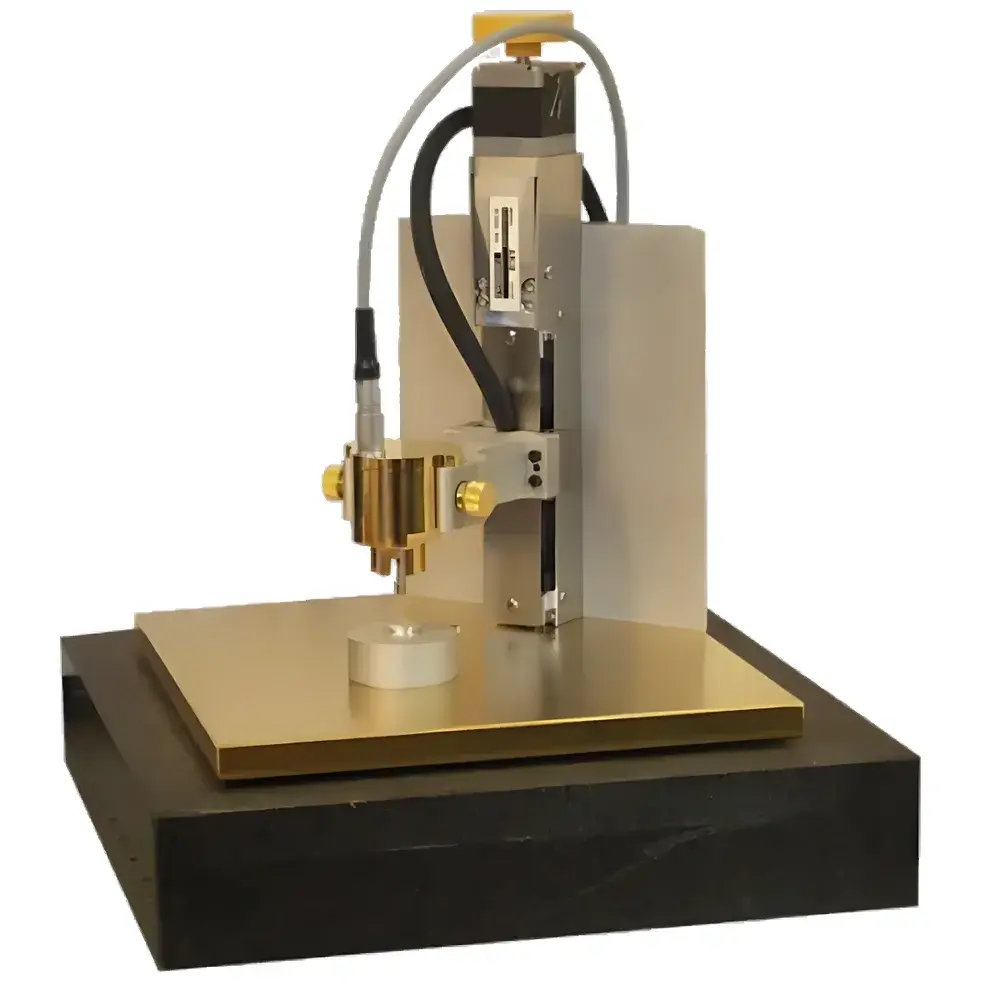
Makeway MKW-KP002 Single-Point Kelvin Probe System for Work Function and Surface Potential Measurement
| Brand | Makeway |
|---|---|
| Model | MKW-KP002 |
| Origin | Shanghai, China |
| Application Environment | Ambient, Controlled Atmosphere, or Humidity-Regulated Conditions |
| Work Function Resolution | 1–3 meV (2 mm tip), 5–10 meV (50 µm tip) |
| Tip-to-Sample Distance Control | Down to ≤400 nm |
| Digital Control Architecture | Full FPGA-based digital signal processing with ON (Off-Null) detection, Height Regulation (HR), Parallel Plate (PP) oscillation mode, Signal Averaging (SA), Work Function Averaging (WA), Quick-Change Tip (QT), Faraday Cage (FC), TTL Output Channel (OC), Data Export to Excel/Origin (DE) |
Overview
The Makeway MKW-KP002 Single-Point Kelvin Probe System is a precision electrostatic measurement instrument engineered for non-contact, non-destructive characterization of surface electronic properties. It operates on the principle of vibrating capacitor nulling—where a conductive probe oscillates above a sample surface, generating an alternating current proportional to the contact potential difference (CPD) between probe and sample. By applying a compensating DC bias to null the AC signal, the system directly quantifies the work function (for conductors) or surface potential (for semiconductors and insulators). As surface electronic structure is governed by the topmost 1–3 atomic or molecular layers, the MKW-KP002 delivers exceptional surface sensitivity—making it indispensable for interfacial physics, thin-film electronics, corrosion science, and surface functionalization studies. Unlike scanning variants, this single-point configuration prioritizes metrological stability, repeatability, and rapid point-wise acquisition under ambient or controlled gas/humidity environments—ideal for process monitoring, reference calibration, and comparative batch analysis.
Key Features
- Off-Null (ON) Detection Architecture: Utilizes high-gain, wide-dynamic-range signal amplification operating far from zero-crossing—eliminating susceptibility to low-frequency drift and 1/f noise inherent in traditional lock-in amplifier (LIA)-based null-detection systems.
- Height Regulation (HR) Mode: Patented real-time vertical position control maintains sub-400 nm tip–sample separation during measurement, decoupling CPD from topographic artifacts and ensuring high reproducibility across heterogeneous surfaces.
- Digital Signal Processing Core: Fully FPGA-controlled detection engine supports simultaneous parameter modulation—including oscillation amplitude, frequency (100 Hz–2 kHz), phase tracking, and adaptive averaging—enabling robust operation in electrically noisy lab environments.
- Modular Probe Compatibility: Supports interchangeable tungsten or gold-coated tips (2 mm macro-tip for bulk averaging; 50 µm micro-tip for localized mapping), each optimized for resolution vs. signal-to-noise trade-offs.
- Integrated EMI Mitigation: Built-in Faraday cage with grounded copper shielding and filtered feedthroughs ensures compliance with electromagnetic compatibility requirements per IEC 61326-1 for laboratory instrumentation.
- Real-Time Monitoring & External Synchronization: TTL-triggered output channel enables synchronization with external stimuli (e.g., light pulses, bias sweeps, gas flow controllers); user-defined analog input channels allow concurrent acquisition of temperature, humidity, or optical signals.
Sample Compatibility & Compliance
The MKW-KP002 accommodates rigid and flexible substrates up to 100 mm in diameter, including metals, doped and intrinsic semiconductors, metal oxides, organic thin films, self-assembled monolayers (SAMs), and passivated electrodes. Sample mounting is compatible with standard vacuum-compatible stages and atmospheric sample holders equipped with gas inlets (optional AC module) or humidity control chambers (optional RH module). The system adheres to ISO/IEC 17025 traceability guidelines for surface potential metrology when used with certified Au–Al reference samples (RS). All firmware and data logging modules support audit trails compliant with GLP and GMP documentation standards. While not FDA 21 CFR Part 11–certified out-of-the-box, the architecture permits integration with validated third-party electronic lab notebook (ELN) systems via standardized CSV/Excel export (DE) and timestamped binary logging.
Software & Data Management
Acquisition and analysis are managed through Makeway’s KPSuite v4.x—a Windows-based application built on Qt framework with deterministic real-time thread scheduling. The interface provides live CPD waveform visualization, FFT spectral analysis, automated drift correction (DC module), and multi-parameter scripting (e.g., time-resolved WF under illumination using SPV package). Data files include embedded metadata (timestamp, environmental conditions, tip ID, calibration constants) and are exportable in ASCII, Excel (.xlsx), OriginLab (.opj), or HDF5 formats. Batch processing tools enable statistical reporting across datasets—including mean WF, standard deviation, spatial gradients, and correlation with external sensor inputs (UC channels). All software updates undergo regression testing against NIST-traceable reference materials and are distributed with SHA-256 checksums and version-controlled release notes.
Applications
- Surface dipole layer formation and charge transfer at organic/inorganic heterojunctions
- In-situ monitoring of electrode work function evolution during battery cycling or electrocatalytic reactions
- Corrosion initiation mapping on coated metals under variable relative humidity (RH module)
- Surface photovoltage (SPV) analysis of photoactive films for OPVs and perovskite solar cells
- Quantitative assessment of surface contamination, oxidation states, and Fermi-level pinning in semiconductor fabrication
- Work function engineering of transparent conductive oxides (TCOs) and 2D materials (e.g., graphene, MoS₂)
- Educational laboratories for teaching solid-state physics, surface science, and scanning probe fundamentals
FAQ
What is the minimum measurable work function difference?
The system achieves 1–3 meV resolution with the 2 mm tip under stable thermal and electrical conditions; resolution degrades to 5–10 meV with the 50 µm tip due to reduced capacitance and increased thermal noise.
Can the MKW-KP002 operate inside a glovebox or environmental chamber?
Yes—the probe head and controller are designed for integration into inert-atmosphere enclosures via standard CF-35 or KF-40 feedthroughs; optional AC module provides mass-flow-controlled gas inlet ports.
Is vacuum compatibility available for this model?
No—the MKW-KP002 is optimized for ambient and controlled-pressure environments; ultra-high vacuum (UHV) operation requires the separate MKW-KP-UHV series.
How is calibration performed?
Calibration uses a certified Au–Al dual-reference sample (RS) with known work function differential (ΔΦ = 0.89 eV ± 0.01 eV at 25 °C); daily verification is recommended before critical measurements.
Does the system support automated multi-point grid acquisition?
Not natively—the MKW-KP002 is a single-point platform; automated XY rastering requires integration with third-party motorized stages via TTL/USB command set (documentation provided).



