
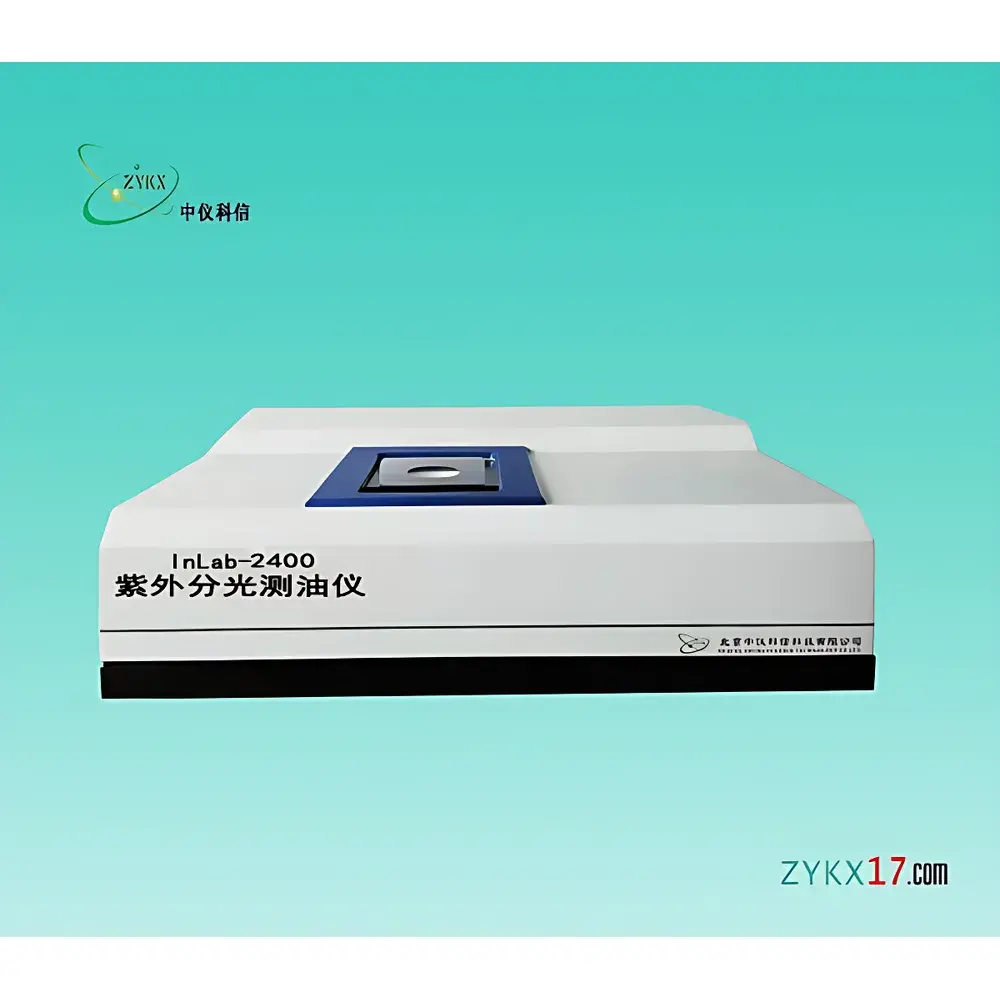
InLab-2400 UV Spectrophotometric Oil Analyzer
| Brand | ZYKX |
|---|---|
| Origin | Beijing, China |
| Manufacturer Type | Authorized Distributor |
| Country of Origin | China |
| Model | InLab-2400 |
| Price Range | USD 4,200 – 7,000 |
| Instrument Type | Laboratory Water Quality Analyzer |
| Target Analyte | Petroleum Hydrocarbons (Oil Content) |
| Compliance | HJ 970–2018 |
| Wavelength Range | 190–400 nm |
| Primary Measurement Wavelength | 225 nm |
| Absorbance Stability | ±0.005 Abs / 10 min |
| Absorbance Range | 0.000–2.000 Abs |
| Detection Limit | 0.001 mg/L |
| Repeatability | RSD ≤ 1% (for 2–20 mg/L oil standards, n=11) |
| Accuracy | ±2% |
| Resolution | 0.001 mg/L |
| Correlation Coefficient | R > 0.9995 (calibration range: 0–20 mg/L) |
Overview
The InLab-2400 UV Spectrophotometric Oil Analyzer is a dedicated laboratory instrument engineered for the quantitative determination of petroleum hydrocarbons in aqueous matrices—specifically surface water, groundwater, and seawater—according to the Chinese Environmental Protection Standard HJ 970–2018, “Determination of Petroleum Hydrocarbons in Water by Ultraviolet Spectrophotometry”. It operates on the fundamental principle of ultraviolet absorption spectroscopy, leveraging the characteristic absorbance of aliphatic and aromatic hydrocarbons at 225 nm following solvent extraction. Sample preparation involves acidification (pH ≤ 2), liquid–liquid extraction with n-hexane, dehydration using anhydrous sodium sulfate, and polar interference removal via magnesium silicate adsorption. The resulting extract is optically measured under controlled photometric conditions, and concentration is calculated directly from the Beer–Lambert relationship without manual interpolation. This method eliminates reliance on infrared absorption bands that overlap with natural organic matter, offering improved selectivity for petroleum-derived compounds in complex environmental samples.
Key Features
- Full compliance with HJ 970–2018—including automated wavelength scanning (190–400 nm), real-time spectral acquisition, and automatic peak detection at 225 nm
- n-Hexane-based extraction protocol—reducing operator exposure and environmental hazard compared to CCl4-dependent IR methods
- Integrated optical architecture with post-dispersion absorption design: monochromator precedes sample cell, optimizing signal fidelity and minimizing stray light
- Electronically modulated deuterium lamp source—eliminating mechanical chopper components, enhancing thermal stability and long-term photometric reproducibility
- Lock-in amplifier signal processing—significantly improving signal-to-noise ratio (SNR) and lowering practical detection limits
- Pre-stored calibration curves for immediate analysis; supports user-defined curve import, auto-validation, and versioned storage (up to 100 curves)
- High-resolution true-color touchscreen interface (optional) with single-screen visualization of transmittance, absorbance, concentration, wavelength, spectral plot, and extraction ratio
- Onboard data management: spectra and quantitative results saved to internal storage with timestamp, operator ID, and method metadata; exportable via USB to CSV or PDF
Sample Compatibility & Compliance
The InLab-2400 is validated for use with raw and treated water matrices across diverse regulatory and operational contexts: municipal drinking water sources, wastewater effluents, industrial cooling discharges, marine monitoring stations, and groundwater assessment wells. Its methodology aligns with internationally recognized principles for hydrocarbon quantification—though not directly certified to ISO 9377-2 or ASTM D7066, its photometric rigor, documented linearity (R > 0.9995 over 0–20 mg/L), and repeatability (RSD ≤ 1%) support equivalence assessments for GLP-compliant laboratories. All software operations maintain full audit trail capability—including parameter changes, calibration events, and result exports—enabling traceability per FDA 21 CFR Part 11 requirements when deployed in regulated QA/QC environments.
Software & Data Management
The proprietary InLab Analysis Suite provides complete instrument control, spectral visualization, calibration management, and report generation. It supports method-driven workflows: users select preconfigured protocols (e.g., “HJ 970–2018 Standard Method”) or build custom sequences including blank subtraction, multi-point calibration, and dilution factor application. All raw absorbance data and processed spectra are stored with embedded metadata (date/time, operator code, instrument serial number, cuvette pathlength). Reports comply with ISO/IEC 17025 documentation standards—exportable as PDF with digital signature fields, or as structured CSV for LIMS integration. Software updates are delivered via secure firmware packages with SHA-256 verification; no cloud dependency or external telemetry is enabled by default.
Applications
- Regulatory compliance testing for discharge permits (e.g., EPA NPDES, local ecological bureaus)
- Source water screening in municipal water utilities prior to treatment
- Leak detection and plume delineation in industrial site remediation
- Baseline characterization and long-term trend analysis in watershed monitoring programs
- Method validation and inter-laboratory comparison studies in environmental testing labs
- Teaching applications in university environmental chemistry and analytical science curricula
FAQ
Does the InLab-2400 require daily recalibration?
No—its photometric stability (±0.005 Abs/10 min) and robust optical design allow for calibration verification at the start of each analytical batch, with full recalibration recommended only after maintenance or when QC standards deviate by >±5% from expected values.
Can it quantify diesel or lubricating oil separately from crude oil?
Not selectively—the method targets total petroleum hydrocarbons (TPH) as defined by HJ 970–2018. Compound-class differentiation requires GC–FID or GC–MS.
Is n-hexane purity critical for accurate results?
Yes—only UV-grade n-hexane (absorbance <0.03 at 225 nm in 1 cm pathlength) must be used to avoid spectral interference; lot-specific blanks are required for every new solvent batch.
What sample volume is needed per test?
Standard protocol uses 1 L of water sample, yielding a final extract volume of 10 mL; smaller volumes may be used with proportional adjustment of extraction efficiency validation.
Is third-party certification available for ISO/IEC 17025 accreditation?
The instrument itself is not accredited, but its documented performance specifications, traceable calibration procedures, and software audit logs fully support inclusion in an accredited lab’s scope of testing under ISO/IEC 17025:2017 Clause 6.4 and 6.5.







