
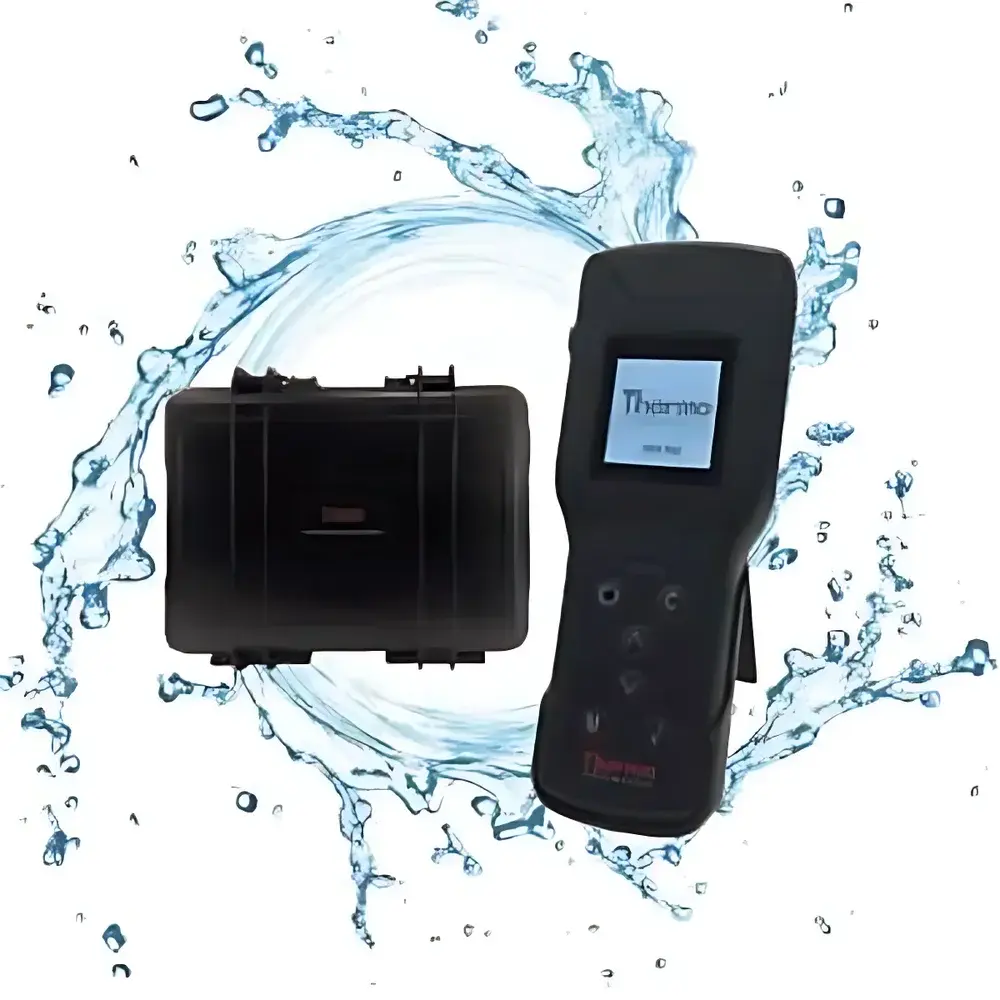
Thermo Scientific AQ4700 Water Toxicity Analyzer
| Brand | Thermo Fisher |
|---|---|
| Origin | USA |
| Model | Thermo Scientific AQ4700 |
| Instrument Type | Online |
| Biological Indicator | Bioluminescent Bacteria |
| Detection Time | 5 min |
| Compliance | ISO 11348 |
Overview
The Thermo Scientific AQ4700 Water Toxicity Analyzer is a compact, field-deployable online instrument engineered for rapid, quantitative assessment of acute aquatic toxicity using bioluminescent bacterial biosensors. It operates on the principle of luminometric bioassay: viable Vibrio fischeri (or equivalent standardized luminescent strains) emit stable, measurable blue-green light (λ ≈ 490 nm) under optimal conditions; exposure to toxicants—including heavy metals, pesticides, pharmaceuticals, surfactants, and industrial effluents—induces immediate, dose-dependent inhibition of cellular respiration and ATP-dependent luciferase activity, resulting in quantifiable reduction in relative light units (RLU). This mechanism enables detection of synergistic, antagonistic, or additive effects across complex mixtures—without requiring compound-specific calibration—making it uniquely suited for screening unknown or variable matrices where chemical analysis alone is insufficient. Designed for compliance with ISO 11348-1/2/3 (Water quality — Determination of the inhibitory effect of water samples on the light emission of Vibrio fischeri), the AQ4700 delivers reproducible, GLP-aligned results within 5 minutes per sample.
Key Features
- Three configurable assay modes: ISO-compliant toxicity mode (standardized exposure time, temperature, and dilution protocol), Basic Toxicity Mode (user-defined kinetics), and RLU Mode for ad hoc ATP quantification or method development
- Integrated optical path with temperature-controlled cuvette holder (20 ± 0.5 °C) ensuring consistent bioluminescence response across ambient fluctuations
- High-sensitivity photomultiplier tube (PMT) detector with linear dynamic range spanning 10²–10⁶ RLU, enabling detection of low-level inhibition (<10% signal loss) and robust EC₅₀ determination
- Onboard data logging with timestamped RLU traces, automatic blank subtraction, and real-time % inhibition calculation
- Portable form factor (3.2 kg) with ruggedized carry case, internal rechargeable battery (≥8 h operation), and IP54-rated enclosure for field deployment in wastewater plants, riverside stations, or emergency response vehicles
Sample Compatibility & Compliance
The AQ4700 accepts liquid samples directly—including raw influent, treated effluent, drinking water, surface water, leachates, and industrial process streams—without pre-filtration in most cases (optional 0.45 µm filtration recommended for turbid or particulate-rich matrices). It supports serial dilution via integrated syringe pump or manual pipetting, facilitating EC₁₀/EC₂₀/EC₅₀ derivation per ISO 11348-3. The system meets requirements for routine environmental monitoring under EU Water Framework Directive (WFD) Watch List programs and U.S. EPA Method 1693 (for wastewater toxicity screening). Its audit-trail-capable firmware supports 21 CFR Part 11–compliant user access control and electronic signature when connected to validated LIMS environments.
Software & Data Management
Instrument control, assay configuration, and data review are managed via Thermo Scientific AQ Manager PC software (Windows 10/11 compatible). The application provides automated report generation compliant with ISO 11348 Annex D templates, including uncertainty estimation (k = 2), confidence intervals for EC₅₀, and outlier detection per Grubbs’ test. Raw RLU time-series data export is supported in CSV and XML formats for secondary statistical analysis (e.g., PCA, mixture toxicity modeling). All measurement metadata—including operator ID, sample ID, calibration history, and environmental logs—is embedded and cryptographically signed to satisfy GLP/GMP traceability requirements.
Applications
- Rapid emergency response to chemical spills or unknown contamination events at municipal water intakes or watershed boundaries
- Continuous or semi-continuous toxicity surveillance in WWTPs (influent, activated sludge, final effluent) to verify treatment efficacy and regulatory compliance
- Pharmaceutical manufacturing: release testing of antibiotic-containing rinse waters and cleaning validation swab extracts
- Academic and contract research laboratories conducting comparative ecotoxicity studies, QSAR model validation, or nanomaterial hazard assessment
- Drinking water utilities performing source water early-warning monitoring and disinfection by-product toxicity profiling
FAQ
What bacterial strain is used in the AQ4700 assays?
The system utilizes freeze-dried, lyophilized Vibrio fischeri (NRRL B-11177) supplied in certified vials conforming to ISO 11348 specifications. Each batch is independently tested for luminescence stability, sensitivity, and shelf life.
Can the AQ4700 quantify specific contaminants like lead or atrazine?
No—it measures integrated biological effect, not individual analyte concentrations. However, it reliably detects their presence when present above effect thresholds and is often deployed alongside GC-MS or ICP-MS for tiered testing strategies.
Is calibration required before each run?
A daily performance check using the supplied control standard (non-toxic reference solution) is recommended. Full recalibration with reference toxicant (e.g., 3,5-dichlorophenol) is performed quarterly or after maintenance.
How does temperature affect assay results?
The integrated Peltier-controlled chamber maintains 20 °C ± 0.5 °C during exposure, eliminating manual incubation and minimizing inter-laboratory variability inherent in non-thermostatted systems.
Does the AQ4700 support remote data transmission?
Yes—via optional Ethernet or 4G LTE module, enabling integration into SCADA networks or cloud-based environmental dashboards with TLS 1.2 encryption and configurable alarm thresholds.







