
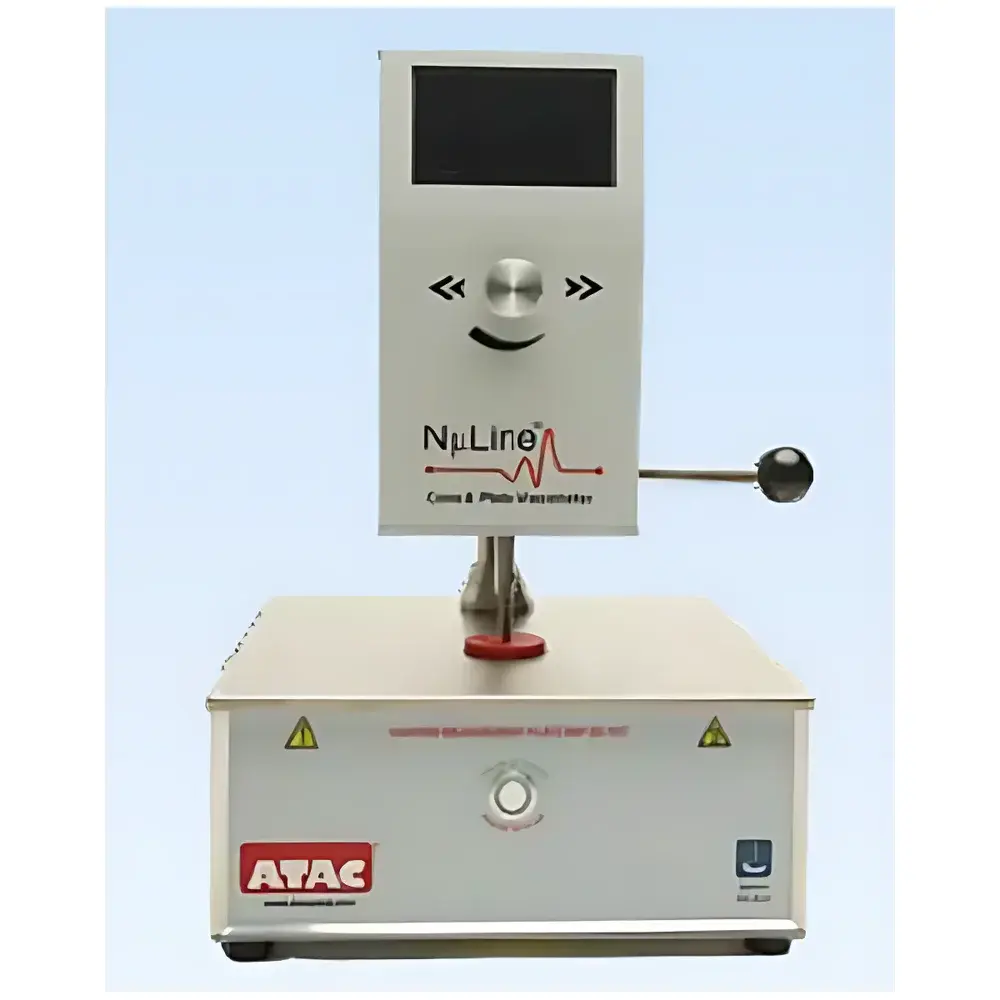
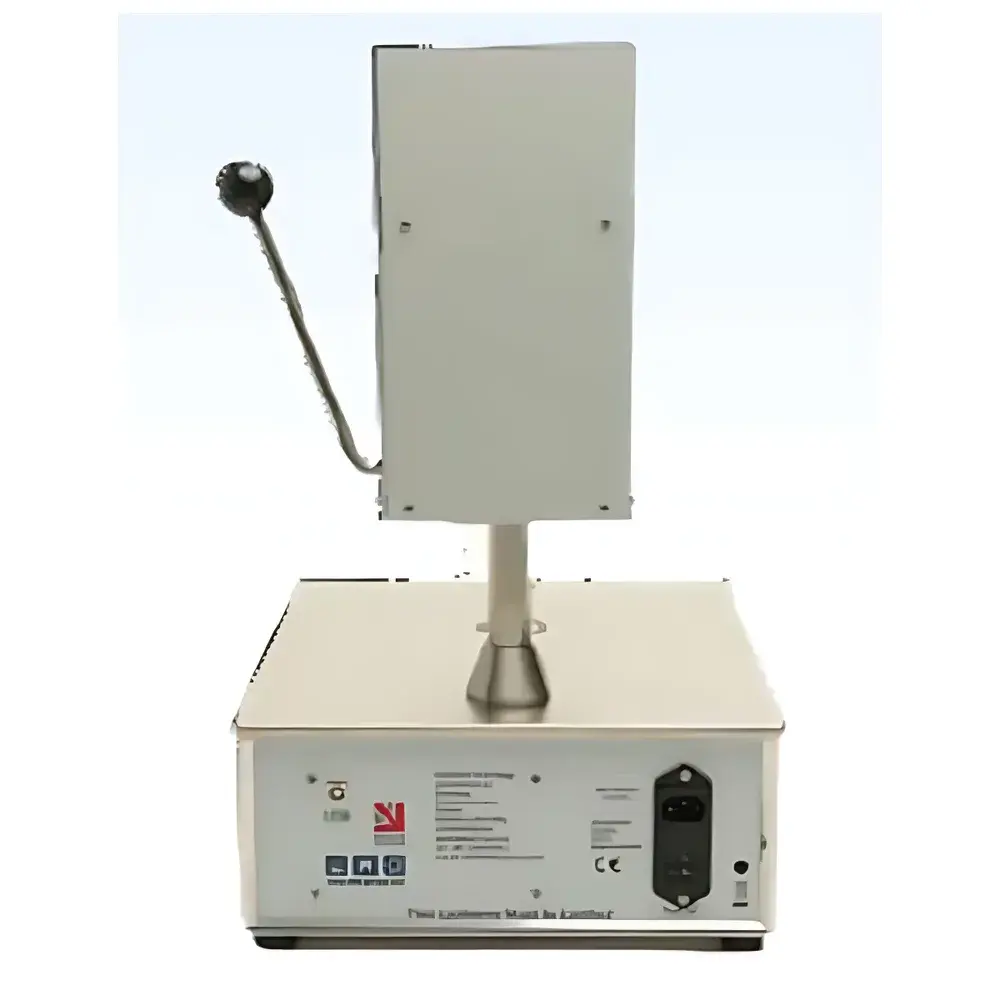
ATAC REL0250 Cone-Plate Viscometer
| Brand | ATAC |
|---|---|
| Origin | United Kingdom |
| Model | REL0250 |
| Instrument Type | High-Temperature Portable Cone-Plate Viscometer |
| Speed Range | 5–900 rpm (Low-Speed Mode: 5–90 rpm, Adjustable in 0.1-rpm Increments) |
| Display | 4.3-inch Color LCD |
| Calibration | Onboard Auto-Calibration for Multiple Cone-Plate Geometries |
| Cone Options | Six Standard Cone-Plate Sets Available |
| Accuracy | ±1% (Verified with NIST-Traceable Standard Oils) |
| Compliance | BS EN ISO 2884-1:2006 |
| Temperature Capability | High-Temperature Operation (Compatible with External Heated Sample Chambers or Integrated Thermal Control Systems) |
| Connectivity | RS-232/USB PC Interface with Dedicated Data Acquisition Software |
Overview
The ATAC REL0250 Cone-Plate Viscometer is a precision-engineered rotational viscometer designed for high-temperature rheological characterization of structured and thermally sensitive fluids. Based on the classical cone-and-plate geometry, it operates under controlled shear conditions where the sample is confined between a stationary plate and a rotating conical spindle—enabling uniform shear rate distribution across the entire measurement gap. This geometry ensures first-order accuracy in viscosity determination under steady-state shear, particularly critical for non-Newtonian materials exhibiting shear-thinning or yield stress behavior. The REL0250 inherits the metrological legacy of the historic ATAC REL series, originally adopted as the reference instrument for BS 3900 (now superseded by BS EN ISO 2884-1:2006), establishing its foundational role in industrial standardization for paint, coating, and polymer formulation testing.
Key Features
- Portable, benchtop-integrated architecture with integrated 4.3-inch color LCD interface for real-time parameter monitoring and local operation without external computing.
- Onboard auto-calibration routine supporting six interchangeable cone-plate geometries—each optimized for specific viscosity ranges (e.g., low-viscosity solvents to high-viscosity asphalt binders).
- Variable rotational speed control from 5 to 900 rpm, with dedicated low-speed mode (5–90 rpm) enabling fine-resolution shear rate sweeps at increments as small as 0.1 rpm—essential for yield stress estimation and creep recovery analysis.
- Thermally robust mechanical design compatible with externally heated sample stages or integrated thermal enclosures (not included), permitting stable measurements up to 200 °C when used with appropriate accessories.
- Compliance with BS EN ISO 2884-1:2006 for viscosity determination of paints and varnishes, ensuring data integrity meets internationally recognized quality assurance requirements.
- Integrated RS-232 and USB interfaces for bidirectional communication with Windows-based acquisition software, supporting time-resolved viscosity, shear rate, and torque logging.
Sample Compatibility & Compliance
The REL0250 is routinely deployed for quality control and R&D applications involving thermally stable and temperature-dependent fluids—including solvent-borne and waterborne coatings, UV-curable resins, hot-melt adhesives, bituminous binders, edible oils, and pharmaceutical suspensions. Its cone-plate configuration minimizes edge effects and sample volume requirements (typically 0.5–1.0 mL), reducing material waste and improving test repeatability. All measurements adhere to ISO/IEC 17025 traceability principles when calibrated using certified reference oils (e.g., Cannon-Manning series). The instrument satisfies prerequisite conditions for GLP-compliant laboratories performing viscosity assessments under ASTM D1084, ISO 2555, and USP <911> methodologies—provided thermal control and calibration documentation are maintained per internal SOPs.
Software & Data Management
The included PC software provides full remote control, real-time graphical display of viscosity vs. time or shear rate, and export capabilities in CSV, TXT, and XLSX formats. Audit-trail functionality records operator ID, timestamp, calibration status, and geometry selection—supporting compliance with FDA 21 CFR Part 11 when configured with electronic signature modules and system access controls. Data sets can be annotated with batch IDs, environmental conditions (ambient temperature/humidity), and test protocols, facilitating integration into LIMS environments. Firmware updates and geometry-specific calibration coefficients are managed via secure software interface, ensuring long-term metrological consistency.
Applications
- Quality assurance of architectural and industrial coatings per BS EN ISO 2884-1 and ASTM D1200.
- Rheological profiling of hot-melt adhesives during melt processing and cooling cycles.
- Bitumen viscosity grading for pavement engineering (AASHTO T 201, ASTM D3381).
- Stability assessment of concentrated food emulsions and dairy-based suspensions under elevated temperatures.
- Formulation development of shear-thinning pharmaceutical gels and topical suspensions requiring precise yield point determination.
- Process validation of polymer melts in extrusion and injection molding feedstock qualification.
FAQ
Is the REL0250 suitable for measuring yield stress?
Yes—the low-speed mode (5–90 rpm, 0.1-rpm resolution) enables controlled ramped shear rate tests and controlled-stress creep experiments when paired with optional torque-sensing firmware upgrades.
Can I use the REL0250 without a computer?
Yes—full standalone operation is supported via the onboard LCD interface, including speed setting, unit selection, and real-time viscosity readout.
Does the instrument include temperature control?
No—the REL0250 does not integrate active heating or cooling; however, it is mechanically and electrically compatible with third-party heated sample holders and Peltier-controlled plates meeting ISO 2884-1 dimensional tolerances.
What cone-plate geometries are available?
Six standard geometries are offered: 1°, 2°, and 4° cones with diameters of 25 mm and 40 mm—each assigned a unique calibration coefficient stored in the instrument memory.
How often must the instrument be recalibrated?
Annual recalibration against traceable standard oils is recommended; field verification using a single-point check oil is advised before each daily shift in regulated environments.



