
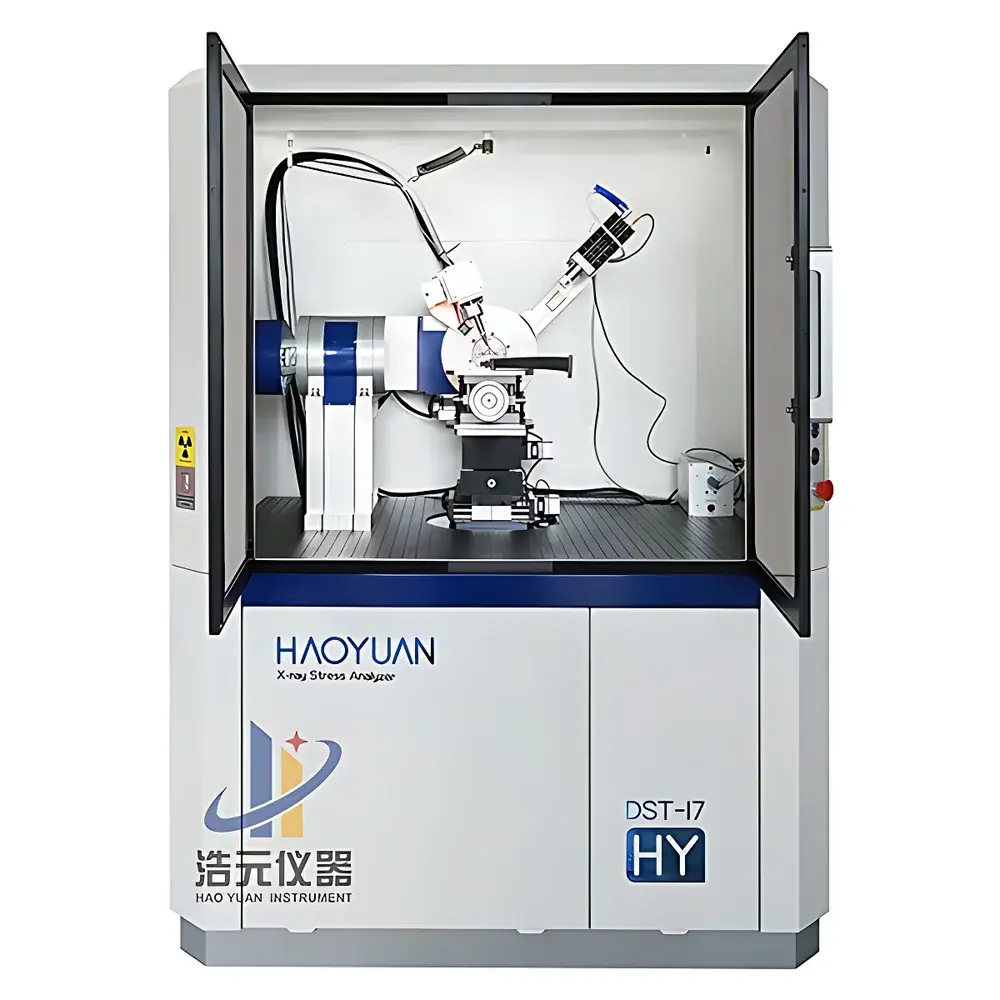
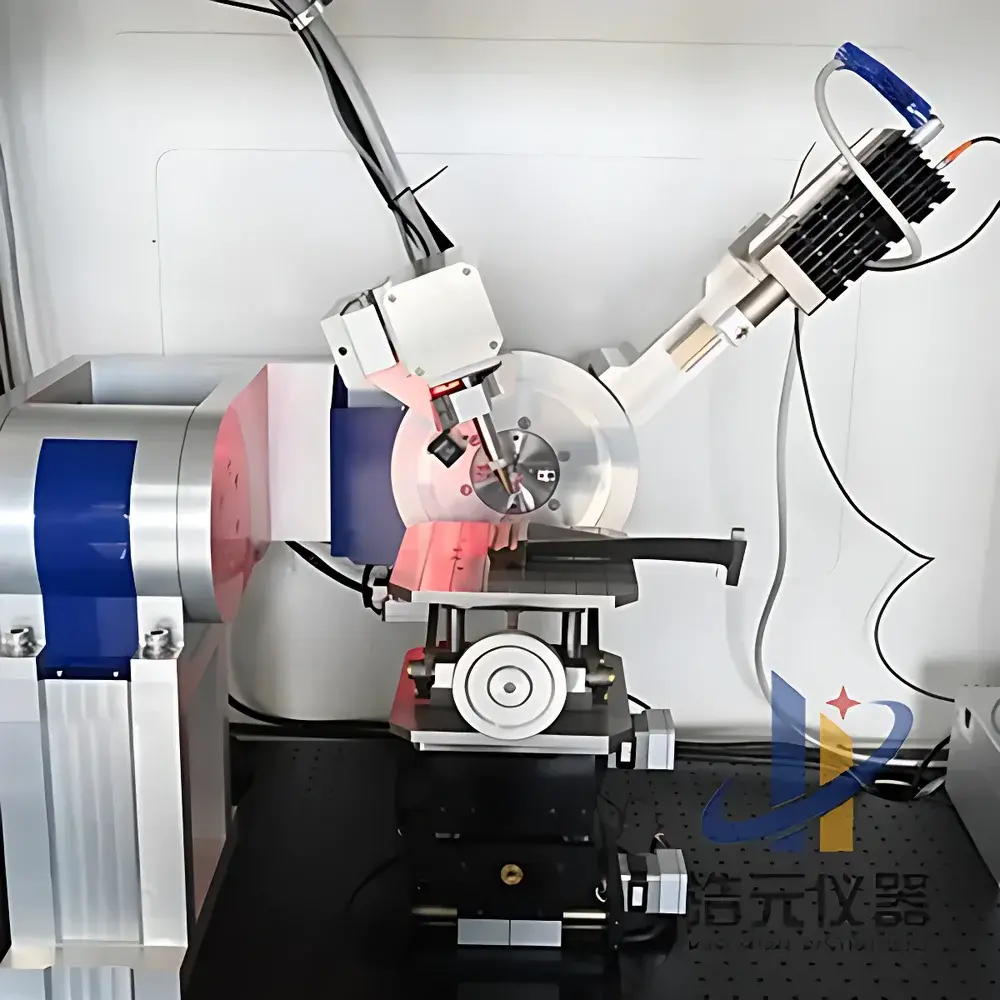
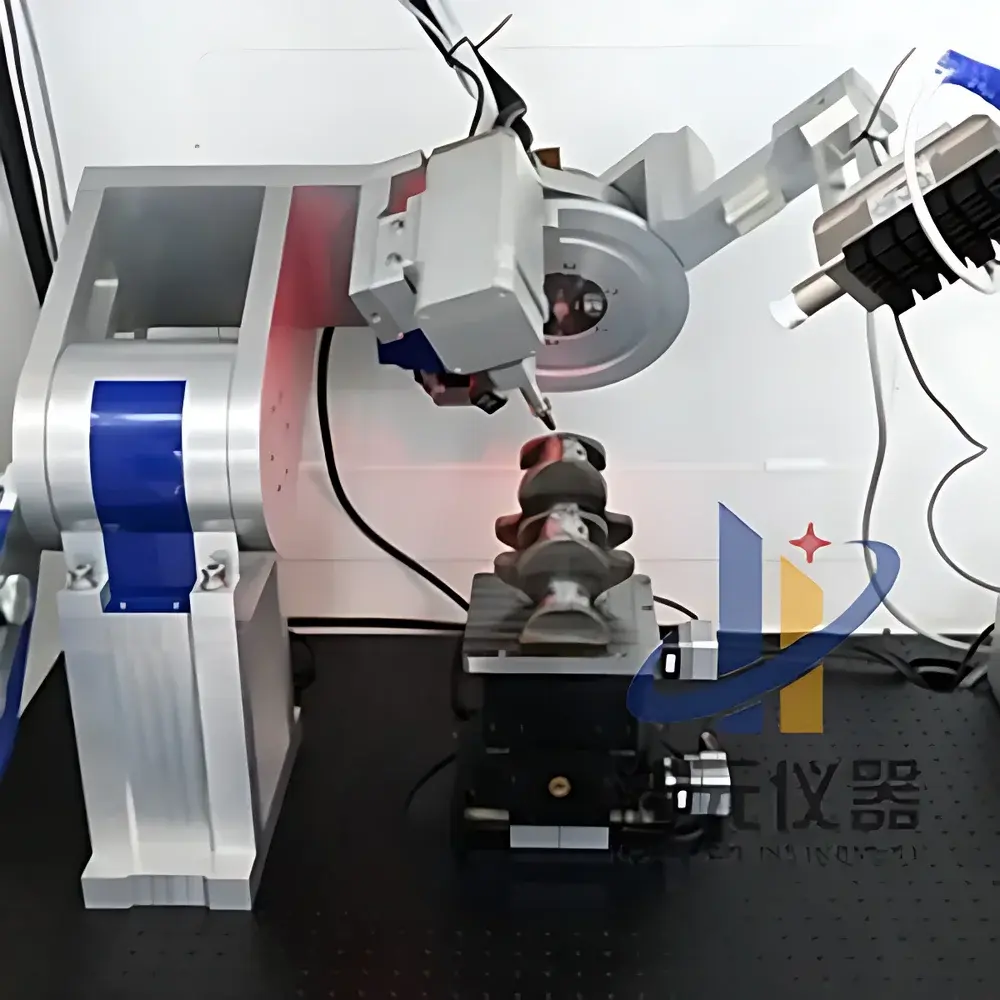
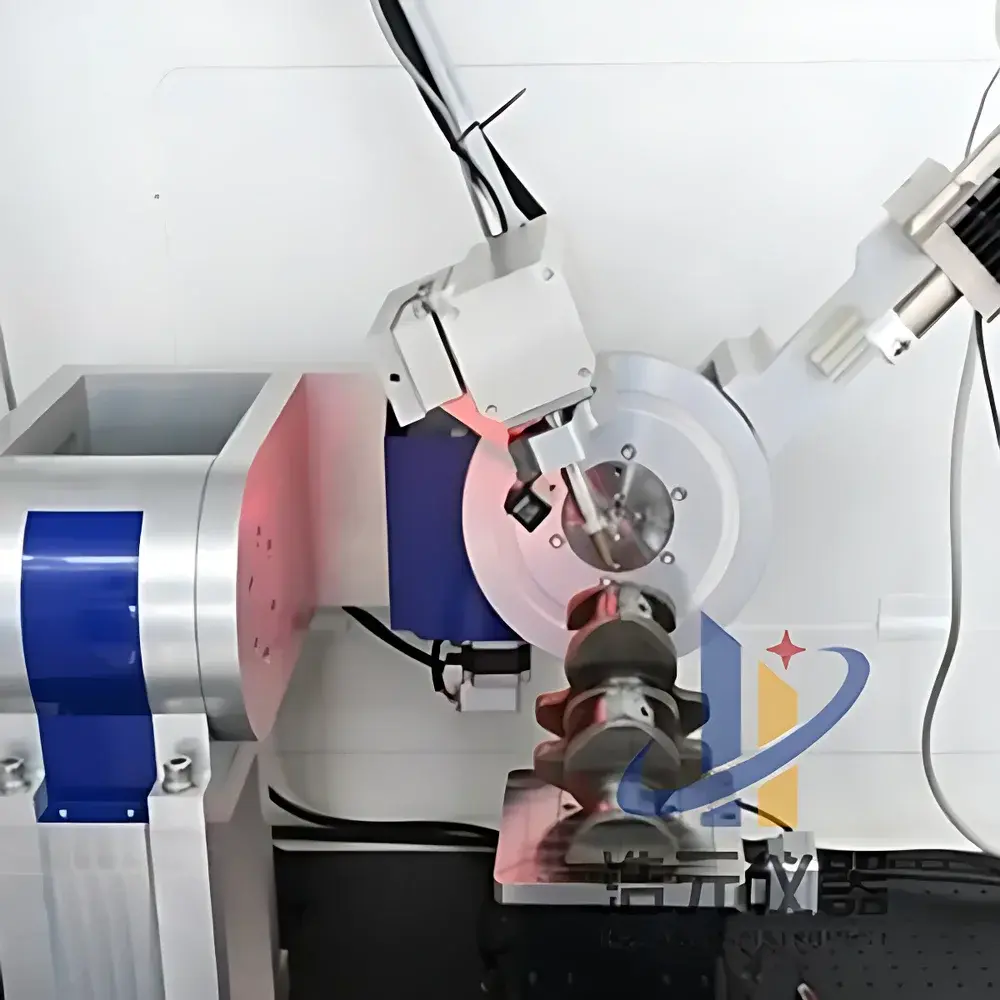
Haoyuan DST-17 High-Resolution X-Ray Stress Analyzer
| Brand | Haoyuan |
|---|---|
| Origin | Liaoning, China |
| Manufacturer Type | Direct Manufacturer |
| Product Origin | Domestic (China) |
| Model | DST-17 |
| X-ray Tube Power | 3000 W |
| 2θ Angular Range | 45°–170° (continuously adjustable) |
| ψ Angular Range | −25° to +50° |
| Target Materials | Cr, Cu, Mn, Ti, Co, V, Fe |
| Angular Resolution (2θ) | 0.0001° |
| 2θ Repeatability | < 0.003° |
| Stress Measurement Accuracy | ±5 MPa |
| Detector | High-resolution Silicon Drift Detector (SDD), linear array configuration |
| Sample Positioning | Laser displacement sensor with < 3 µm repeatability |
| Motion System | 4-axis motorized sample stage + 360° precision rotation stage |
| Radiation Shielding | Fully enclosed lead-glass enclosure compliant with ANSI N43.2 |
| Standards Compliance | ASTM E915-2010, EN 15305-2008, GB/T 7704-2016, ISO 9001 |
Overview
The Haoyuan DST-17 High-Resolution X-Ray Stress Analyzer is a laboratory-grade, benchtop X-ray diffraction (XRD)-based instrument engineered for quantitative residual stress evaluation, retained austenite quantification, and crystallographic texture analysis in polycrystalline metallic and ceramic materials. It operates on the principle of sin²ψ X-ray diffraction, where lattice strain—induced by residual stress—is determined via precise measurement of angular shifts in Bragg diffraction peaks as a function of sample tilt (ψ) and detector azimuth (2θ). The system supports both side-inclination (ψ-split) and conventional tilting (ψ-scan) geometries, enabling full stress tensor reconstruction—including in-plane normal (σₓ, σᵧ) and shear (τₓᵧ) components—at user-defined spatial coordinates. Designed for R&D laboratories, aerospace component QA/QC facilities, and nuclear material certification centers, the DST-17 delivers metrological-grade data traceable to international diffraction standards.
Key Features
- 3000 W high-power microfocus X-ray tube with interchangeable anode targets (Cr, Cu, Mn, Ti, Co, V, Fe), optimized for Kα radiation selection and minimal background scattering
- Ultra-high angular resolution: 2θ measurement resolution of 0.0001° and repeatability better than 0.003°, ensuring sub-MPa strain sensitivity
- Extended 2θ range (45°–170°) enables accurate retained austenite phase fraction determination using multiple reflection families (e.g., γ-(200), γ-(220), γ-(311)) per ASTM E975
- Wide ψ-angle range (−25° to +50°) accommodates low-symmetry and coarse-grained materials, including Ni-based superalloys and additively manufactured Inconel 718 turbine blades
- Linear-array silicon drift detector (SDD) with real-time energy discrimination, achieving single-point stress measurement in under 60 seconds without scanning
- Four-axis motorized sample stage with integrated 360° goniometric rotation, supporting pole figure acquisition and complete orientation distribution function (ODF) reconstruction
- Laser-assisted auto-alignment system with < 3 µm positional repeatability, eliminating manual centering errors during multi-point mapping
- ANSI N43.2-compliant lead-glass enclosure (standard dimensions: 1.4 × 1.2 × 1.6 m), fully interlocked and certified for Class I radiation safety
Sample Compatibility & Compliance
The DST-17 accepts irregularly shaped components up to Ø300 mm × 150 mm height, including forged gears, welded joints, shot-peened surfaces, and single-crystal turbine airfoils. Its modular target/detector geometry supports both reflection and transmission modes for thin films, coatings, and bulk substrates. All measurements adhere strictly to ASTM E915-2010 (Standard Test Method for Verifying the Alignment of X-Ray Diffraction Instrumentation for Residual Stress Measurement), EN 15305-2008 (Non-destructive testing — Test method for residual stress analysis by X-ray diffraction), and GB/T 7704-2016 (Chinese national standard for X-ray diffraction residual stress testing). Manufacturing follows ISO 9001:2015 quality management protocols; documentation includes full calibration certificates, uncertainty budgets, and traceability records to NIST-traceable reference materials.
Software & Data Management
The proprietary StressMaster™ software suite provides full workflow automation—from instrument control and peak search to stress tensor calculation and visualization. Peak fitting algorithms include Gaussian, Lorentzian, Pearson VII, and parabolic background models, with automatic FWHM and integrated intensity extraction. Software modules support: (i) multi-point sequential mapping with customizable grid patterns; (ii) contour-stress distribution plotting with interpolation; (iii) retained austenite quantification using Rietveld refinement or direct intensity ratio methods; (iv) pole figure generation via series ψ-tilt acquisitions; and (v) single-crystal stress modeling for Ni-based superalloys using elastic stiffness tensors. Audit trails, electronic signatures, and user-access controls comply with FDA 21 CFR Part 11 requirements for regulated environments. Raw diffraction patterns are saved in industry-standard .raw and .xye formats for third-party analysis.
Applications
- Aerospace: Residual stress profiling in compressor disks, fan blades, and landing gear components pre- and post-shot peening or laser shock peening
- Automotive: Stress mapping of cylinder heads, crankshafts, and gear teeth subjected to thermal cycling and mechanical loading
- Energy: Integrity assessment of welds in pressure vessels, steam generator tubes, and nuclear cladding materials
- Additive Manufacturing: In-process and post-build stress validation of Ti-6Al-4V and IN718 builds to guide heat treatment optimization
- Academic Research: Quantitative texture evolution studies during thermomechanical processing and phase transformation kinetics
- Quality Assurance: Batch-to-batch verification of surface integrity for medical implants and orthopedic devices
FAQ
What X-ray tube voltages and currents does the DST-17 support?
The 3000 W tube operates at up to 60 kV and 50 mA, with programmable ramping and stable regulation to minimize thermal drift during extended acquisitions.
Can the system perform stress measurements on coated or layered substrates?
Yes—the combination of variable incidence angle (α), selectable Kα lines, and SDD energy resolution allows depth-resolved stress analysis through controlled penetration depth modulation.
Is remote operation and data export supported?
The system supports Ethernet-based remote control via TCP/IP protocol; all processed data exports to CSV, Excel, and HDF5 formats with metadata embedding.
Does the software include uncertainty estimation for reported stress values?
Yes—StressMaster™ calculates combined standard uncertainty per GUM (JCGM 100:2008), incorporating contributions from angular calibration, peak position fitting, elastic constants, and instrumental broadening.
What maintenance intervals are recommended for the X-ray tube and detector?
Annual preventive maintenance is advised, including tube vacuum integrity check, detector energy calibration, and goniometer backlash verification—full service logs are stored within the software audit trail.




