
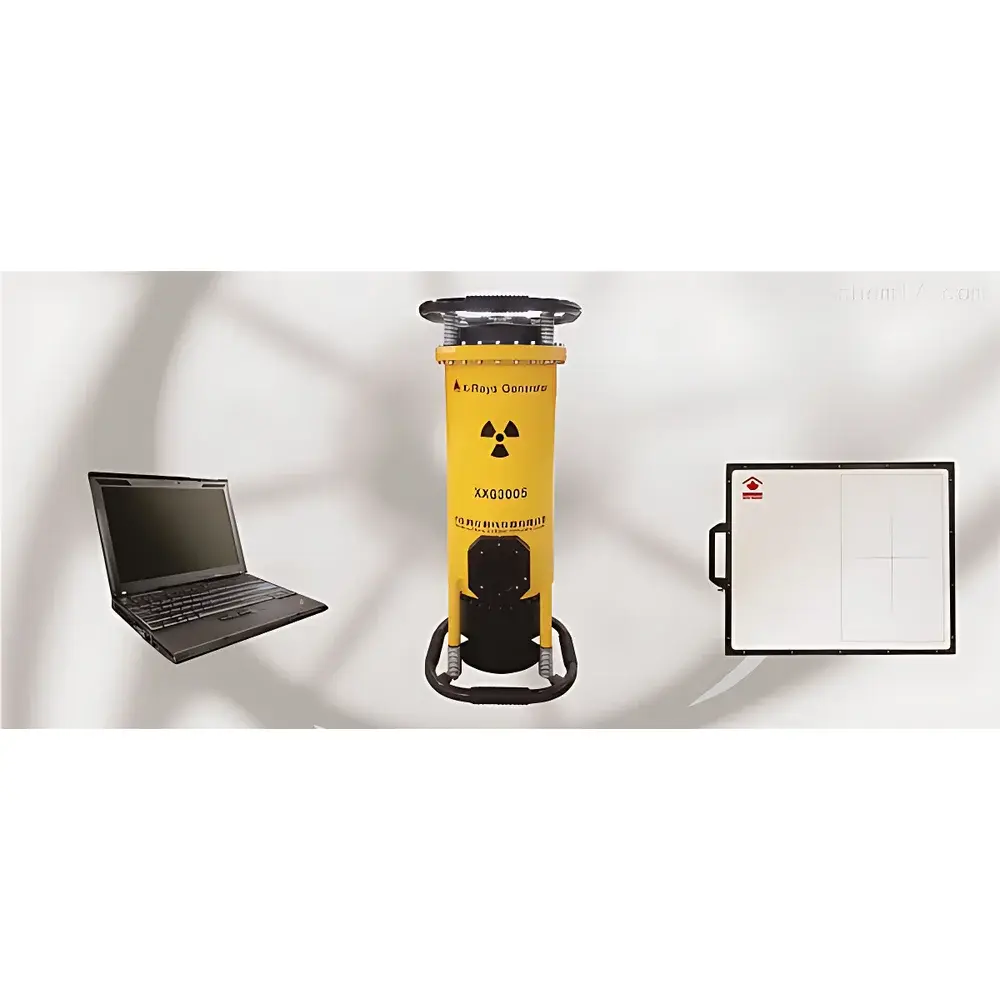
Aolong AL-DR-300B Variable-Frequency Portable X-ray Digital Radiography (DR) System
| Brand | Aolong |
|---|---|
| Origin | Liaoning, China |
| Manufacturer Type | Manufacturer |
| Origin Category | Domestic |
| Model | AL-DR-300B |
| Price Range | USD 140,000 – 280,000 |
| Max. X-ray Energy | 350 kV |
| Tube Current | 5 mA |
| Focal Spot Size | 2.0 mm |
| Beam Divergence Angle | 40° |
| Sensitivity | ≤1.5% |
| Detector Type | Amorphous Silicon (a-Si), Custom-Optimized for Variable-Frequency X-ray Source |
| Active Imaging Area | 35 × 21 cm |
| Pixel Pitch | 140 µm |
| Spatial Resolution | 3.2 LP/mm |
| A/D Conversion | 16-bit |
| Image Acquisition Time | 1 s (wired), 2.5 s (wireless) |
Overview
The Aolong AL-DR-300B Variable-Frequency Portable X-ray Digital Radiography (DR) System is an integrated, field-deployable non-destructive testing (NDT) platform engineered for high-fidelity radiographic inspection of metallic, composite, and heterogeneous industrial components. Unlike fixed-energy X-ray sources, its variable-frequency high-voltage generator enables precise, real-time adjustment of tube voltage (selectable models: 160 kV, 200 kV, 250 kV, and 350 kV) to match material density, thickness, and defect sensitivity requirements—optimizing contrast-to-noise ratio (CNR) across diverse applications from pipeline weld verification to aerospace castings. The system operates on the principle of digital radiography: X-rays transmitted through the object are captured by a custom-designed amorphous silicon (a-Si) flat-panel detector, converted into digital signals via 16-bit analog-to-digital conversion, and reconstructed into high-fidelity grayscale images with quantifiable geometric fidelity and dynamic range exceeding 90 dB.
Key Features
- Variable-frequency X-ray generator supporting continuous kV modulation from 40–350 kV (model-dependent), enabling adaptive penetration control without hardware swapping
- Compact, battery-assisted portable architecture compliant with ISO 17636-2:2013 for field radiography—fully self-contained with integrated HV generator, collimator, and detector mounting frame
- Custom a-Si flat-panel detector (35 × 21 cm active area) optimized for pulsed and variable-kV exposure regimes; 140 µm pixel pitch ensures 3.2 line pairs per millimeter (LP/mm) spatial resolution at Nyquist frequency
- Real-time image acquisition: sub-second display latency (1 s wired / 2.5 s wireless) with full 16-bit raw data preservation for quantitative analysis
- Zero-hazard transport profile: no radioactive isotopes, no hazardous chemicals, no darkroom infrastructure—fully compliant with IATA Packing Instruction 950 and DOT 49 CFR §173.421 for air/road shipment
- Embedded radiation safety logic: automatic beam gating, real-time dose monitoring, and programmable exposure interlocks aligned with IEC 61331-1:2014 and ANSI N43.3-2022
Sample Compatibility & Compliance
The AL-DR-300B accommodates ferrous and non-ferrous alloys (steel, aluminum, titanium), fiber-reinforced polymers (FRP), concrete, and ceramic-matrix composites up to 85 mm steel-equivalent thickness at 350 kV. Its imaging performance meets or exceeds ASTM E2737-22 (Standard Practice for Digital Radiographic Testing) and ISO 17636-2:2013 (Radiographic testing of welds — Part 2: X- and gamma-ray techniques with digital detectors). Detector calibration is traceable to NIST SRM 2082 (X-ray imaging phantoms), and system-level IQI sensitivity validation confirms ≤1.5% penetrameter visibility per EN 1435:1997 Annex B. All firmware and software modules support audit-ready operation under GLP and GMP environments, including electronic signature capability and 21 CFR Part 11–compliant user access logs.
Software & Data Management
The AL-DR-300B runs on Windows 7–10 (64-bit) with Aolong DR-View v4.x software—a CE-certified, DICOM 3.0–compliant application designed for metrology-grade radiographic analysis. Core capabilities include calibrated dimensional measurement (±0.1 mm accuracy with reference scale), multi-frame sequence capture and playback, window/level optimization, edge-enhanced negative inversion, and pseudo-color LUT mapping. All images retain embedded EXIF metadata (kV, mA, exposure time, SID, detector SN, calibration timestamp). Data export supports TIFF (16-bit), DICOM, and PDF report formats. Local storage utilizes encrypted RAID-1 SSD arrays (2 TB standard); optional cloud synchronization enables secure, role-based remote review via TLS 1.2–secured API endpoints. Software update history, parameter change logs, and user session records are retained for ≥36 months to satisfy ISO 9001:2015 clause 7.5.3.
Applications
- Weld inspection in oil & gas pipelines, pressure vessels, and structural steel joints per ASME BPVC Section V, Article 2
- In-service corrosion mapping of aircraft fuselage skins and wing spars using dual-energy subtraction workflows
- Porosity and inclusion detection in investment-cast turbine blades (ASTM E192–20)
- Quality assurance of additive-manufactured (AM) metal parts—identifying lack-of-fusion defects and internal void networks
- Field verification of railcar axle integrity and brake component wear without disassembly
- Educational NDT training platforms with repeatable phantom-based assessment protocols
FAQ
Does the AL-DR-300B require regulatory licensing for field use in the EU or North America?
Yes—operation requires site-specific radiation safety authorization per national regulations (e.g., UK HSE IRR17, US NRC 10 CFR Part 34, or Canadian CNSC REG-265). Aolong provides technical documentation packages supporting license applications, including shielding calculations, dose rate maps, and operational SOP templates.
Can the system perform quantitative thickness measurement of corroded pipe walls?
Yes—using calibrated step-wedge references and dual-image subtraction, wall loss can be measured to ±0.2 mm accuracy within 20–60 mm steel thickness range. Requires pre-installed calibration curves and validated ROI analysis protocols.
Is the detector compatible with third-party imaging software such as ImageJ or MATLAB?
Yes—the system exports raw 16-bit TIFF files with embedded header metadata (including exposure parameters and detector gain map), enabling direct import and algorithmic processing in MATLAB, Python (OpenCV/scikit-image), or ImageJ/Fiji with appropriate scaling and offset correction.
What maintenance intervals are recommended for the X-ray tube and detector?
X-ray tube: 1,000 operating hours or 2 years (whichever occurs first); detector: annual NIST-traceable sensitivity verification and flat-field correction. Preventive maintenance kits and OEM-certified service contracts are available.
How is image quality assurance performed between inspections?
Built-in QC routines include daily warm-up checks, weekly IQI sensitivity verification using duplex wire IQIs (EN 462-1), and monthly MTF measurement using edge-spread function (ESF) analysis per ASTM E2737-22 Annex A3.



