
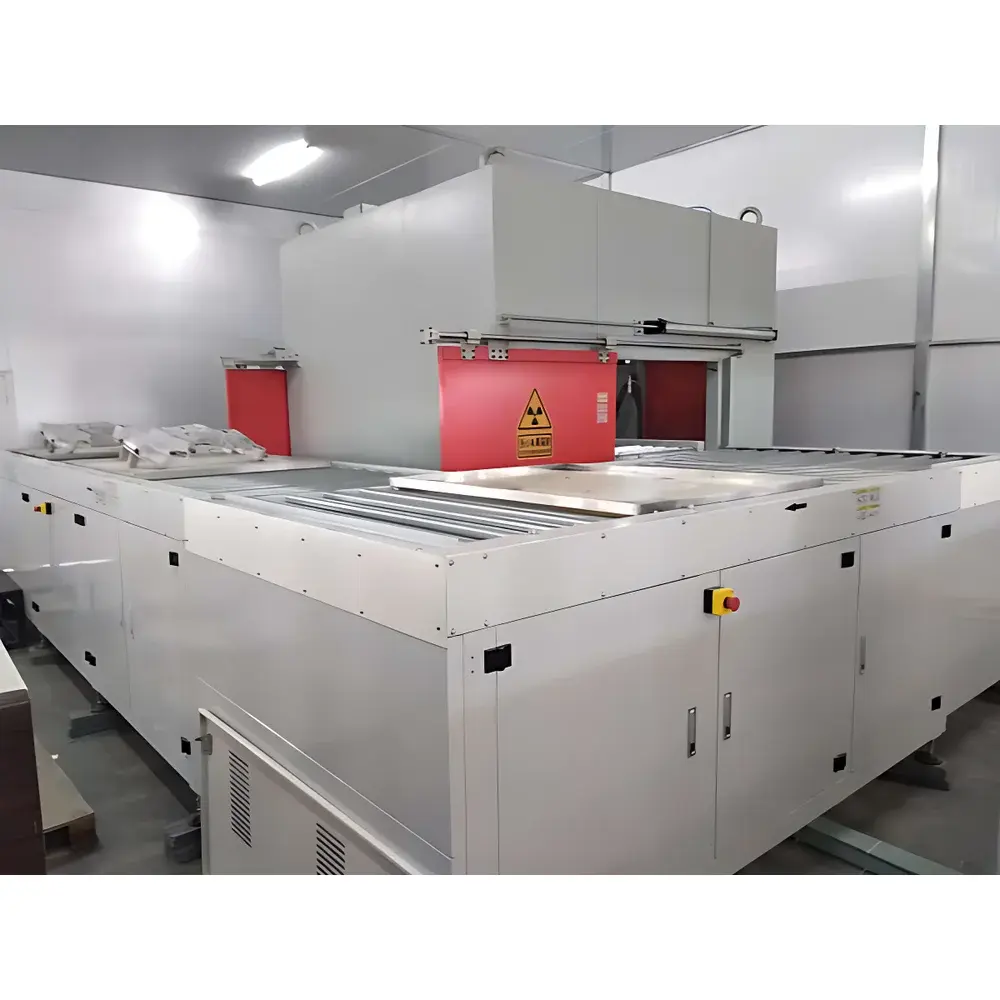
Aolong X-ray In-Line Casting Inspection System
| Brand | Aolong |
|---|---|
| Origin | Liaoning, China |
| Manufacturer Type | OEM/ODM Manufacturer |
| Product Category | Domestic Industrial Micro-CT System |
| Model | X-ray In-Line Casting Inspection System |
| Pricing | Available Upon Request |
| Tube Voltage | 20–450 kV |
| Tube Current | 0.1–20 mA |
| Repeatability | ±0.01% |
| High-Voltage Rise Time | 0.1–0.3 ms |
| Spatial Resolution | 16–60 lp/cm (depending on detector configuration) |
| Contrast Sensitivity | 1.2–1.5% |
Overview
The Aolong X-ray In-Line Casting Inspection System is an industrial-grade, real-time radiographic inspection platform engineered for automated, high-throughput non-destructive evaluation (NDE) of metal castings in production environments. Based on transmission X-ray imaging physics—where differential X-ray attenuation reveals internal density variations—the system detects volumetric and planar defects including gas porosity, slag inclusions, shrinkage cavities, micro-cracks, and core shift with high spatial fidelity. Unlike conventional offline benchtop radiography, this system integrates directly into casting finishing lines or heat-treatment conveyors, enabling 100% in-process screening without interrupting workflow. Its modular architecture supports both static and dynamic scanning modes, and it is calibrated to meet the foundational metrological requirements of ASTM E94/E1742 (Standard Guide for Radiographic Examination) and ISO 5579 (Non-destructive testing — Radiographic testing of metallic materials using film and X- or gamma rays). Designed for long-term stability in foundry-floor conditions—including ambient temperature fluctuations, airborne particulates, and electromagnetic interference—the system employs hardened mechanical gantries, sealed detector enclosures, and redundant thermal management.
Key Features
- Multi-kV X-ray source with continuously adjustable tube voltage (20–450 kV) and current (0.1–20 mA), enabling optimal penetration across aluminum, magnesium, cast iron, and steel alloys.
- High-repeatability high-voltage generator with sub-millisecond rise time (0.1–0.3 ms), ensuring consistent exposure timing critical for motion-synchronized imaging.
- Dual-detection pathway support: configurable integration with image intensifiers, linear array detectors, or flat-panel detectors (FPDs), each selected per resolution–throughput trade-off (e.g., 16 lp/cm for rapid inline screening; up to 60 lp/cm for high-fidelity micro-defect analysis).
- Motorized multi-axis inspection platform (X/Y/Z + rotation) with programmable trajectory control, facilitating full 360° circumferential scanning or localized region-of-interest (ROI) interrogation.
- Lead-shielded radiation containment enclosure compliant with national Class II radiation facility standards (GBZ 138–2002), featuring interlocked access doors, dose-rate monitoring sensors, and emergency beam cutoff.
- Real-time image acquisition engine capable of >15 fps at full detector resolution, synchronized with conveyor speed via encoder input for distortion-free projection geometry.
Sample Compatibility & Compliance
The system accommodates cast components ranging from small precision parts (e.g., brake calipers, fuel injectors, turbine blades) to large structural assemblies (e.g., engine blocks, marine gear housings, wind turbine hubs) weighing up to 200 kg and measuring up to 1,200 × 800 × 600 mm. Sample handling interfaces include custom fixture mounts, vacuum chucks, and robotic arm adapters for seamless integration with Industry 4.0 production cells. All hardware and software modules conform to IEC 61000-6-2/6-4 (EMC immunity/emission), CE machinery directive 2006/42/EC, and are documented per ISO 9001:2015 quality management requirements. Radiation safety documentation includes full shielding verification reports, annual leakage tests, and operator training protocols aligned with national regulatory frameworks.
Software & Data Management
The proprietary Aolong CAST-INSIGHT™ software suite provides DICOM-compliant image acquisition, contrast-enhanced defect segmentation, automated pass/fail classification (via threshold-based or AI-assisted rule sets), and audit-trail-enabled reporting. Image processing pipelines support dynamic range compression, noise reduction (non-local means filtering), edge enhancement, and multi-frame averaging to improve low-contrast detectability. All inspection records—including raw projections, reconstructed slices (if CT mode enabled), measurement logs, and operator annotations—are stored in a secure, timestamped database with role-based access control. The system supports export to PDF, CSV, and XML formats for traceability in QS-9000, IATF 16949, and AS9100-certified quality systems. Optional FDA 21 CFR Part 11 compliance package includes electronic signatures, change history tracking, and data integrity validation reports.
Applications
- Automotive: Cylinder heads, engine blocks, transmission cases, suspension knuckles, wheel hubs, and starter motor housings.
- Aerospace: Investment-cast turbine vanes, structural brackets, and landing gear components requiring zero-tolerance defect thresholds.
- Heavy Machinery: Machine tool beds, hydraulic valve blocks, pump casings, and gearbox housings subject to fatigue-critical loading.
- Marine & Energy: Propeller hubs, turbine casings, and offshore valve bodies exposed to corrosive and cyclic stress environments.
- General Foundry: Aluminum die-cast enclosures, ductile iron pipe fittings, and spheroidal graphite castings where porosity clustering affects pressure integrity.
FAQ
Does this system support computed tomography (CT) reconstruction?
Yes—when equipped with a high-precision rotary stage and FPD detector, the system can perform fan-beam micro-CT scans with isotropic voxel resolution down to 50 µm, enabling volumetric defect characterization and dimensional metrology per ISO 12751.
Can it interface with existing MES or SCADA platforms?
Yes—the system provides OPC UA and Modbus TCP communication protocols, allowing bidirectional data exchange with manufacturing execution systems for real-time SPC dashboarding and OEE analytics.
What radiation safety certifications does the lead room carry?
The fully welded lead-lined enclosure meets GBZ 138–2002 (China), IEC 61331-1 (lead equivalence ≥ 3.0 mm Pb), and includes third-party certified dose mapping reports demonstrating ≤ 0.5 µSv/h at 5 cm from all surfaces during operation.
Is remote diagnostics and software update capability available?
Yes—optional secure VPN-enabled remote maintenance module allows authorized service engineers to monitor system health, calibrate detectors, and deploy firmware updates without onsite intervention.
How is image quality validated over time?
The system includes built-in NIST-traceable step-wedge and line-pair test objects for daily resolution and contrast sensitivity verification, with automated log generation compliant with GLP audit requirements.
Related Products



