
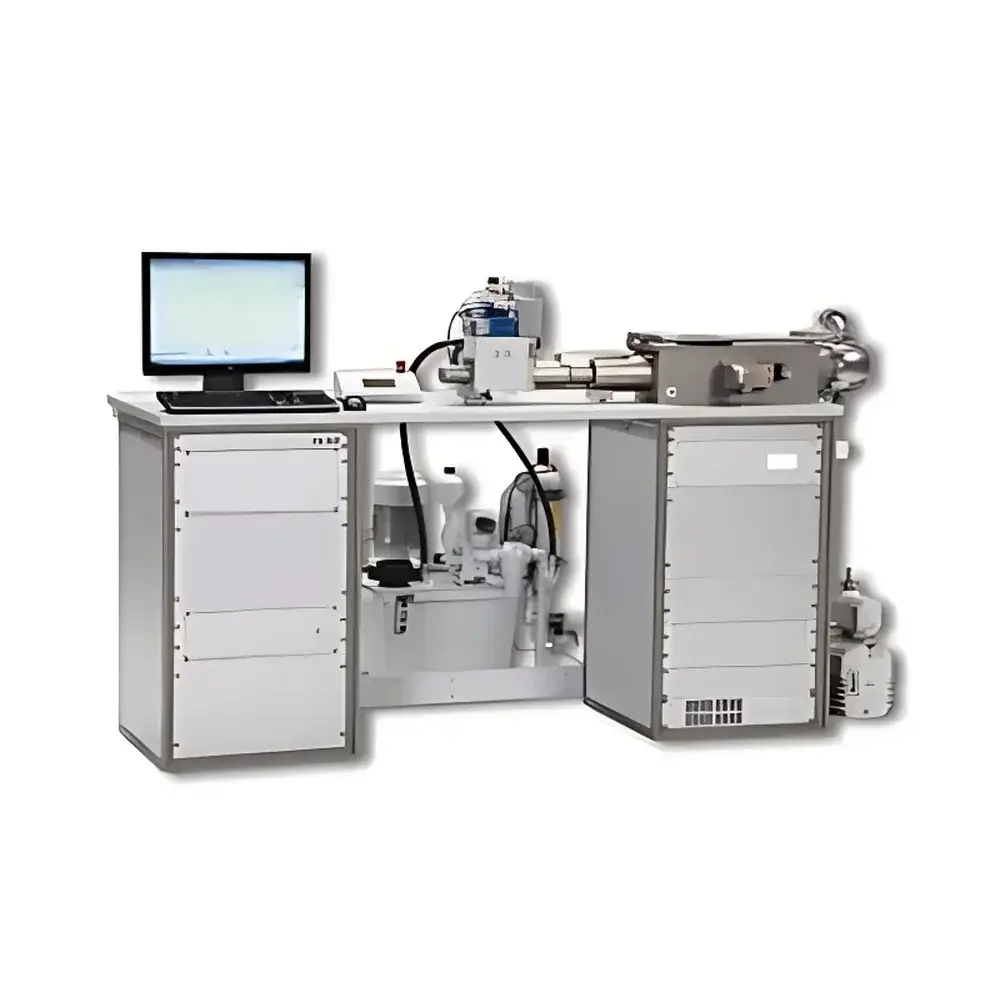
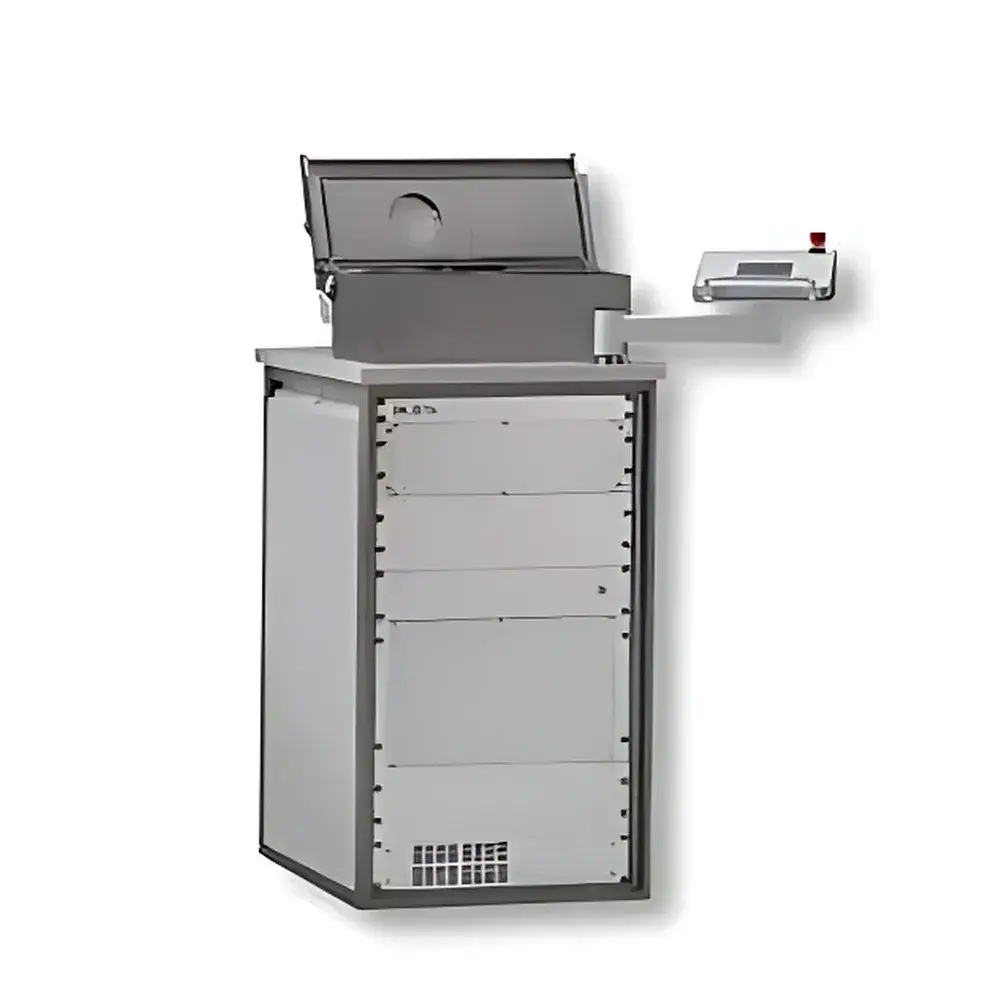
TA Instruments DIL 805 Quenching and Deformation Dilatometer
| Brand | TA Instruments |
|---|---|
| Origin | USA |
| Model | DIL 805 |
| Temperature Range | −150 to 1300 °C |
| Maximum Heating Rate | ≤4000 °C/s |
| Measurement Resolution | 0.01 µm / 0.05 °C |
| Atmosphere Options | Air, Vacuum, Inert Gases (e.g., Ar, N₂, He) |
| Quench Medium | High-velocity Helium Gas |
Overview
The TA Instruments DIL 805 Quenching and Deformation Dilatometer is a high-performance thermal dilatometry system engineered for precise, dynamic measurement of dimensional changes in metallic alloys and advanced materials under controlled thermal and mechanical loading conditions. Unlike conventional dilatometers limited to slow heating/cooling protocols, the DIL 805 integrates rapid induction heating, programmable helium-gas quenching, and real-time uniaxial deformation capability—enabling full simulation of industrial heat treatment cycles including austenitization, isothermal holding, quenching, and post-quench deformation. Its core measurement principle relies on non-contact optical interferometry, delivering sub-micrometer displacement resolution synchronized with high-fidelity temperature acquisition. This architecture supports quantitative correlation between macroscopic dimensional response and underlying solid-state phase transformations—such as martensitic, bainitic, or pearlitic reactions—making it indispensable for metallurgical process development, alloy design validation, and microstructure–property modeling.
Key Features
- High-speed induction heating system capable of ramp rates up to 4000 °C/s, enabling precise replication of industrial heating profiles used in forging, welding, and laser processing.
- Dedicated helium quench module with adjustable flow rate, pressure, and nozzle geometry to achieve reproducible cooling rates from ~10 to >1000 °C/s—critical for constructing continuous cooling transformation (CCT) diagrams.
- Integrated uniaxial deformation stage allowing simultaneous or sequential application of compressive/tensile loads (up to 5 kN) during thermal cycling, supporting thermo-mechanical fatigue and shape memory alloy characterization.
- Optical displacement sensor with 0.01 µm resolution and 0.05 °C temperature resolution, referenced to an internal quartz calibration standard traceable to NIST.
- Modular furnace design accommodating interchangeable sample holders for rods, discs, and thin foils; compatible with both horizontal and vertical configurations depending on experimental requirements.
- Full atmosphere control via integrated mass flow controllers and vacuum pump, supporting operation under air, inert gases (Ar, N₂), reducing atmospheres (H₂/N₂), or high-vacuum (<10⁻³ mbar) conditions.
Sample Compatibility & Compliance
The DIL 805 accommodates cylindrical specimens (typically Ø3–6 mm × 10–25 mm length) and flat geometries (e.g., thin films, coatings on substrates) across a broad range of metallic systems—including steels, aluminum alloys, titanium alloys, nickel-based superalloys, and shape memory materials. Sample mounting utilizes low-thermal-expansion ceramic fixtures to minimize parasitic signal contributions. The system complies with ASTM E228, ISO 7991, and DIN 51045 standards for linear thermal expansion measurement. Data acquisition and instrument control meet GLP/GMP documentation requirements, with optional FDA 21 CFR Part 11-compliant software modules available for regulated environments requiring audit trails, electronic signatures, and user access controls.
Software & Data Management
Operation is managed through TRIOS™ Thermal Analysis Software, a unified platform supporting method development, real-time data visualization, and post-experiment analysis. The software includes dedicated modules for TTT/CCT diagram generation, derivative thermomechanical analysis (dL/dT), and kinetic modeling (e.g., Johnson–Mehl–Avrami analysis). All raw data are stored in vendor-neutral HDF5 format with embedded metadata (time stamp, atmosphere, load profile, calibration parameters). Export options include CSV, Excel, and ASCII for integration with third-party modeling tools such as Thermo-Calc, JMatPro, or MATLAB-based microstructure simulators. Remote monitoring and diagnostic support are enabled via secure TLS-encrypted cloud connectivity.
Applications
- Development and validation of heat treatment schedules for high-strength steels and aerospace alloys.
- Quantification of transformation start/finish temperatures (Ac1, Ac3, Ms, Mf) under non-isothermal conditions.
- Construction of time–temperature–transformation (TTT) and continuous cooling transformation (CCT) diagrams for new alloy compositions.
- Thermo-mechanical coupling studies in additive manufacturing feedstock materials and post-build stress relief processes.
- Evaluation of dimensional stability in near-net-shape sintered components subjected to rapid thermal cycling.
- Characterization of reversible strain in NiTi-based shape memory alloys during constrained heating/cooling cycles.
FAQ
What types of phase transformations can be detected using the DIL 805?
The DIL 805 resolves discrete dimensional jumps associated with diffusion-controlled (e.g., ferrite → austenite) and diffusionless (e.g., austenite → martensite) transformations, provided the resulting lattice parameter change exceeds ~0.01% strain.
Is helium the only quench medium supported?
Helium is the standard and recommended quench gas due to its high thermal conductivity and inertness; however, nitrogen and argon may be used where lower cooling rates or cost constraints apply.
Can the DIL 805 operate under reducing atmospheres?
Yes—the system supports H₂/N₂ mixtures up to 10% H₂ concentration when equipped with appropriate safety interlocks and leak-tested gas lines.
How is temperature calibrated across the full range?
Calibration employs multiple reference points: ITS-90 fixed points (e.g., In, Sn, Zn, Al, Ag) verified with certified thermocouples and blackbody cavity sources for radiometric validation above 660 °C.
Does the system support automated batch testing?
Yes—TRIOS software enables script-driven execution of multi-step programs, including conditional branching based on real-time displacement thresholds or temperature derivatives.



