
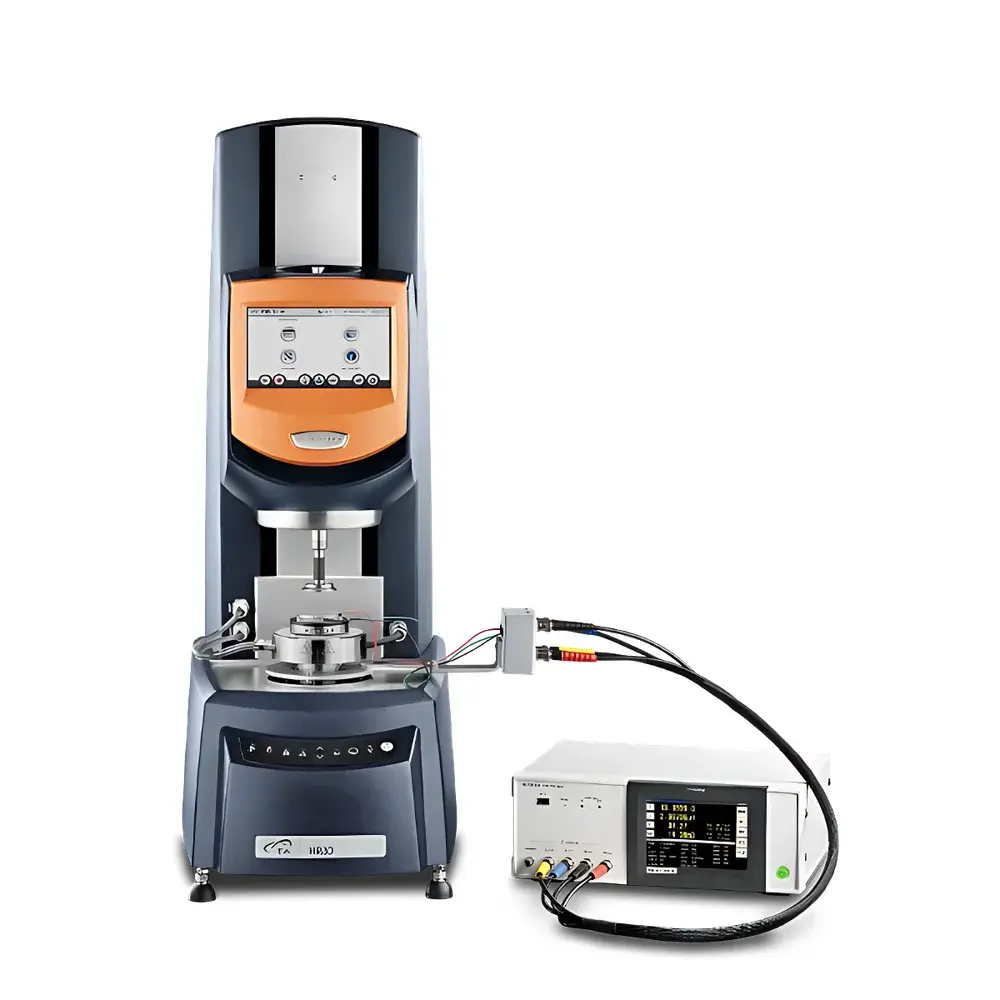
TA Instruments Rheo-IS Rheo-Impedance Spectroscopy Accessory
| Brand | TA Instruments |
|---|---|
| Origin | USA |
| Model | Rheo-IS |
| Application | In-situ rheo-electrochemical coupling for complex fluids |
| Compatibility | Designed exclusively for TA Instruments Discovery HR Hybrid Rheometers |
| Measurement Mode | Simultaneous dynamic oscillatory rheology and electrochemical impedance spectroscopy (EIS) |
| Operating Frequency Range (EIS) | 10 mHz – 10 MHz |
| Electrode Configuration | Integrated parallel-plate or cone-and-plate dual-function geometry with embedded platinum or stainless-steel working/counter electrodes |
| Temperature Control | Compatible with TA’s Peltier and environmental chamber systems (−40 °C to 200 °C) |
| Data Synchronization | Hardware-triggered, sub-millisecond time alignment between rheological and impedance data streams |
Overview
The TA Instruments Rheo-IS is a purpose-engineered rheo-electrochemical coupling accessory designed for simultaneous, time-synchronized measurement of mechanical rheological properties and electrical impedance response in complex structured fluids. Unlike conventional standalone rheometers or impedance analyzers, the Rheo-IS integrates electrochemical impedance spectroscopy (EIS) directly into the measurement gap of TA’s Discovery HR Hybrid Rheometers—enabling true in situ, in operando characterization under controlled shear, oscillation, or rest conditions. The system operates on the principle that microstructural evolution—such as particle network formation, percolation threshold crossing, or binder-mediated restructuring—in conductive suspensions (e.g., battery electrode slurries, conductive polymer dispersions, or carbon-black-filled emulsions) manifests concurrently in both viscoelastic moduli (G′, G″, η*) and complex impedance (Z*, phase angle, capacitance, charge-transfer resistance). By correlating these orthogonal physical responses at identical temporal and mechanical states, the Rheo-IS provides a mechanistic bridge between macroscopic flow behavior and nanoscale interfacial/electronic structure.
Key Features
- Hardware-synchronized acquisition: Sub-millisecond temporal alignment between rheological torque/displacement signals and EIS voltage/current waveforms ensures fidelity in transient structural analysis.
- Dual-function sensor geometry: Interchangeable parallel-plate or cone-and-plate fixtures incorporate precision-machined Pt or 316 stainless-steel electrodes embedded flush within the measuring surfaces—preserving standard gap calibration while enabling low-noise EIS.
- Full compatibility with Discovery HR platform: Leverages existing temperature control (Peltier, convection oven, cryogenic), normal force compensation, and advanced motor control for combined amplitude sweeps, frequency sweeps, and multi-step strain-controlled recovery protocols with concurrent EIS.
- Wide electrochemical bandwidth: Supports impedance measurements from 10 mHz to 10 MHz, enabling resolution of bulk electrolyte resistance, double-layer capacitance, and interfacial charge-transfer processes across multiple relaxation timescales.
- Modular signal routing: Dedicated BNC interfaces for external potentiostat integration (e.g., BioLogic VSP-300) allow extension to DC polarization, cyclic voltammetry, or galvanostatic intermittent titration techniques (GITT) alongside rheology.
Sample Compatibility & Compliance
The Rheo-IS is validated for use with non-corrosive, low-conductivity to moderately conductive suspensions—including aqueous and organic solvent-based battery cathode/anode slurries (NMC, LFP, Si-C composites), conductive ink formulations, rheologically structured emulsions, and functional coatings. It complies with IEC 61000-4-30 (power quality measurement standards) for low-voltage signal integrity and meets electromagnetic compatibility (EMC) Class B requirements for laboratory instrumentation. All firmware and data acquisition routines are architected to support audit-ready workflows compliant with GLP and GMP environments, including full metadata logging (temperature, normal force, gap, electrode potential, excitation amplitude) and user-accessible raw binary export for third-party analysis.
Software & Data Management
Control and analysis are executed via TA Instruments’ TRIOS software v2024+ with the optional Rheo-IS Module. The interface provides synchronized plot overlays (e.g., G′ and |Z| vs. time; tan δ and phase angle vs. frequency), automated parameter extraction (percolation onset from G′ inflection and Rct minimum), and batch processing for multi-condition experiments. All impedance spectra are stored in IEEE Std 1158-compliant .isd format; rheological datasets adhere to ASTM D7175-22 (standard test method for dynamic shear rheometry of asphalt binders) metadata conventions. Data exports include CSV and HDF5 formats with embedded SI units and traceable instrument configuration stamps—fully compatible with LIMS integration and FDA 21 CFR Part 11–enabled electronic signature modules when deployed on validated systems.
Applications
- Battery electrode slurry development: Quantifying dispersion homogeneity post-mixing via initial EIS, mapping shear-induced breakdown/recovery of conductive networks during coating-relevant deformation, and correlating final electrode porosity/resistivity with rheological hysteresis.
- Conductive ink formulation: Identifying optimal binder-to-conductor ratios by detecting the critical strain amplitude at which electrical percolation collapses—prior to macroscopic yield.
- Stimuli-responsive hydrogels: Tracking ion-driven swelling kinetics through coupled changes in storage modulus and ionic conductivity during pH or redox triggers.
- Latex film formation: Monitoring coalescence progression via concurrent loss of elastic modulus and rise in dielectric constant during drying.
- Pharmaceutical suspensions: Assessing physical stability of nanoparticle carriers by correlating sedimentation-induced impedance drift with time-dependent thixotropic recovery.
FAQ
Is the Rheo-IS compatible with non-TA rheometers?
No. The Rheo-IS is mechanically, electrically, and firmware-integrated exclusively with TA Instruments Discovery HR series rheometers. It requires proprietary communication protocols and real-time FPGA-based synchronization unavailable on third-party platforms.
Can I perform DC electrochemical measurements (e.g., potentiostatic hold) with the Rheo-IS?
The base Rheo-IS module supports only AC impedance spectroscopy. DC techniques require integration with an external potentiostat via the auxiliary analog I/O interface and custom scripting in TRIOS.
What electrode materials are available, and how are they cleaned between runs?
Standard configurations include sputter-coated Pt or passivated 316 stainless steel. Electrodes are cleaned in situ using programmed ultrasonic agitation in ethanol or isopropanol, followed by nitrogen purge—protocols are scriptable and logged.
Does the system support variable-gap EIS during shear startup?
Yes. Gap control remains fully active during EIS acquisition. Users may define ramped gap profiles synchronized with strain rate ramps to simulate blade-coating or slot-die gap compression while recording impedance evolution.
How is electrical shielding managed to prevent rheometer motor noise from corrupting EIS signals?
The Rheo-IS employs differential current sensing, guarded electrode traces, and optically isolated signal paths. All low-level analog circuits are housed in a mu-metal–shielded sub-assembly mounted directly on the transducer housing—achieving >100 dB common-mode rejection at 1 kHz.



