
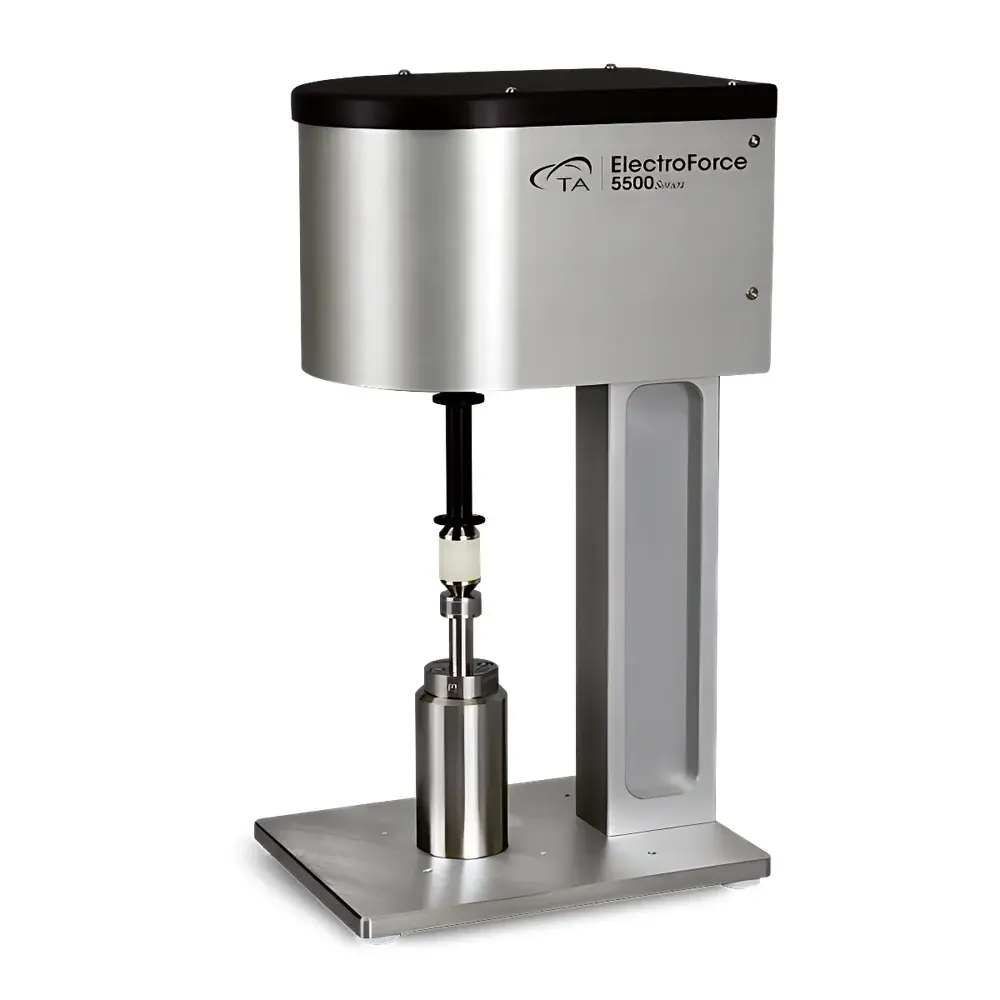
ElectroForce® 5500 Series Electromechanical Testing System
| Brand | TA Instruments |
|---|---|
| Origin | USA |
| Model | ElectroForce® 5500 |
| Frequency Range | 0.0001 – 20 Hz |
| Force Control Range | ±0.002 N to ±200 N |
| Architecture | Single-Beam Open-Frame Design |
| Environmental Compatibility | Compatible with Incubators & Gloveboxes |
| Optional Fixture | 24-Well Compression Fixture for Multi-Specimen Testing |
Overview
The ElectroForce® 5500 Series Electromechanical Testing System is a high-precision, single-beam open-frame instrument engineered for dynamic and static mechanical characterization of soft and semi-rigid biomaterials, polymers, hydrogels, tissues, and cellular constructs. Utilizing a direct-drive linear motor actuation principle—free of hydraulic fluid, belts, or gearboxes—the system delivers true force-, displacement-, and strain-controlled testing with sub-millisecond response time and exceptional waveform fidelity. Its fundamental architecture eliminates mechanical hysteresis and backlash, enabling high reproducibility in low-force regimes (down to ±0.002 N) and precise control across the full operational frequency spectrum (0.0001–20 Hz). Designed specifically for integration into controlled environments—including CO₂ incubators, anaerobic gloveboxes, and temperature-regulated chambers—the 5500 supports longitudinal studies under physiologically relevant conditions, making it a cornerstone platform for mechanobiology, regenerative medicine, and preclinical biomaterial evaluation.
Key Features
- Direct-drive linear motor actuator ensures zero maintenance, silent operation, and absence of oil contamination—critical for sterile or sensitive biological testing environments.
- Three-sided open test space facilitates unobstructed optical access for concurrent microscopy (e.g., brightfield, phase contrast, or fluorescence), digital image correlation (DIC), or real-time sensor integration.
- Modular force transducer system allows rapid interchange of calibrated load cells (±0.002 N to ±200 N), each traceable to NIST standards and compensated for thermal drift and off-axis loading.
- Integrated high-fidelity power amplifier provides closed-loop control with 100 dB signal-to-noise ratio across the entire dynamic range.
- Micrometer-level Z-axis fine adjustment enables precise specimen alignment and gap control—essential for thin films, electrospun scaffolds, or delicate tissue explants.
- Standardized mechanical interfaces (ISO 8015-compliant mounting threads and T-slot rails) support seamless integration with third-party grips, environmental chambers, and custom fixtures—including the optional 24-well compression plate compatible with standard ANSI/SLAS-format cell culture plates.
Sample Compatibility & Compliance
The ElectroForce® 5500 accommodates specimens ranging from sub-millimeter hydrogel beads to 50 mm-diameter tissue discs, with configurable stroke limits (±10 mm standard; extended options available). It complies with ASTM E4, ASTM E8/E8M, ISO 527-1, and ISO 6892-1 for tensile, compression, and cyclic loading protocols. When operated with validated software configurations and audit-trail-enabled data acquisition, the system meets GLP and GMP documentation requirements per FDA 21 CFR Part 11. All firmware and controller logic are developed under IEC 62304-compliant processes, and calibration certificates include uncertainty budgets aligned with ISO/IEC 17025 guidelines.
Software & Data Management
TA Instruments’ TRIOS™ TestWorks software provides intuitive test method development, real-time parameter monitoring, and automated pass/fail criteria evaluation. The platform supports script-based protocol sequencing (Python API), multi-channel synchronized acquisition (up to 16 analog/digital inputs), and export of raw data in HDF5, CSV, and MDF4 formats. Built-in statistical modules calculate hysteresis area, modulus evolution, fatigue life (S–N curves), and viscoelastic parameters (e.g., storage/loss moduli via dynamic oscillatory analysis). Audit trails record user actions, calibration events, and configuration changes with immutable timestamps—fully compliant with electronic record retention policies in regulated research environments.
Applications
- Mechanical phenotyping of engineered cardiac patches under paced contractile loading.
- Cyclic compression of cartilage explants to assess matrix degradation kinetics and chondrocyte metabolic response.
- Tensile testing of electrospun PCL nanofibers at physiological temperatures and humidity levels.
- Multi-well screening of hydrogel stiffness-dependent stem cell differentiation using the 24-well compression fixture.
- Creep-recovery and stress-relaxation profiling of decellularized extracellular matrix scaffolds.
- Dynamic mechanical analysis (DMA) of thermoresponsive polymer gels across transition temperatures.
FAQ
What is the minimum resolvable force resolution of the ElectroForce® 5500?
The system achieves force resolution down to 0.0001 N when configured with the ±0.002 N load cell and operated under optimal signal conditioning and environmental stability.
Can the 5500 be used inside a CO₂ incubator?
Yes—the compact footprint (W × D × H: 32 × 43 × 65 cm), fanless thermal design, and non-outgassing materials enable safe, long-term operation within Class II biosafety cabinets and humidified CO₂ incubators (37°C, 5% CO₂, 95% RH).
Is the 24-well compression fixture compatible with standard microplates?
Yes—it is engineered for ANSI/SLAS-compliant 24-well plates (15.6 mm well spacing, 1.27 mm pitch), with independent vertical actuation per well to eliminate cross-talk during parallel mechanical stimulation.
Does the system support closed-loop strain control for viscoelastic materials?
Yes—TRIOS™ implements dual-loop control (force + displacement) with real-time strain calculation using calibrated extensometry or video-based tracking, enabling accurate strain-controlled ramp-hold and sinusoidal protocols.
How is calibration traceability maintained?
Each force transducer ships with a NIST-traceable certificate of calibration, including sensitivity, linearity, hysteresis, and temperature compensation coefficients; annual recalibration is recommended per ISO/IEC 17025 and internal QA procedures.



