
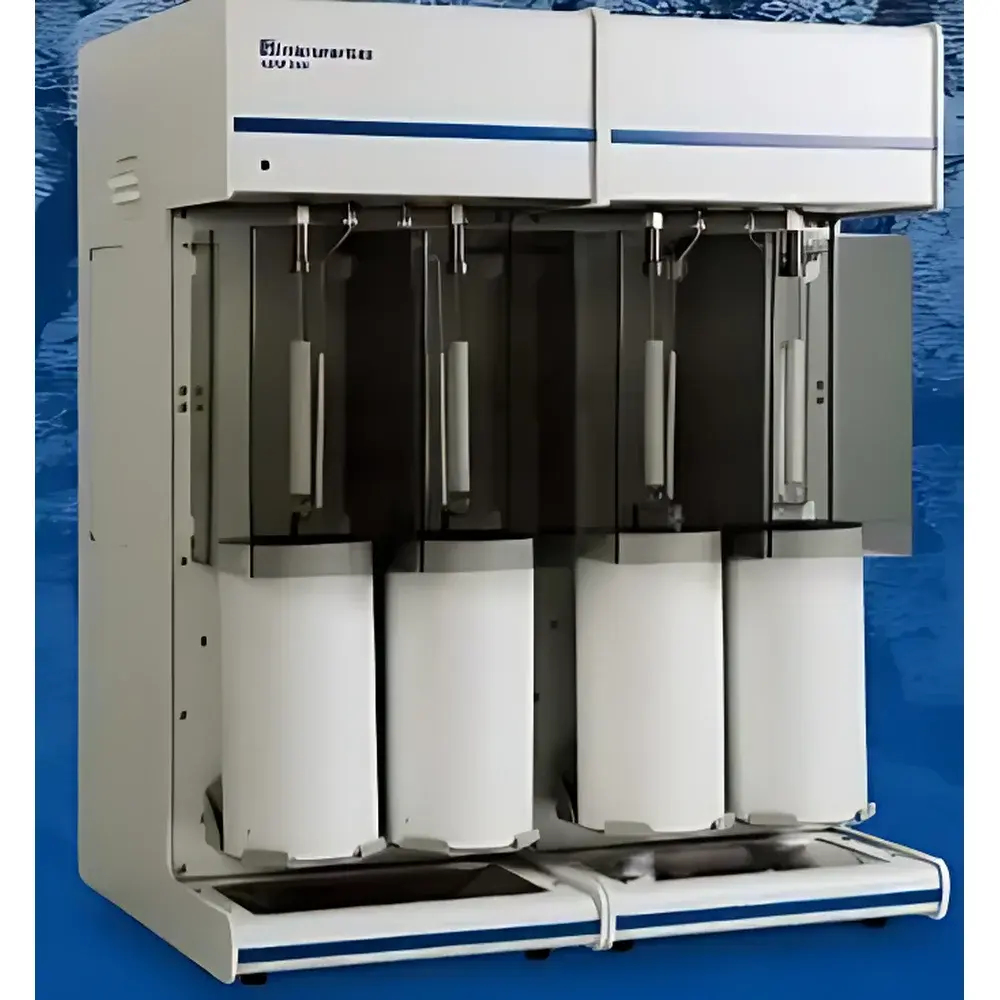
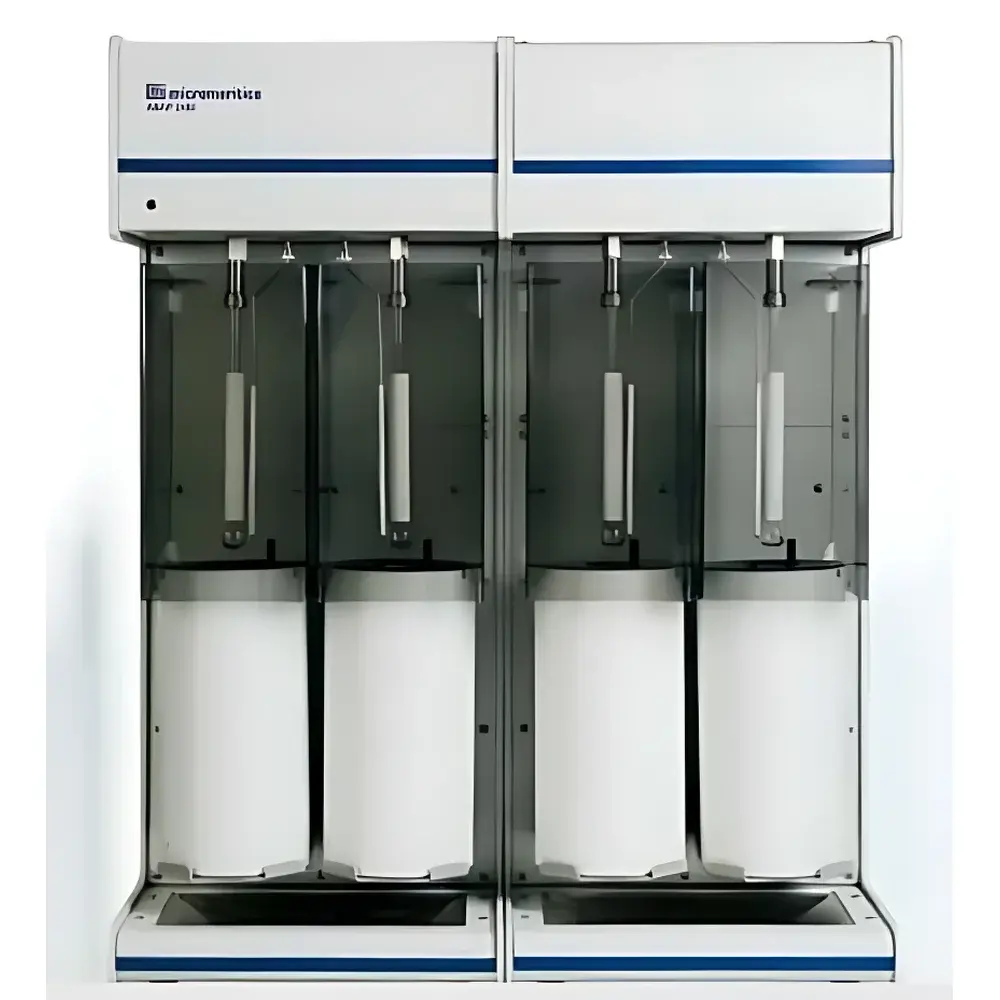
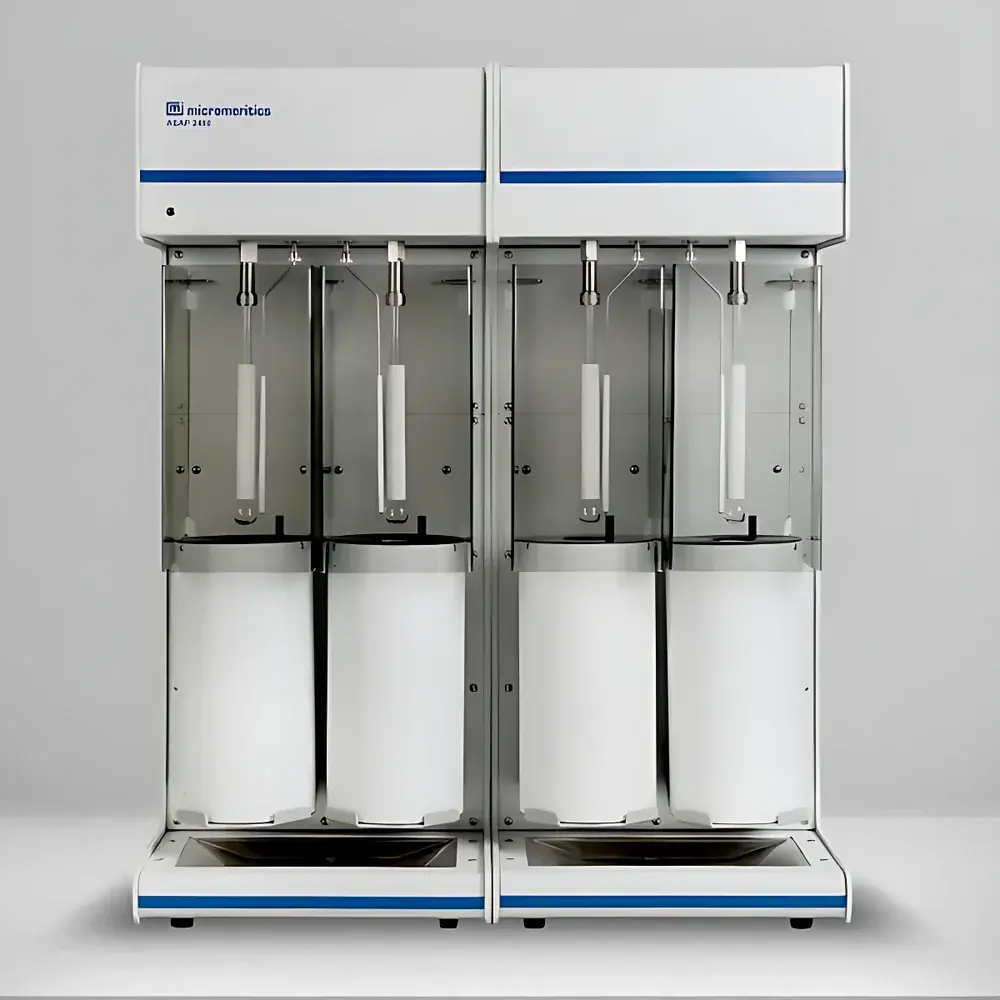
Micromeritics ASAP 2460 Multi-Station Expandable Surface Area and Porosity Analyzer
| Brand | Micromeritics |
|---|---|
| Origin | USA |
| Model | ASAP 2460 Series |
| Instrument Type | Specific Surface Area and Pore Size Analyzer |
| Measurement Principle | Static Gas Adsorption (Volumetric Method) |
| Number of Analysis Stations | 2–6 (Modular Expansion) |
| Pore Size Range | 0.35–500 nm |
| Pressure Range | 0–1000 mmHg (absolute) |
| Analytical Theory | Gas Adsorption Isotherm Analysis (N₂, Ar, CO₂, H₂, Kr) |
| Optional Configurations | Low-Surface-Area (Kr), Micropore-Optimized (1 mmHg Transducer) |
Overview
The Micromeritics ASAP 2460 Multi-Station Expandable Surface Area and Porosity Analyzer is a high-precision, fully automated instrumentation platform engineered for static gas adsorption analysis under controlled vacuum and cryogenic conditions. It operates on the fundamental principles of physical gas adsorption—primarily nitrogen at 77 K—to quantify specific surface area (via BET theory), pore size distribution (using DFT/NLDFT kernel models), total pore volume, and micropore characteristics. Designed for laboratories requiring throughput flexibility without compromising metrological integrity, the ASAP 2460 employs a modular architecture: a base dual-station control module can be extended with up to two additional dual-station modules, enabling concurrent analysis across two, four, or six independent sample ports. Each station functions autonomously—supporting staggered start times, variable equilibration durations per isotherm step, and real-time pressure monitoring—ensuring compliance with ISO 9277, ASTM D3663, and IUPAC 2015 guidelines for physisorption characterization.
Key Features
- Modular scalability from 2 to 6 independent analysis stations via plug-and-play expansion modules, maintaining full calibration traceability across all ports
- Servo-controlled, high-resolution gas dosing system with five dedicated inlet ports—including a dedicated free-space measurement port—for precise incremental gas introduction
- Extended unattended operation: up to 60 hours per run without liquid nitrogen replenishment, enabled by optimized Dewar geometry and thermal management
- Two optional hardware configurations: Low-surface-area mode (Kr adsorption, 10 mmHg transducer) for materials < 0.1 m²/g; Micropore-optimized mode (1 mmHg transducer, enhanced low-pressure resolution) supporting N₂, Ar, CO₂, and H₂ at sub-10⁻⁶ P/P₀
- Real-time instrument health dashboard with predictive maintenance alerts, including valve cycle counters, transducer drift indicators, and cold trap status
- Programmable equilibrium criteria: user-defined pressure stability thresholds (e.g., ΔP ≤ 0.001 mmHg over 60 s) applied independently per isotherm step
Sample Compatibility & Compliance
The ASAP 2460 accommodates standard 6-mm and 9-mm glass sample tubes, as well as custom holders for powders, monoliths, fibers, and thin-film substrates. Sample degassing is performed in situ using programmable heating (up to 400 °C) under dynamic vacuum (≤10⁻³ Torr), with optional cooling traps for volatile removal. All measurement protocols support audit-ready data capture aligned with GLP and GMP environments. Raw isotherm data, instrument logs, and user actions are timestamped and stored with immutable metadata—fully compliant with FDA 21 CFR Part 11 requirements when deployed with validated MicroActive software configuration and electronic signature workflows. Calibration certificates for pressure transducers and temperature sensors are NIST-traceable and documented per ISO/IEC 17025.
Software & Data Management
MicroActive software serves as the analytical engine and reporting interface, offering both batch processing and interactive isotherm interrogation. Users manipulate dynamic calculation sliders directly on linear or log-log isotherm plots to define data ranges for BET, t-plot, Langmuir, BJH, DFT, and NLDFT model fitting—without reprocessing raw files. The software supports overlay of up to 25 isotherms (including mercury intrusion porosimetry data) for cross-technique correlation. Reports are fully customizable: templates include summary statistics, tabulated results (surface area, pore volume, PSD), annotated graphs, and uncertainty estimates derived from replicate measurements. All outputs are exportable in CSV, PDF, and XML formats; project archives preserve complete experimental context—including degas history, instrument configuration, and operator ID—for long-term data integrity.
Applications
The ASAP 2460 delivers quantitative textural characterization for R&D and QC applications across catalysis (zeolites, MOFs, supported metals), battery materials (anode/cathode powders, separators), pharmaceuticals (excipient surface uniformity, API crystallinity), environmental sorbents (activated carbons, biochars), and advanced ceramics (sintering aids, nanoparticle agglomerates). Its multi-station capability enables statistically robust inter-lot comparisons, DOE-based formulation screening, and accelerated method development for novel adsorbents. The Kr-based low-surface-area option meets ASTM D6560 requirements for carbon black and highly sintered oxides, while the micro-pore configuration satisfies IUPAC recommendations for ultramicroporous (< 0.7 nm) material assessment using CO₂ at 273 K.
FAQ
How does the modular station expansion affect measurement accuracy?
All expansion modules undergo factory calibration against the master control unit using certified reference materials (e.g., NIST SRM 1990); inter-station reproducibility remains within ±1.5% RSD for BET surface area across six stations.
Can the ASAP 2460 perform non-nitrogen analyses without hardware modification?
Yes—argon (87 K), carbon dioxide (273 K), and hydrogen (77 K) analyses require only gas-specific calibration files and updated saturation pressure tables; no physical retrofitting is needed.
Is remote monitoring and control supported?
MicroActive includes secure client-server architecture with role-based access, enabling real-time status viewing and queue management from off-site locations via TLS-encrypted connections.
What validation documentation is provided for regulated environments?
Micromeritics supplies IQ/OQ protocols, 21 CFR Part 11 readiness assessment reports, and instrument-specific uncertainty budgets—all available upon request for GxP-compliant deployment.
How is free-space volume determined during analysis?
A dedicated purge-and-fill sequence using helium at ambient temperature measures dead volume prior to each adsorption run, eliminating reliance on geometric approximations or separate calibration runs.



